The art of Kevin Blythe Sampson

THE ART OF
KEVIN BLYTHE SAMPSON

8/29/09

OK I have got to say some thing when did americans get so smart......Two in Three Doubt Congress’ Grasp of Healthcare Issues

July 27, 2009

Kevin says

why why do american  think they know so much.

Why do they think at this juncture they have the health debate figured out

I am not saying americans are dumb.....just not as smart as they think they are on this issue.

what american are these polls taken from

the mid-west is that still America or a picture of some thing that is almost finished


Two in Three Doubt Congress’ Grasp of Healthcare Issues

Americans perceive themselves as more knowledgeable than lawmakers

by Frank Newport

PRINCETON, NJ -- Americans view themselves as more knowledgeable than members of Congress regarding the current debate over healthcare reform. Nearly half (48%) say they personally have a good understanding of the issues involved, while only 27% say so about members of Congress.

zttngljrw0sh9rdtmhfh9a

These Gallup findings are based on interviewing conducted Sunday, July 26, as the push toward new healthcare reform legislation continues to dominate the focus of Congress, the White House, and the national news media.

That less than 3 in 10 Americans believe that Congress has a good understanding of the issues involved in the healthcare debate underscores the basic lack of confidence that Americans have in the men and women they elect and send off to Washington to represent them. Gallup's recent update on confidence in institutions, for example, found that 17% of Americans have a great deal/quite a lot of confidence in Congress, near the bottom of the list of institutions tested.

The current data show that Americans are certainly not overly confident in their own understanding of healthcare reform. But the public's personal level of confidence -- 48% say they have a good understanding of healthcare reform -- is substantially higher than the 27% who say members of Congress understand.

The American public can be split into four groups on the basis of their responses to these two questions.

xuifqk2zr0mx4oqvq6jrda

It would be optimal in a democracy if the people of the country believed that they and their elected representatives in Congress had a good understanding of something as important as a major overhaul of the nation's healthcare system. But only about one in six Americans fit that description, leaving the vast majority of the public with doubts about the level of understanding of either themselves or Congress.

Indeed, the largest two groups of Americans are those who believe that Congress doesn't have a good understanding, but they personally do, and those pessimists (or realists) who simply say that healthcare reform is understood well by neither themselves nor Congress. The remaining group of 11% says that Congress understands but that they personally do not.

There are significant patterns of differences in response to these questions by partisan orientation:

  • Republicans are above average in the belief that they personally understand the issues involved in healthcare reform, but below average in their belief that Congress understands. Given that the big push on healthcare reform is from a Democratic president, and that Congress is controlled by the Democrats, these findings are not surprising.
  • Democrats are at about the average level in terms of believing that they personally understand, but slightly above average in their belief that Congress understands. Again, this is fitting given the Democratic control of Congress.
  • Independents don't differ much from average in terms of their own beliefs that they understand healthcare reform, but are slightly below average in thinking that Congress has a good understanding.

0c8yg

Implications

Americans have quite negative attitudes about Congress in general, making it less than surprising to find that the significant majority of the public believes that Congress does not have a good grasp on the issues involved in the current debate over healthcare reform. It is possible that if Gallup were to ask this "good understanding" question about any type of pending congressional legislation, we would find the same level of distrust that representatives fully understand the issues involved. Americans are certainly more confident in their own personal level of understanding of healthcare reform, but even with that, half don't believe that they personally have a good grasp of what's involved.

The overall finding that 16% of Americans believe that they and members of Congress have a good grasp of the issues in the healthcare reform debate could suggest that Americans would resist the idea of rushing healthcare legislation into law posthaste. Indeed, separate Gallup result from July 23 showed that less than half of Americans want healthcare reform legislation to be passed this year. The majority say Congress should pass healthcare reform legislation, but not necessarily this year, or should not pass a new healthcare reform law at all.

Survey Methods

Results are based on telephone interviews with 526 national adults, aged 18 and older, conducted July 26, 2009. For results based on the total sample of national adults, one can say with 95% confidence that the maximum margin of sampling error is ±5 percentage points.

Interviews are conducted with respondents on landline telephones (for respondents with a landline telephone) and cellular phones (for respondents who are cell phone only).

In addition to sampling error, question wording and practical difficulties in conducting surveys can introduce error or bias into the findings of public opinion polls.

Polls conducted entirely in one day, such as this one, are subject to additional error or bias not found in polls conducted over several days.

Click below for more on these topics:

Has any body here seen my old friend…………… memories….Kennedy my sister donna and childhood memories

Anybody here seen my old friend Abraham?
Can you tell me where he's gone?
He freed lotta people but it seems the good they die young
You know I just looked around and he's gone

I loved Teddy Kennedy so much

Because he was flawed

Because he crawled back from hell

Overcame so much

That many of us couldn’t

And because most of all that he cared

Agree with him or not

That man cared…………….

One of our elders is gone

One of our protectors has

Moved on

Watching the Kennedy funeral

brings back

Well memories

Anybody here seen my old friend John?
Can you tell me where he's gone?
He freed lotta people but it seems the good they die young
I just looked around and he's gone

November 22, 1963, was the day John Kenney was killed

I was about 9 years old

My sister donna and I along with

the rest of the kids In our school,

Were sent home

Some how or another

Donna and I knew that some thing terrible had happened

Lots of terrible things were happening then

Anybody here seen my old friend Martin?
Can you tell me where he's gone?
He freed lotta people but it seems the good they die young
I just looked around and he's gone

Civil rights, war and more

But this was different a president

That my parent loved

Had been killed

I remember my mother being quiet

Real quiet

People were scared

We lived at 143 Catherine st in Elizabeth then

Over my grandfather Major cleaning show

Anyway we went outside to our second story

Back porch

Strangely enough

We found a dead pigeon on the porch

So donna and I decided

To have a funeral for the bird

And for the dead president

So we buried that bird

Under a loose board on the board

And we had our funeral

Complete with pray

We were a Baptist deacons kids

We knew how to pray

Didn't you love the things that they stood for?
Didn't they try to find some good for you and me?
And we'll be free
Some day soon, it's gonna be one day

After wards I remember my Cousin Virginia

Coming over to the house

She was the first afro centric

She was dressed as partly African

With a short cropped afro

And she came and go us

With her high pitched laugh

We called her the witch

And her presence

Broke the spell of a presidents

Death and we became kids again

The I remember through the years

Watching the others

Who were soon to die

Watching Bobby

And Martin

Has any body here

Seen my old friend Abraham

So Edward Kennedy

We salute you

People are speaking now of your greatness

And of your flaws

But most of al of your transience

From dad times

From crazy times

To productive times

So I salute you are a hero

To all of us

Who have had problems

And endured

Flowered and prospered

Oh not as great as you Ted

You did too much

For too long

Take a rest

Join your brothers

Anybody here seen my old friend Bobby?
Can you tell me where he's gone?
I thought I saw him walkin' up over the hill
With Abraham, Martin and John
And Ted

Today ill look for another

Pigeon

And some place in Newark

Ill stand out in the rain

And remember you

Your brothers

And a family

That has always been like

My family

God bless……………..

watching the Kennedy funeral reminded me of this.........The Thief on the Other Cross: A Good Friday Monologue

Christian Articles Archive

The Thief on the Other Cross: A Good Friday Monologue

by Dr. Ralph F. Wilson

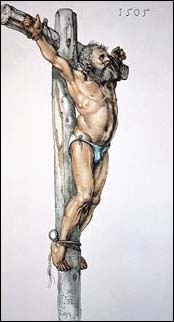
Albrecht D�rer, "The Good Thief" (1505)
Albrecht D�rer, "The Good Thief" (1505), watercolor, Albertina Graphic Collection, Vienna.

I don't belong here. I really don't. Paradise is the last place I expected to end up after all I've done. Let me tell you my story.

I am -- I was -- an armed robber, I guess you'd call it. Me and Jake and the others would live in caves in the Judean hills near the road from Jerusalem to Jericho. We made our living by violence. We wouldn't take on people in the big groups that passed. They traveled together for safety. But a family alone would be an easy mark, as well as anyone fool enough to travel by himself.

Brandishing a strong staff would usually do the trick. Threaten them with a beating and they'd give up without much of a fight. But I've been known to break a few bones in my day, God forgive me. I don't think I actually killed anyone, but then I never stayed around long enough to find out.

The first time I meet Jesus is when I am invited to a party in his honor in Jericho at the home of a rich tax collector named Zacchaeus. I am introduced, we shake hands, and Jesus looks me in the eye for a long moment. He can see right into me, who I am, every crime I have ever committed. Then he smiles this big friendly smile. "You know," he says, "there's forgiveness for you in my Kingdom. How about it?"

I drop my eyes, say something non-committal, and shuffle away. The next day I'm in the crowd, hanging on every word he says. Jesus is talking about his Kingdom, comparing it to a mustard seed, calling it the Kingdom of Heaven. I  want so much to go up to him after he has finished and take him up on that forgiveness thing, but I just can't bring myself to do it.

I wish I had. It isn't much later when me and my friend Jake -- the guy on the third cross -- get caught by a Roman patrol. The others run off, but they catch us, beat us silly, drag us into Jerusalem, and throw us in prison. No mercy for the likes of us.

And so it happens that on the same day that they crucify Jesus, they crucify me and Jake -- one of us on his left, the other on his right. This ain't no normal crucifixion. Mobs of people are there just because of Jesus. Self-righteous Pharisees are swaggering and mocking. "If you're some kind of messiah," one sneers, "come on down from that cross. If you're a savior, save yourself -- if you can!"

Jake begins cat-calling, too, if you can imagine that. I yell over at him, "You miserable thug, don't you have any fear of God? Can't you see that we're going to die just like he is? Show a little decency! We're getting exactly what we deserve, but he ain't done nothing wrong."

Jake quiets down and the Pharisees lose interest. But I can't get Jericho out of my mind. I can't forget Jesus' eyes, his words, his invitation. And so I call over to him, though it's getting hard to breathe and talking makes it that much harder.

"Jesus!" I say. He turns his head towards me. "Jesus, I was there in Jericho. I met you at a party at Zacchaeus' house. Remember?"

He looks at me for a moment and then nods his head just a little. He does remember.

"I never forgot what you said. I wanted to say yes, but just couldn't. And now look at me -- look at us!"

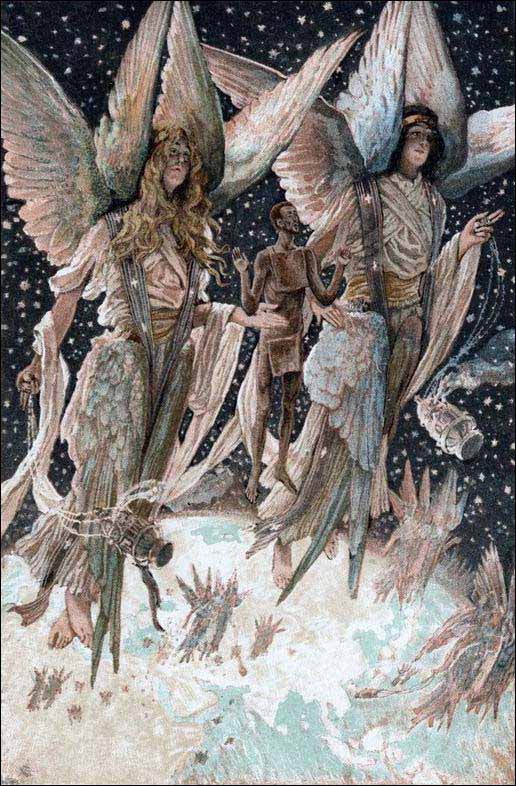
James J. Tissot, The Soul of the Penitent Thief in Paradise (1896)
James J. Tissot, "The Soul of the Penitent Thief in Paradise" (1896). Larger image

He is in bad shape -- exhausted, in excruciating pain, back oozing, breath labored. He isn't going to last long. I can see that. But somehow I can see beyond all that. He was the Messiah, is the Messiah, no matter what those priests and Romans and Pharisees have done to him. And when he dies, he will be with God. In a few hours, maybe less, he will be vindicated. He will reign in that Kingdom he told us about.

"Jesus," I call again, quieter now.

He opens his eyes. They are the same eyes, the same piercing, loving, honest eyes.

"Jesus," I say, "when you come into your Kingdom, would you remember me?"

His words are labored, his lips parched, but I can still hear him pretty well. "Truly, I say to you...." His voice cracks, then is stronger for a moment. "Truly, this very day you will be with me in Paradise."

His eyes droop. He is fading quickly now. But I believe him. I do! That's what gets me through those next few hours until they break my legs to kill me. I do believe him!

And then I find myself here in heaven, in Paradise. I sure don't deserve to be here, but here I am anyway. I guess that's what a man like me gets when the King himself grants a pardon. Full forgiveness. Pretty amazing, don't you think?


This story is fictional, of course, though it is based on the account in Luke 23:32-43. The criminals described by the Greek word lestes, "robber, highwayman, bandit." Since Josephus used this as a derisive term to refer to the Zealots, some have thought that it might mean "revolutionary, insurrectionist, guerrilla" here. (lestes, BDAG 594; K.H. Rengstorf, lestes, TDNT 4:257-262). However, in this story I take the thief as a highwayman or bandit, like the one who had robbed the man in Jesus' Parable of the Good Samaritan (Luke 10:30-37). 

Click here for more Easter articles and stories


Disc jockey DJ AM dies

NEW YORK (CNN) -- Nearly a year after surviving a plane crash in South Carolina, disc jockey Adam "DJ AM" Goldstein was found dead in his New York apartment Friday afternoon, his publicist said. He was 36.

"The circumstances surrounding his death are unclear," his publicist, Jenni Weinman, said in a statement confirming the performer's death. "Out of respect for his family and loved ones, please respect their privacy at this time."

Goldstein was found unconscious and unresponsive in his lower Manhattan apartment Friday afternoon, New York police said. The cause of death would be determined by medical examiners, but "There is no criminality suspected at this time," a police statement reported.

Goldstein and Travis Barker, the former drummer for rock band Blink-182, were the only survivors of a September 2008 plane crash in South Carolina that left both critically injured. Four others aboard the plane were killed when the Learjet skidded off a runway during takeoff from Columbia. VideoWatch more about his career »

"Daily I live with the guilt and grief of what happened that night, what I saw, who was lost and why I was spared," he wrote in a December 2008 post on his Web site. "I have no words to express the pain that comes with knowing four people died, while I lived."

In addition to spinning beats at clubs and festivals, Goldstein was known for dating reality-TV star Nicole Richie and actress Mandy Moore.

At the time of his death, he had been working on an MTV show about drug addiction that had been scheduled to debut in October. Goldstein himself had been a crack cocaine addict who said he wanted the show to help others recover.

CNN's Denise Quan contributed to this report.

All AboutMTV Networks CompanyTravis Barker

8/28/09

Art to Make You Laugh (and Cry)

August 28, 2009

Art to Make You Laugh (and Cry)

By RANDY KENNEDY

Philadelphia

WHEN it rains, geysers of water have been known to erupt from the floor drains of the art collective here known as Fluxspace, which makes its home in a mammoth former textile mill in the northern part of the city. The building has no air-conditioning, and on the harshest winter days its heating system borders on notional. It’s also a bear to find: one morning this week a taxi driver on his way to it ended up taking several unintended detours down trash-filled alleys, cursing the calm voice issuing from his dashboard G.P.S.

But the three-year-old collective is becoming known in the Philadelphia art world for its monthly exhibitions of work by its members and other artists. And “we actually get awesome turnout for our shows, considering the location and everything,” said Danielle Ruttenberg, one of 25 young artists who either pay for raw studio space in the building or take on chores in exchange for it. (The current exhibition, of bird-centric prints and drawings by a local artist named Tory Franklin, continues through Sept. 13.)

I had sought out Fluxspace at the beginning of Day 2 of a thoroughly idiosyncratic personal art tour (with some good eating woven in) of a city that has emerged, especially over the last decade, as a lively and unpredictable place to see new art.

There is a particularly Philadelphian brand of hardy, low-budget, do-it-yourself, do-it-for-love creativeness evident in art and art spaces across the city. It is a climate that, as new as it sometimes feels, has been embodied and nurtured for decades by organizations like two I included on my itinerary: the Fabric Workshop and Museum, founded in 1977 as a way to combine world-class artistic collaborations with community outreach and education, and the Mural Arts Program, which grew out of the city’s anti-graffiti efforts and has worked with neighborhood residents and artists for 25 years to create more than 2,800 towering murals on walls throughout the city.

But my first stop, after stepping off the train in 30th Street Station on Monday morning, was a real outlier: a tiny, hidden museum that interested me not because of new art — most of its pieces are well over a century old — but because of the obsessive nature it shares with so many places in the city, the sense that it exists only because its founders felt a necessity borne of fascination. Located on the grounds of a cemetery in the suburb of Drexel Hill, the Museum of Mourning Art — a name to make Edward Gorey proud — is a compilation of American and European funerary art and artifacts from several private collections, assembled by the family that has owned the cemetery for generations.

The small, haunting, very serious collection includes an ornate horse-drawn hearse from 1890, parked over a coffin made in 1610 with an oval window in the lid so — as the museum’s curator, Elizabeth Wojcik, explained — one could make the sure the deceased was good and deceased, and so the soul had an easy means of egress.

Housed in a reproduction of Mount Vernon, the museum centers on the profusion of objects (broaches, ribbons, books, paintings, embroidery) that were produced in the wake of the prolonged period of mourning after Washington’s death. And its highlight is one of a small number of mourning rings ordered to be made by Washington’s will, with a small glass oval lined with seed pearls and filled with gray strands of the president’s hair. The museum’s visitors — tours are by appointment — run the gamut from historians to artists to student undertakers to those who simply seem to be drawn to things deathly. (I was there that morning with two local artists and jewelry designers interested in mourning jewelry.)

“There’s a woman who comes in a lot,” said Ms. Wojcik, pointing out a gorgeous 1797 memorial embroidery, “and stands in front of this work and looks at the weeping willows in it and just cries and cries.”

As much as I enjoyed a museum about death and decay, I found myself slightly relieved that I had already eaten, at an unassuming nearby diner called the Hibernia Deli Coffee Shop, which serves a superb full Irish breakfast: eggs, beans, black and white pudding, thick rashers, potatoes and even a good grilled tomato.

For the rest of my dining, in the spirit of the trip, I decided to stick exclusively to restaurants in Philadelphia’s unusual bring-your-own-bottle scene, a huge number of no-wine-list establishments that have sprung up partly because of Pennsylvania’s state-controlled alcohol sales system, which means smaller profits and expensive licensing costs for restaurant owners. Many of the B.Y.O.B. restaurants are tiny, run by chefs who, maybe because of the absence of a bar, put the focus intensely on the food, which can be fantastic.

For lunch I visited Matyson — a longtime favorite among local foodies, opened in 2003 near Rittenhouse Square — and had perfectly cooked scallops on a bed of succotash, a Pennsylvania Dutch staple, with big, plump lima beans. (I forgot to hunt down a wine store ahead of time and had to settle for iced tea.)

Nicely fed, I walked over to the Fleisher/Ollman Gallery, a 47-year-old center for the work of self-taught artists which has also, since 1997, focused on contemporary artists whose work reflects the influence of such outsider art. The show on view, “Frenz,” which ends on Saturday, is a good, oddball one, with pieces by 11 artists who were chosen by the indie musician Will Oldham, including hilarious, rustic drawings by Able Brown, a New York City park ranger, and powerfully strange collages by Mr. Oldham’s mother, Joanne. A surreal, as yet unfinished animated video work by Lori Damiano, an artist in Portland, Ore., composed of thousands of her individual drawings, is almost impossible to take your eyes off of.

Next I made my way to the Fabric Workshop and Museum, the nonprofit art space founded by Marion Boulton Stroud that has finally — maybe — secured a permanent home in the eight-story building near the Philadelphia Convention Center that it moved into last year after inhabiting several other homes in the course of its 32 years. Over that time the workshop’s definition of fabric (wicker, horsehair, paper, wood, film emulsion, even metal) has grown almost as expansive as its list of artists in residence who have come to make works there: Vito Acconci, Claes Oldenburg, Kiki Smith, Louise Bourgeois, Roy Lichtenstein and Rachel Whiteread, to name just a few.

The workshop’s current show includes work by four artists living in Philadelphia — Tristin Lowe, Virgil Marti, Peter Rose and Ryan Trecartin — and is worth the trip if only to spend some time walking around Mr. Lowe’s “Mocha Dick,” a life-size re-creation, in pale industrial felt, of the notorious 19th-century sperm whale of that name that inspired Melville’s great white menace. This version, which took Mr. Lowe and a team from the workshop six months to make, is inflated and dominates a huge eighth-floor gallery, a ghostly beached immensity encrusted with sewn barnacles and scored with realistic-looking harpoon scars and squid-tentacle circles.

After seeing such a big fish, it was somehow appropriate — and also convenient for a writer later to be in need of a good transition — that I went to dinner that night at a wonderful South Philadelphia restaurant called Little Fish, which has room inside for about 20 people, if you don’t count the cooks crammed into the narrow open kitchen. The restaurant’s much-praised chef, Mike Stollenwerk, wasn’t there — he is busy getting ready to open a bigger sister restaurant, to be called Fish.

But Chadd Jenkins, the sous chef, filled in beautifully, with an appetizer of sweet peekytoe crab arranged atop a tarragon-infused fried green beefsteak tomato and an unlikely but delicious jerk-style lobster dish (inspired by Mr. Jenkins’s recent vacation to Jamaica) over a rice-and-peas risotto with nice black-eyed peas instead of kidney beans.

My second day started with a strong cup of cappuccino from Old City Coffee, a Philadelphia roaster, in the Reading Terminal Market, and then the long, wandering ride with the cursing cabby to Fluxspace. Amy Adams, the director of the Fleisher/Ollman Gallery, had suggested the day before that if I were in the area, I should also check in on one of the stranger collectives to spring up recently in the city, the impressively named Philadelphia Institute for Advanced Study, whose Web site, pifas.net, presents it as a gleaming-glass academic palace rising above manicured grounds.

It is actually located in an old, ramshackle industrial space that its founders — Brandon Joyce and Richard Davis, who met while studying philosophy at the University of Virginia — discovered after they lost a previous space as a result of what Mr. Joyce called a “profound misunderstanding” with their landlord, which led to a police raid. (“I think he thought we were running some sort of a criminal enterprise in there,” Mr. Joyce said.)

Pifas, as the collective is known, is like Fluxspace in some ways, a fluid gathering of artists paying ridiculously low rent for studios in a city that is unlike New York, as Mr. Joyce observes, in that “there are gobs of space — it’s like you can just walk down the street and grab it.” But the institute often functions more like a friendly anarchist academy, with lectures and seminars and experiments, than a place for making and showing art. (The next event open to the public, on Saturday at 8 p.m., is described as “an intrepid show of audio, poetry and acrobatics” by the institute’s scholar in residence, Luke Yates, a doctoral student from the University of Manchester in England, about Henry Box Brown, a slave who mailed himself in a box to Philadelphia in 1849.)

Lunch with Mr. Joyce was a quick but decadent suckling-pig hoagie from a tiny storefront called Paesano’s, an offshoot of another highly regarded Italian B.Y.O.B. called Modo Mio, just across West Girard Avenue from the sandwich shop.

The final stop on my tour actually ended up being many stops, as I stared out the window of an elevated-subway train in West Philadelphia, where the Mural Arts Program has been working for weeks with the artist Stephen Powers, a West Philadelphia native, and many local painters to create a series of more than 30 huge, text-based murals, collectively called “Love Letter,” along a sometimes blighted stretch of Market Street.

The project, painted in consultation with business and building owners, is in part Mr. Powers’s homage to Darryl McCray, known as Cornbread, a legendary Philadelphia graffiti artist who began painting messages of love on walls in the late 1960s to impress his girlfriend. (Mr. McCray also once managed to tag the Jackson Five’s private jet, and painted “Cornbread Lives” on the side of an elephant at the Philadelphia Zoo to dispel rumors that he had died.)

Jane Golden, the executive director of the Mural Arts Program, said she remembered Mr. Powers as a teenager, when he was a prolific and notorious graffiti writer known as Espo who couldn’t be persuaded to “come over to the other side” and paint legally. So there is a “wonderful irony,” she said, to the fact that now, as an established gallery artist living in New York, he has returned to Philadelphia to mount an ambitious urban beautification project, one whose odd, affectionate messages — like “Forever Starts When You Say Yes” and “Pre-pay is on/Let’s talk/Till my minutes are gone” — are about love and reconciliation. (The project will be unveiled officially on Sept. 10, though most of the signs are now visible for the price of a $2 subway token.)

Mr. Powers said the idea was to create a single, serial urban work whose hopeful messages might resonate with a kind of universality in a neighborhood in need of hopeful messages. And as a fringe benefit, he said the murals might even help in a more practical way.

“Hopefully, there will be a few sly guys out there who say to their girl: ‘Hey, Baby, I wrote that up there for you.’ ”


DCSIMG

8/27/09

Deal: United States soldiers will deploy to Colombia

Stephen C. Webster
Published: August 15, 2009
Updated 2 weeks ago
Chavez: ‘The winds of war [are] beginning to blow’

Some American troops will soon find themselves stationed at military bases scattered across the South American nation of Colombia with a mission to use advanced Predator drone technology to aid in fighting the drug trade and to combat terrorism, according to published reports Saturday.

But Colombia’s neighbors certainly do not see it that way.

In Venezuela, officials bristled. President Hugo Chavez warned, “the winds of war [are] beginning to blow.”

Chavez has already accused Colombian troops of making an incursion over the border and regional tensions are running high. Ecuadorian President Rafael Correa also took exception, saying the United States would target Colombia’s neighbors if the deal is finalized.

“It has also sparked concern from moderate Colombian allies, such as Chile and Brazil, who want assurances that U.S. forces won’t be operating outside Colombia’s territory,” The Wall Street Journal adds.

Colombia says its agreement with the United States will allow Washington to use its military bases to track drug-runners through the use of remote aircraft.

“The Brazilian president, Luiz Inacio Lula da Silva, called for a meeting between US President Barack Obama and the region’s leaders, saying the ‘climate of unease disturbs me,’” reported the BBC.

“This agreement reaffirms the commitment of both parties in the fight against drug trafficking and terrorism,” Colombia’s foreign ministry said in a statement Friday.

Officials here said the two countries agreed the text of an agreement, which now has to be reviewed by government agencies in Bogota and Washington before getting a final signature.

The controversial deal would permit the US military to operate surveillance aircraft from seven bases to track drug-running boats in the Pacific Ocean.

A senior US general said Thursday that the United States needed to reassure regional powers about the deal.

“I think we need to do a better job of explaining to them what we’re doing and making it as transparent as possible, because anybody’s concerns are valid,” General James Cartwright, vice chairman of the US Joint Chiefs of Staff, told a news conference.

Washington sought out its ally Colombia to make up for the loss of its hub for counternarcotics operations in Manta, Ecuador.

Ecuadoran President Rafael Correa had refused to renew an agreement that allowed the US military to fly out of Manta for the past 10 years.

The deal is worth over 40 million dollars for Bogota, along with expanded US military assistance for Bogota’s counternarcotics efforts, according to a US defense official, who spoke on condition of anonymity.

Cartwright and Defense Secretary Robert Gates also said this week the deal was not a unilateral move but the product of a partnership with Colombia designed to target drug cartels.

“The strategic intent is, in fact, to be able to provide to the Colombians what they need in order to continue to prosecute their efforts against the internal threats that they have,” Cartwright said.

Colombia raised concern throughout the region, which has a troubled history of US military interventions, after announcing July 15 that it was negotiating the deal.

Venezuelan President Hugo Chavez led the charge, alongside his Ecuadoran counterpart and ally Correa.

Speaking in Quito at a regional summit last weekend, Chavez said he was fulfilling his “moral duty” by telling fellow leaders that the “winds of war were beginning to blow.”

“This could generate a war in South America,” he said.

Other regional leaders, including Brazilian President Luiz Inacio Lula da Silva, have asked Colombia to explain its decision.

Responding to criticism, Colombian President Alvaro Uribe said Friday the purpose of the deal was to “defeat terrorism,” adding that the accord with the United States will serves “as an insurance policy for neighboring nations.”

Uribe said he would attend an emergency summit of the Union of South American Nations (Unasur) that will gather on August 28 in Bariloche, Argentina, to discuss the situation created by the Colombian base agreement.

However, Frank Mora, a US Defense Department official for Latin America, said the controversy was a storm in a teapot.

“This agreement simply formalizes what already almost exists right now,” he told AFP.

In his remarks, Uribe also extended an olive branch to Ecuador, saying the two countries “could have dialogue” and “resolve their differences in the future.”

Ecuador broke off diplomatic relations with Colombia over last year’s air strike by the Colombian military against a Colombian leftist guerrilla base located in the Ecuadoran selva. Raul Reyes, a top leader of the Revolutionary Armed Forces of Colombia (FARC), was killed in that attack.

“I apologize for that,” Uribe said. “But we are interested in the future, and the same goes for Venezuela.”

With AFP.

A prior version of this article incorre

After Bias Ruling, Firefighter Applicants Look BackBy

KAREEM FAHIM

Published: August 27, 2009

Dreaming of careers fighting fires, they applied by the hundreds, only to end up with test scores that put highly coveted jobs in the city’s Fire Department hopelessly out of reach. So they turned their attention to seeking — or settling for —other jobs: U.P.S. worker, credit union teller.

Josh Haner/The New York Times

Jamel Nicholson applied to the city's Fire Department, but after passing his exams he was put on a waiting list. He eventually became a train conductor for the Metropolitan Transit Authority.

Jamel Nicholson, who had a family to support, unclogged drains for a living before becoming a subway conductor. Staveus Daley took a job as a deckhand on the Staten Island Ferry.

Others joined the Police Department, but remain troubled by a bitter irony: They were deemed qualified to carry guns, but not to pull victims from burning buildings.

The men are among thousands of applicants who took the Fire Department’s entrance examinations in 1999 and 2002, tests that a federal judge recently found had discriminated against black and Hispanic applicants. Now, the parties to the lawsuit are hashing out how to redress past wrongs and diversify a department that is still overwhelmingly white, though city officials say minority outreach efforts and a new test introduced in 2007 are steps in the right direction.

In a recent court hearing, lawyers with the federal Department of Justice, who sued the city based on complaints made by a black firefighter’s association, the Vulcan Society, said that granting hearings for each applicant would be unwieldy. Instead, the parties foresee a broader remedy, including a combination of back pay, retroactive seniority and priority hiring.

In the thousands of stories the court will not hear, there are common threads. Some of the minority applicants, like Mr. Nicholson, who is black, decided to join the department after 9/11, looking for a decent job and a way to do good, even if a career in the Fire Department seemed exotic.

“Nobody in my neighborhood was a firefighter,” said Mr. Nicholson, who is from Bedford-Stuyvesant, Brooklyn.

In 2001, he was working at Memorial Sloan-Kettering Cancer Center delivering boxes and supplies. He bought a study guide for the Fire Department examination at a Worth Street bookstore and took the test in 2002. He said he received a score of 74.12 percent — a low passing grade — and a year later, received an almost perfect score on the physical examination. But his place on the list of applicants — No. 7,221, he said — meant he might never be called.

“I left it alone,” he said. In the meantime, Mr. Nicholson, who has two children, scrambled to find another career. He took the exam to become a subway conductor in 2004 and trained to become a plumber. He worked for Roto-Rooter for a spell, and then, in 2008, the Metropolitan Transit Authority called him up to work on the trains.

He is 34 now, too old to take another Fire Department exam (candidates who wish to take the test cannot be older than 29).

“I still want to do it,” he said. “As a conductor, though, I help people at a different level.”

The scarcity of black firefighters persists more than a hundred years after the department hired its first African-American employee: William E. Nicholson, a 27-year old former cement tester, joined the Fire Department in 1898 and took care of the horses, said John L. Ruffins, a former Fire Department captain who has researched the history of the department.

From there, progress came at a crawl. In 1919, the first African-American in New York to actually fight fires, John Woodson, sent a letter of advice to the next black firefighter, Wesley A. Williams, who later rose to battalion chief.

“Do your work, and do it as near-perfect as you can,” Mr. Woodson advised. “Don’t force your friendship on anyone.”

Mr. Ruffins, who joined in 1952, was the only black firefighter in Engine 44, and one of the only firefighters — besides perhaps the Jewish ones — whom the captain would not invite to parties at his house. “I enjoyed my time in the department,” he said. “But I didn’t direct any of my children to it.”

In a profession handed down from fathers to sons, Mr. Ruffin’s reluctance might be as important as any other in explaining why the Fire Department remains resistant to change: At the end of May, 3 percent of the 11,529 firefighters were black and 6 percent were Hispanic — in a city where each group makes up about 27 percent of the population, according to federal census estimates.

Those who sought to break that cycle first had to navigate the Fire Department’s daunting admission process.

Like Jamel Nicholson, Mr. Daley, who is black, took the entrance examination in 2002. He, too, was inspired to join after 9/11, he said, when he and his fellow deckhands at NY Waterway got off their boats in Lower Manhattan and tried to help emergency workers.

He ran into a friend from high school, a trainee firefighter who had barely escaped from one of the falling buildings. “It was overwhelming,” Mr. Daley said. “I said, “That’s something I’d like to do.’ ”

He was 26, and he and a racially diverse group of friends who played football and basketball together studied for the exam.

He was aware of the department’s poor minority recruitment record, but said that he went “with an open mind.”

“If I’m good enough, I should be taken,” he said.

Mr. Daley, who had attended college for three years, did well, scoring more than 85 percent on the written exam and earning spot No. 5,795 on the firefighters list, he said.

As he waited for the department’s decision, he took a job as a deckhand with the Staten Island Ferry, and was later promoted to work for the head supervisor.

The signals were encouraging: Mr. Daley cleared his physical and a drug screening and was even fitted for a uniform.

“Right before the class was supposed to start, I asked them what time I was supposed to show up,” Mr. Daley said. “They told me the list for my test had expired, and said, ‘Good luck with your life.’ ”

Mr. Daley has stayed in shape, running every day, and held on to a dimming hope that he could still be a firefighter. When the news of the judge’s decision’s came last month, raising the possibility that he could join the department, he admitted that he was not sure what he would do. “I think I would have made an excellent firefighter,” he said.

“There’s a part of you that’s still interested,” he added, “and there’s a part of you that’s beaten down.”

Sign in to Recommend Next Article in New York Region (1 of 17) »

Reflections on old age

My world is shrinking.

This middle age thing

is

some thing special

I wake up most days

And

before I sit up

too quickly

Like I used too

When everything worked

I start sitting up

gingerly

Hoping

No praying

That I haven't left any body parts on the pillow

That I haven't swallowed any

of my loose teeth in my sleep

I try to reassure myself

that I am really waking up in my bed

And not in some alternative universe

Like heaven for instance

Middle age

Every thing is moving so fast now

I have trouble crossing the street

The cars move quicker now

I think

In any case

I have no idea what kind of cars they are

any way

I used to know car's

GTO,chevys

What happened

That's the quote

of most of my days

What happened

Young people talk to me now

and they sound like roaches

Or insects

buzzing around in my head

I have no idea what they are talking about

Less information

Is getting in

and I am glad for that

I am tired all the time

I nap on the bus

On the train

What happened

In my car

I drool

I Snore

My stomach make noises

That I am convinced no

Human being can make

Some times

I talk to it

Thinking I might have a alien

Growing inside me

And if I am not in my bed

I wake up from a nap fitfully

Shaking myself alive

And the world

and its folly's

Bore me now

News of death and mayhem

Just causes me to click my tongues

And mutter some thing like old lord

As my mind wanders on to the next subject

Usually

Its about where I left my glasses

Or my pipe

Or my keys

Or my mind

What's happening

The world is self destructing

And we have a black man as president

Perhaps I didn't really wake up today at all

Perhaps I am still sleeping

But it's a good dream for once

In the old days nightmares

would wake me up

Almost screaming

Now they come

And they are warm and cozy things

If I can still feel fear

I am still alive

The real world scares me more

Wondering if and when

I will wind up eating cat food

Will it be tainted by some

Chinese additive

Buy American that's my motto

Damn I cant even be reassured

by my misery anymore

its moving too fast

what happened

what happened

I have problems crossing the street

Fast moving traffic

Confuses me

And the cap off is

That the last time it snowed

I did my usual falling thing

I know you shouldn't wear

Sneakers in the snow

But my damn feet hurt

Anyway

The last time I feel

I was waking in the street

Slipped feel flat on my back

Right in the middle of the street

Their was no traffic

So I just refused to get up

No I wasn't hurt

I just didn't care

It was warm and cozy laying in the street

Looking at the sky for the first time in years

I finally got up

Looking behind me for lost body parts

And didn't come out again

Until the sun was melting that shit

Old age

Golden years my ass

I used to dream of building a shack by the railroad tracks

Covering it with bottle caps

Or some refuse and whiling my time

Away making art

And talking to other vagrants

That's a fantasy now

With this economy

I am not ever sure

If their will be any land available

Anyway more

Ok I cant write long

My wrist is cramping

My arm is tired and I cant stop

Looking at a fly that has landed on my

Monitor

Told you the focus is gone

Staring off into space

Is now

the old order of the day

Hopefully every thing will be there when

I awaken

And if not

So what………………

Papa John's founder pays $250K for beloved Camaro

Tuesday, August 25, 2009


John Schnatter sold the gold-and-black 1971 Chevrolet Camaro Z28 for $2,800 in 1983. The money helped save his father's tavern in Jeffersonville, Ind., and he used the rest to start what would become a worldwide pizza business.

But he still missed his beloved Camaro and spent years searching for it. He created a Web site on the search, held promotional appearances and eventually offered $250,000 to whoever found it.

It turns out he didn't have to leave Kentucky, where the pizza chain is based in Louisville. The car only changed hands twice from the original buyers, ending up with Jeffery Robinson in Flatwoods, about 165 miles to the east.

"When I first saw it I still wanted to look it over to make sure it was the car even though I knew it," Schnatter told The Associated Press. "That kind of hit me emotionally. I was kind of numb."

The original buyers of Schnatter's car heard about the search when he appeared in a TV interview before an NFL game this month. An online search led them to the car blog Jalopnik, which has followed the search and tipped off Papa John's.

Robinson, who bought the car about five years ago for $4,000, recently delivered the Camaro to Schnatter, earning the $250,000 reward. The original buyers will get $25,000 for their help tracking it down.

Schnatter says it looks very much the same as it did when he sold it in 1983, but with a larger motor and fatter tires for drag racing.

The car will be displayed at the company headquarters in Louisville, replacing a replica Schnatter commissioned while he searched for his original car.

In honor of the reunion, Papa John's planned to offer all Camaro owners a free pizza at stores on Wednesday.

___

Papa's Road Trip: www.papasroadtrip.com/

Read more: http://www.sfgate.com/cgi-bin/article.cgi?f=/n/a/2009/08/25/financial/f053510D35.DTL&type=autos#ixzz0PP8ub33c

Commentary: Kennedy opened door for Obama

By Thomas Maier
Special to CNN

Editor's note: Thomas Maier is the author of "The Kennedys: America's Emerald Kings," (Basic Books), which was the basis of a Warner Bros. video documentary released in November. He is a reporter for Newsday.

Thomas Maier says Ted Kennedy's immigrant heritage helped drive his advocacy of a more open America.

(CNN) -- With a sign from Dunganstown, Ireland, hanging in his U.S. Capitol office, a reminder of the famine-ravished farm where his ancestors began, Sen. Edward "Ted" Kennedy always seemed to understand that the Kennedys were perhaps America's greatest immigrant story -- overcoming religious, ethnic and cultural barriers to reach once unimaginable heights.

"My brother Jack wrote 'A Nation of Immigrants' in 1958, and his words ring true as clearly today as they did half a century ago," said Ted early last year, a few months before he was struck with a malignant brain tumor that claimed his life Tuesday. "I'm constantly reminded of my immigrant heritage."

Indeed, the Kennedys' vision of "A Nation of Immigrants" -- which Ted championed throughout his public career -- dramatically transformed today's America, opening the door for millions of new citizens and paving the way for Barack Obama's presidency. It is the Kennedys' most lasting legacy.

John F. Kennedy's idealistic belief in America's dream of opportunity for all was clearly stated in "A Nation of Immigrants," which reflected so much of his family's story as Irish Catholic immigrants.

The essence of this little known, little-studied book became the 1965 Immigration Reform Act, which ended the discriminatory preference given to white Europeans and opened the door to millions from Latin America, Asia, Africa and around the world.

Don't Miss

First proposed by President Kennedy in July 1963, a few months before his assassination, the bill was passed in his memory, pushed by his two brothers in the U.S. Senate and signed by President Lyndon Johnson beneath the Statue of Liberty. Ted was particularly proud of its passage and referred to it often in public. No law in our lifetime has done more to change the demographics of modern America.

Many historians routinely ignore, or give only a passing nod, to the underlying forces of ethnicity and religion that so often influenced the Kennedy family's actions and outlook. Often their years in power were lionized as "Camelot" by the press. But as Ted Kennedy realized, a comparison to British royalty hardly seemed proper for the great-grandson of an Irish migrant worker who fled from a Dunganstown, County Wexford, farm during the Great Famine.

That Dunganstown sign in Ted's office was a reminder of the Kennedys' sense of their own immigrant heritage, their epic encounters with religious bigotry, and how the complex dynamics of their family life reflected the Irish Catholic experience in America.

From his grandfather, former Boston Mayor John F. "Honey Fitz" Fitzgerald, young Ted heard of the great wave of Irish immigrants to America that included their family. And in the 1990s, the efforts of Ted and his sister, U.S. Ambassador Jean Kennedy Smith, to bring peace to their ancestral homeland seemed to reflect their deeper sense of being Irish, of being Catholic and of being members of a family coming from an often oppressed immigrant minority. Ted went back to Ireland many times, including to the old Kennedy homestead in Dunganstown.

The culmination of this Kennedy's immigrant legacy was most apparent by the 2008 presidential campaign, which offered many reminders for Ted Kennedy of the barriers his brother faced in 1960, becoming the first U.S. president from a minority background. Most notably, Obama, the U.S. senator from Illinois, possessed a style and dignity particularly reminiscent of the Kennedy era.

At a key moment in the primary campaign, Ted Kennedy publicly supported Obama who, in turn, said the Kennedy family always stood for "what is best about America." Obama's campaign faced many tests similar to those that John Kennedy endured in 1960 as the first and only Roman Catholic elected to the presidency.

As a minority, born to black and white parents, Obama had to overcome code words and subtle biases historically applied to African-Americans. Like Catholic hard-liners who complained that Kennedy wasn't "Catholic enough" in 1960, Obama was sometimes criticized within the black community for not seeming "black enough" in 2008.

And yet when the media made it seem Obama had been attacked for his minority status, African-Americans rallied to his support, just as Catholics did in 1960 for Kennedy. Ted Kennedy's dramatic embrace of Obama's candidacy carried a powerful symbolism, one of the last significant acts of his distinguished career before he fell ill.

From the broadest vantage, the Kennedy story reminds us of the glories and the limits of America's melting pot and those histories that paint people from minority groups in familiar "just like us" tones. We gain a better grasp of the Kennedys' appeal beyond Irish Catholics -- to countless other immigrant and minority groups who share a dream of ascendancy in America.

In this context, our understanding of the Kennedys becomes richer, more complex and of greater historical significance to what John Kennedy called a nation of immigrants. It recalls how far we've progressed as a country since the 1960 election, and yet how many barriers still remain today. No one understood that better than Ted Kennedy.


Dream saved from death by 30-second plea

By Thom Patterson
CNN

(CNN) -- High school athletic director Brian Bordainick felt like he'd been shot when he learned the crushing news about his "9th Ward Field of Dreams" project.

Architects who had agreed to help the Katrina battered Carver High School in New Orleans, Louisiana, win an NFL grant to build a $2 million stadium were pulling out -- the weekend before a Monday deadline.

The firm apologized, Bordainick said, but it would not be able to provide a design proposal for the facility, which was critical to winning the $200,000 grant.

"I've never been shot, but I imagine it felt something similar to that," said Bordainick, recalling that day in December 2008.

To make matters worse, swarms of news media were gathering at the school to interview the 23-year-old boy wonder -- the self-described "youngest high school athletic director in Louisiana" -- who was leading an effort to bring Carver's athletic program back from near death.

"I sucked it up, did the story ... and when they left, I picked up the phone book and started calling architects in the city." VideoWatch update on New Orleans' schools after Katrina »

In an amazing moment of serendipity and opportunity, an entrepreneur friend of Bordainick's happened to be at a party and cornered a partner in one of the city's top architectural firms.

"You've got 30 seconds to give your best elevator schpiel you've ever given," Bordainick said he was told.

The target of the elevator schpiel was Steve Dumez, design director for Eskew+Dumez+Ripple, who agreed to help, despite Bordainick's preposterousplea.

"The one-day turnaround came as a bit of a shock," Dumez said. "What was crazy about it was trying to pull together an entire design proposal -- and that's just something that doesn't happen in 24 hours." Usually such design proposals require as long as a month to complete.

"How could you not get sucked into such an amazing story?" asked Dumez's partner, Mark Ripple, a 30-year veteran New Orleans architect. "There really isn't a good outlet in the area where kids can develop skills and self-esteem and all the things that come with a healthy recreation program."

The next day, the firm organized a small army of construction companies, civil engineers and architects who offered their support. "We got the satellite images and the renderings done in 8 hours," Bordainick said.

The proposal worked. In March the school learned it had won the NFL grant.

Nike also has backed the project -- donating $100,000 and joining thousands of individuals who have offered $1.5 million in pledges, cash and services so far.

All this during one of the nation's worst-ever economies. Bordainick credits much of the fundraising success to a network of e-mailers who started with a Web site created by a Web-developer-turned-Carver teacher.

He crafted an e-mail touting his "passion for building character through sports," and "creating something from nothing" while working with "people crazy enough to believe that they have the power to create change."

"I made it a goal to just e-mail a couple hundred people a day," he said. "I was teaching and calling people during my lunch break, and trying to get other people to make calls during their lunch break, and e-mailing people and doing all these things to get the word out about what we're doing and what we're trying to accomplish."

The proposed stadium -- which would host football, track, soccer and lacrosse -- is just one facet of Carver's struggle to regain its former self four years after the ravages of Katrina. A perennial football powerhouse, the team re-formed after Bordainick arrived at Carter in 2007, his first year in the Teach for America program.

He touts athletics as "changing the dynamics of the school and having it not be someplace where the bus just drops you off in the morning."

But four years after the storm, Carver students on the 65-acre campus are still struggling to learn without the benefit of permanent classrooms.

All of Carver's 530 students -- down from more than 1,000 students before the storm -- still attend classes in FEMA trailers.

The actual building which used to be the school is now boarded up. The cafeteria is a hollowed-out shell. The school district has plans to rebuild Carver's classrooms and other facilities, but it's not clear when.

"If you kick a field goal on one side of our football field -- the ball goes into the gym, which was condemned after the storm," said Bordainick. "And, if you kick a field goal on the other side, it goes into a house which was knocked off its foundation from Katrina." The track team, he said, now practices on nearby city streets.

Last season, the Carver Rams failed to win a single game. But many fans, school officials and alumni are hoping the proposed stadium will increase pride and confidence for the revitalized team and student fans.

"If we give kids some constructive things to be involved in -- guide them and give them discipline, we can help them achieve their dreams," said Charles Webb, a project board member and 1965 Carver quarterback. "It'll bring back pride the way it used to be."

"With a sense of pride and teamwork, anything can happen," said Carver head football coach Shyrone Carey.

Carey -- a standout running back for Louisiana State University from 2001 to 2005 -- arguably couldn't have chosen a more challenging post as his first head coaching job than rebuilding Carver from the ground up.

"The overall motivation that comes from athletics is an overall lifelong lesson," said Carey, who's pushing his players hard in advance of a big game Saturday. "If you make the right decisions then positive things can come."

Backers of the 9th Ward Field of Dreams hope to break ground sometime next year and complete construction in time for the 2010 football season.

Supporters are trying to bolster support by offering the stadium for use as a free jogging track and a venue for middle school sporting events.

"If we're able to lock sixth-, seventh- and eighth-graders in at a younger age, we'll be able to train and get them into mentors' hands so they're able lead a more successful life, ultimately," Bordainick said.

"This school -- and these children overcoming the odds stacked against them -- can be a real catalyst for rebirth in this city," Bordainick said. "I think it can be something that people can look to, and something that people can rally behind."

All AboutNew OrleansHurricane KatrinaElementary and High School Education

Find this article at:
http://www.cnn.com/2009/LIVING/08/27/katrina.field.of.dreams/index.html

 Cover Story: Quilting Together Collaborations

Written by Alison Burke
August 12, 2009 – 1:28 pm

633Cover1

It’s ironic that a quilt brought Garbo and Archie Hearne to Chattanooga. A quilt that’s made to tell a story can, in fact, become the catalyst for new stories.  A quilt that’s made by piecing together scraps of fabric can serve to bring people together around it. This is certainly the case for Phyllis Stephen’s story quilt, “A Red Hot Afternoon,” shown earlier this year at Stephen’s Quilting Together workshop at the Chattanooga African American Museum (CAAM) and will be seen again in the Hearnes’ upcoming 54-artist exhibition at CAAM, entitled “Collaborations: Two Decades of African American Art”.

The story of Garbo and Archie Hearne’s gallery in Little Rock, AK takes a parallel path to that of Chattanooga African American Museum. In each case, a business was launched in an effort to give voice to a black community on a local and national scale.  In each case, what began decades ago as a small idea among friends became a multi-faceted community force that is still redefining its focus and scope today.

What is now Hearne Fine Art began 20 years ago as an idea in the minds of two people who, as Garbo Hearne puts it, “recognized a void in both the Central Arkansas art community and its African American community. The former lacked diversity, while the latter had no gallery or retail space dedicated to its culture and heritage.” They decided to carve out their own niche.

Beginning small as the Pyramid Gallery in 1988, the Hearnes’ business took off in the coming years.  Within two years, they had not only moved to a bigger and more centrally located space, but were filling new shelves with books by prominent black authors and becoming a regular stop on book-signing circuits.

Soon, they moved and expanded again to add a frame shop and space enough to host community events, such as annual Kwanzaa celebrations.  All the while, Pyramid’s gallery space remained at the forefront of their endeavors, drawing exhibitions by world-renowned artists like Elizabeth Catlett and George Hunt. They made annual trips to New York to participate in the National Black Fine Arts Show.

Over the course of two decades, what is now known as Hearne Fine Art has become not only a nationally recognized source for African American art and literature, but also the keystone between art and African American culture in Little Rock that it set out to be.

The Hearnes were not the only black Americans to recognize a lack of voice for their community in 1988. Although cities like Chicago, and New York had formed museums and centers for African American history, art and culture beginning in the ’50s and ’60s, in the Southeast, these things took a bit longer.

Throughout the 1970s and 1980s, African Americans all over the Southeast arrived at a similar realization: There were a lot of black stories to tell and not enough venues to tell them in. In cities across the region, African American history museums, cultural centers, bookstores, and galleries began popping up. In 1974, the Spirit Square Afro-American Cultural Center opened in Charlotte, NC.  In 1978, Atlanta’s APEX Museum opened its doors.  And the Tubman Museum of Macon, GA began showing work in 1981.

Chattanooga was no different. The CAAM, dreamt up in 1977 and realized in 1983, was part of this very movement. “It’s no coincidence that the idea for the museum came about the same year that the film Roots came out.  A lot of people, especially in the African American community, were discovering their heritage,” says Carmen Davis, the museum’s education director and curator. “In ’77, a group of people came together and said they wanted to have some sort of Afro-American cultural center here in the city. In ’83, we got our first building, and the whole shebang was in one room.  Offices, gift shop, and museum—all in one room.”

In spite of these meager beginnings, the museum became a force in the local black community and in 1996, the CAAM moved from the one-room building that is now the Kingdom Center to its current location alongside Bessie Smith Hall. And much like Hearne Fine Art, the museum has steadily broadened its scope over the course of its 26 years. Says Davis, “Our focus is history, but there’s a lot we do outside of that. We’re very interested in preserving music that is unique to the African American community, like blues, jazz, and R&B.  We offer a lot of dance and music lessons. We also bring in performing artists, visual artists, and writers.  Really, we’re changing from primarily a museum to more of a cultural center.”

With such similar histories, it’s no wonder that the Hearnes have chosen the Chattanooga African American Museum as the first stop on the tour of their traveling collection, Collaborations. Their collection, which is accompanied by a coffee-table book of the same name, compiles the works of 54 black artist who’ve shown in the Hearnes’ gallery space over its 20 years, including Leroy Allen, Benny Andrews, John Biggers, Earnest Davidson, William Tolliver, and Ernest Withers.

Celebrated painter Dianne Smith, whose work “Cornered” is included in the exhibit, also wrote the afterward for the Collaborations book.  “Partnerships, alliances, relationships, synergy, and responsibility are what come to mind when I think of Collaborations,” writes Smith, “meaning that we should work together for a greater purpose. It is important for the artists and gallery to find a common ground to work towards a shared vision of protecting our cultural legacy through the visual arts.”
In this expression of artistic community, Smith touches on a focal point of the exhibition, which seeks to express both black history and black experience through visual art.  The paintings, photography, quilts, and sculpture that make up this diverse collection—at times political, at times emotional and evocative—together articulate the many stories of Black America.

In Chattanooga, the exhibition itself is a historical event.  “Because the exhibit covers… ’88 to 2008, you get to see some really heavy hitters like Elizabeth Catlett and George Hunt, but it also gives you some newer artists as well,” says Davis. “Normally, you wouldn’t be able to see many of these artists in Chattanooga, let alone all of them at one time in one exhibit.”

For the CAAM, the exhibit is as much about the future as it is about the past.  In order to make room for Collaborations, the museum is taking down a collection of photographs by Chattanoogans who attended President Obama’s inauguration ceremony.  Like the movement that sparked the movie Roots and initiated the first incarnation of CAAM, the election of the nation’s first black president has created a new climate for African Americans to rediscover their heritage.

In her afterward, Dianne Smith writes powerfully about the importance of our time in history, the role this exhibit plays in telling necessary stories or the past, and its contribution to the future.  “We need to run our leg of the race in preparation to pass the baton,” Smith notes. “This will help to spread and strengthen the vision of Hearne Fine Art. There will be generations of artists to come as Hearne Fine Art celebrates forty, sixty, eighty years. Collaborations was twenty years in the making, yet it is part of a larger historical construct.”

The exhibition also marks the beginning of many revitalizing changes for the museum itself.  In September, CAAM plans to reveal a name change that will more adequately reflect the variety of cultural resources it provides.  “A name change will allow us to really expand and show the community everything that we do,” says Davis, “and help people understand that we offer more than just history.”

Collaborations’ opening on Friday, August 21 coincides with the kickoff of the CAAM’s second annual Bessie Smith Heritage Festival, which takes place the following Saturday afternoon and features workshops with artists, as well as and nationally renowned jazz, funk, and R&B musicians such as Vasti Jackson, Roy Ayers, and Angela Winbush.

More than anything, the presence of the Collaborations exhibit at CAAM functions a great deal like the quilt that first began the dialogue between Hearne Fine Art and CAAM. The exhibition, made by piecing together works of art, serves also to bring people and communities together around it. The exhibition is made to tell a story, and yet it is also the catalyst for new stories—and new collaborations.

To learn about membership opportunities or to obtain additional information about this exhibit and others, call (423) 266-8658.

Collaborations: Two Decades of African American Art
$5
10 a.m.- 5 p.m. Monday-Friday, noon – 4 p.m. Saturday|
Opens August 21, ends November 13
Chattanooga African American Museum, 200 E. MLK Blvd.
(423) 267-1628.  www.caamhistory.org

8/26/09

Born in the USa, Asbury park and me, circa 1970 some thing


I just got off the phone

with my wife’s best friend

Michelle Brown

We rediscovered each other after a long lapse

My wifes death

Moving

And simply life

anyway

They were like sisters

From the time they were kids

Until my wife passed away

Hell they are still best friends

Death doesn’t change that

anyway

I spent my youth with my wife

And Her cut buddy

They were inseparable

Anyway Michelle

got me to thinking about
my youth

19 a cop a gun

A large bottle of liquor

Oh the days

When drinking was still fun

Amway

Michelle was a beautiful girl

A Marilyn (one less bell to answer)McCoo type

If you know what I mean

anyway

She is even more beautiful now

Petit,

high yalla gal

Of Jamaican extraction

Tiny,

big breasted

Big mouthed

Highly intelligent

Full of life

And love

She could eat a man under the table

As well as go

shot for shot

With Ernest Hemingway

Or Me

Anyway

Back in the day

As they young people used to say

Until they heard Lou Dobbs

Say it on Cnn

Anyway it was about

1979 or so

And we all went out on a double date

It was always

Me Pam and Michelle

And her then boyfriend

Jeffrey

Is he still crazy

He used to have the coolest mercury cougar

But I had a GTo

God I miss that car

Anyway

These were the days when drinking was fun

We went to a Asbury park

To the board walk and amusement section

Right by the stone pony

Born in the usa………hell ya

as usual

We were drinking

Party..

Drinking

And having a blast

I was a cop

It was summer time

I always carried my gun in those days

A three inch smith and Weston five shot

It is a rare gun and yes I did say three inch

anyway

I still got it

I had my gun in a shoulder hoister

With a big shirt hiding it

Where was I

Did I tell you that my wife

Was a very physical person

She was a four letter athlete in college

Sound swim like a fish

Shoot a shot gun better than I could

And had the strength of a man

And unlike the rest of Us

My wife did not have a drinking problem

She could drink with the rest of us

But it was never a real problem for her

Like so many of the rest of us

anyway

Pam was a amusement park freak

She loved the rides

The crazier scarier the better

Pam Loved roller coasters

The Cyclone, the zipper

any thing that went high and fast

The last time I was on a ride

It was a kids ride sort of

You know the one

You sit on a swing

And it goes around and around and higher

And higher

Not that high

But I just remembered

Closing my eyes until

It was over

Hey I don’t like rides

Personally

I am scared of heights

Water,

closed spaces

loud noises

And small animals

God I hate squirrels

Nothing can make me

Run as hast as a squirrel

Anyway here we are

drunked up and having a blast

At this amusement park

My wife is begging me to get on a ride with her

Begging

More like forcing me too….

She knew I was scared of rides

Get on the ride

Punk Punk

Remember the octopus

That weird ride that dipped

And did weird motion thingys………….

To some of you

It’s a kids ride

To me it was like

Falling out of a plane

with out a para-shoot

Ok

so I am being forced to get on this ride

Micelle

Yea she got that mouth

Chump chump

Get on the ride Dog face

Yes they some times called me dog face

This was the 1970’s

And cosmopolitan magazine

Was running the world

And woman minds

Men are dogs remember

Ok back to the ranch

Scared chump……….

Michelle

boy could that gal eat

To this day

I have never seen any one

So tiny

Put away so much food

Ok back to the ride

I take a long swing

Of my drink

Which was king Williams the fourth

cheap scotch

bottle in pocket

away I go

I begin my courage mantra

I mutter to my self

I am a cop

I am a cop

I can do this

I think I can

I think I can

I get on the ride

The octopus

It kind of looks like one

Its not too high

Ok I can do this

Punk

Get on the ride

So I did

My wife sat next to me

And off we went

The park wasn’t crowded

So their was just me and Pam

Michelle and Jeffrey

On the ride

Its starts up

My heart starts beating

I cant breath

I close my eyes and wish it gone

Pray it Gone

Its almost over

I feel like I am falling out of this thing

Help Help

Where the hell are the seat belts

I open my eyes and my wife is in bliss

She was always

a better man than me

Smiling

enjoying the wind in her hair

I hated her

I hated every one

Michelle was being loud

Laughing

Every one was having a blast

Except me

Help help

Finally the ride was winding down

And just as it was about to stop

Michelle

Who is a pretty thing

And always knew how to use it

Batted her eyes and asked the guy

To keep the ride going

Come on let us ride again

He was game

I was cursing

Let me the f……….

Off of this thing

The more I yelled

The more every one laughed

My wife could care less

She said nothing

But her eyes did

Got you

You bastard

I know you must have done some thing

If not this is a down payment

On the things that you will do

I am screaming now

Stop this thing

Let me off

They all were laughing

It was becoming a blur

Help

Ok

Screw that

My chant became

Stop this f…….ing ride

Let me the hell off this thing

Now

The guy in charge

A white trash south jersey guy

You know the type

Jeans too tight and dirty

Hair too long

The glazed look in his eyes

Jersey

He Just laughed and laughed

I told him I was a cop

Stop the ride

he kept laughing

Finally I reached for my gun

Pulled it out

And showed it to him

Not pointed it at him

I am too smart for that

No I wasn’t

I just couldn’t aim as the ride was moving

I am not that good of a shot

He saw the gun

And must have seen some thing in my eyes

That told him that I was crazy

Ok he just say the gun

Anyway

The ride stopped

I was shaking

I was still Not sure

I wanted to shoot the guy

Pam said Kevin

You are such a baby

Put that damn gun away

Micelle was still laughing at me

Laughing hysterical

She loved the drama

When she and my wife were young teens

Michelle would always start the festivals

By using her intellect and mouth

To piss some one off

Them my wife

Who as I told you better

Could wrestle Venus Williams

To the ground

Would play clean up

Yes that was MY Apple Plum

Finally Michelle got off the ride

Still Laughing

Then she got a funny look on her face

And looked real sick

Oh oh

Did you forget about all of the food

And drink

That you ate before we got on the ride

Remember all of those clams on a half shell

With lemon

Remember all those pieces of salt water toffee

And the gobs of ice cream

Oops………………

Are you sick

Poor pudums………………yes I did say Pudums………..

Anyway to make a long story

Short

Michelle

Wound up tossing her cookies

After taking several steps

Toward the nearest food stand

And me

The hero

finally had found

some form of satisfaction

in her vomiting up all of her prizes

I think I can

I think I can

I had been redeemed

We walked on

Michelle ate on

And to this day

I think that I should have shot

That guy

Go figure

A day in the life

Of a old guy

Whose memories

Come in spurts now

BLACKS IN CHOCO REGION OF COLOMBIA HIDING IN CHURCH BOMBED: RACISM, GENOCIDE AND NEGLECT IN LATIN AMERICA AGAINST BLACKS.

http://yeyeolade.wordpress.com/

BLACKS IN CHOCO REGION OF COLOMBIA HIDING IN CHURCH BOMBED: RACISM, GENOCIDE AND NEGLECT IN LATIN AMERICA AGAINST BLACKS.

One of the first regions settled by ancient Africans for thosands of years before Columbus is the Choco Region of Colombia. In fact, in certain areas, such as San Agustin, one will see monuments with Negroid featured sculpture holding African shamanistic objects identical to those used by the ancient Oni or Priest-Kings of Nigeria (see the Essay, “African Civilizations of America.”

Choco was one of the primary areas of Portugese and Spanish slave-raiding before Columbus’ official trip to the Americas. The slaves were Africans who had been living on the coast of Colombia for hundreds of years before the arrival of the Europeans to the New World. In fact, some of the very first African slaves to reach North America were Africans captured on the Coast of South America by the Spaniards and Dutch, then sold to North America (the U.S.) (See the writings of Peter Matyr, Balboa, Ivan Van Sertima); see also the world-famous book, “A History of the African-Olmecs, pub. by 1stbooks Library, 2595 Vernal Pike, Bloomington, Indiana 47404 U.S.A
or the work, “Susu Economics: The History of Pan-African Trade, Commerce, Money and Wealth,” by 1stBooks Library.)

SLAVERY, RACISM, EXPLOITATION AND GENOCIDE AGAINST LATIN-AMERICAN BLACKS

Slavery was abolished in Brazil in the late 1800’s. That was one of the last places to abandon slavery, just after some of the Spanish-speaking nations. Yet, today in many Latin American nations, the conditions are no different from the days of slavery. Blacks are stil being oppressed at a level that is beyond anything in existence except the oppression of Black Untouchables (Dalits) in India.

MISCEGENATION AS A TOOL OF GENOCIDE

Oppression against Blacks in Latin America follows a very different pattern from that which existed in the U.S. during the Jim Crow and Civil Rights era or even the slavery era. In the history of people of Spanish and Portugese origins, the African/Blacks are not some strange, unknown race. Blacks ruled Iberia for 800 years and contributed to the technological and cultural development of Spain and Europe. These Blacks who came from an area stretching from Nigeria to Morocco were Africans who had converted to Islam and created an African version of Islamic culture in parts of West Africa and the Maghreb. That culture used Islamic religion but the African customs, family values, structure, architecture, military system and languages remained intact. In Egypt, that was not the case, Arabic customs and culture replaced the old Khemitic (Felahim and Black Egyptian/Nubian traditions).

Thus, the Blacks who entered Spain in 711 A.D. were Islamized Africans and we know them as Black Moors. The Arabs invaded in abot 1000 A.D. and with them came in Jews and others. When Queen Isabella and Ferdinand defeated the Moors, millions dispersed throughout Europe, including the one million who went to Southern France. Many returned to Africa, others were enslaved and shipped to the Americas. Many were eliminated.

So, people of Spanish, Italian, Portugese, French and other southern European origins have been interacting with Africans even before there was a large European (Caucasian) population in Southern Europe.

Hence, the application of racial integration and miscegenation with the objective of blending out the Black is part of the system of Latin American/Spanish genocidal racism called “The Spanish Experiment.” It was applied in Spain to destroy the cultural and racial identify of the Blacks, Arabs and Jews in Spain after the takeover by the Spanish crown. This racist system is today applied in Brazil and Latin America, where the great mythology of “racial harmony” and “integration,” is being promoted. Yet, Blacks in Latin America, who know better, do not accept this genocidal “utopia” that is being pushed by the Latins in these nations.

The reality for Blacks in Latin America is what occurred in Choco, Colombia, where Blacks are not even counted. With about 30 percent or more of Colombia’s population being African descent, it is a matter of time that Blacks in that nation and the rest of Latin America, where the Black population is about 200 million, rise up in a struggle that is unlike any that the Americas has known.

BLACK UNIFICATION IN THE AMERICAS IS VERY IMPORTANT

The Organization of Africans in the Americas (O.A.A.), held a meeting in Venezeula about a year ago. That organization includes representatives of all Blacks living in the Americas, from Argentina to Canada. The objective of the OAA is to improve the lives of Blacks throughout the Americas whose suffering in some Latin American nations and elsewhere is becoming unbearable.

The newspaper “The Final Call,” carried an article about the various forms of racism, neglect and genocide being carried out against Blacks in Latin America. This reality was crucial in pushing for the establishment of the Organization of Africans in the Americas. The aim of that organization is the protection and the development of Blacks throughout the Americas. With the attacks on Blacks in Latin America, including the elimination of Black children on the streets of nations like Brazil and others, the organization has a task on its hands that will one day extend beyond mere poitical solutions.

The attack on the Blacks of Choco, Colombia, a region with remnants of people of African slave origins as well as Africans who lived in the region for thousands of years before European colonialism in the area, is really an attack on Black people all around the world. What do Blacks world-wide do, when racism and genocide worse than anything that happened in South Africa is allowed to fester in Latin America. What does the Black world, particularly powerful Black neighbors like Black America and the Black Caribbean do when Black people in Latin America are being treated worse than animals? We unite and formulate a policy of Black Liberation and upliftment throughout the Americas. We form alliances with Black nations and other nations around the world and work to improve the lives of Blacks on a worldwide scale. That is what the Organization for Africans in the Americas is doing and it is an organization that should build its strengh among the Black nations and communities in every nation of the Americas. It is only through unity and strength that Blacks will not be treated worse than animals in Latin America. It is through close cultural, economic, military and physical unity, contact and unification of African religion, culture and values that Blacks in the Americas will move forward. Languages like Spanish, Portugese, English, French and Dutch were the languages the slave-owning elite of Europe imposed on Blacks in the Americas, but who are we as African people. We are Niger-Congo. Our linguistic pattern, which is still thriving in the accents as well as actual languages of some in Cuba, Brazil and elsewhere is the Niger-Congo pattern. We are Africans of the Negro race and the fact that we are Black people is the reason why we are not respected and ran over by others. We who live throughout the Americas should reject all colonial and slave ties and work to unify our people. Perhaps we should return to making Yoruba a common language among the three hundred million people of African descent of the Americas. We should return the religions of Shango, Mbanda, Vadu, Lucumi and the African metephysical and spiritualist religions as a tool of spiritual and cultural unity. Perhaps publishing companies like Ebony, Essence and others should work to create versions in Spanish and Portugese. BET (Black Entertainment Television) and other Black owned media should expand in Black Latin America, where the vast majority of Americas-Africans reside. After all, WHERE WAS THE INFORMATION ABOUT THE MASSACRE OF BLACK PEOPLE IN COLUMBIA ON WHITE LATIN TELEVISION???? Where is anything about Black culture on white Latin television and media, which is even more racist and exclusive than American television and media, when it comes to Blacks.

It is time for a change and that change will come when Blacks who speak Spanish, French, Dutch, Portugese, Yoruba and Arabic (in Sudan) realize that we are Black Africans first and foremost and no matter which colonial language we speak, RACE IS THE ISSUE, and in Latin America as well as Arabic-speaking North Africa, or even West Papua, its our Blackness and African being that pushes people to attack us. Furthermore, it is the use of religion as an excuse to commit genocide, along with racist ideas that adds to the attack on Blacks. It is time to come up with a religious, political, economic and military ideology and strategy based on Black World Nationalism that counters and defeats racist oppression of Blacks in Latin America, the Americas and around the world.

Pianke Nubiyang

Afro-Peruvian

From Wikipedia, the free encyclopedia

This article includes a list of references, related reading or external links, but its sources remain unclear because it lacks inline citations. Please improve this article by introducing more precise citations where appropriate. (February 2008)

Afro Peruvian

St. Martin of Porres

Notable African Peruvians:
María Elena Moyano and St. Martin de Porres

Total population

3,000,000 [1] 4.5% of total population

Regions with significant populations

Nazca, Ica

Languages

Spanish

Religion

Christianity (Predominantly Roman Catholic, with a minority of Protestants, Islam, and African tribal religions)

Related ethnic groups

African people, Afro-Brazilian People and Peruvian people

Afro Peruvians are citizens of Peru, descended from Black African and Malagasy slaves who were brought to the New World with the arrival of the conquistadors towards the end of the slave trade.

Early history

The first African Peruvians arrived with the conquistadors in 1521, to return permanently in 1525. They fought alongside the conquistadors as soldiers and worked wherever needed. Because of their previous acculturation in Spanish language and culture, they performed a variety of skilled and unskilled functions that contributed to Hispanic colonization.

Gradually, Afro Peruvians concentrated in specialized fields that drew upon their extensive knowledge and training in skilled artisan work and in agriculture. As the mestizo population grew, the role of Afro-Peruvians as intermediaries between the indigenous residents and the Spaniards lessened. The mestizo population increased through liaisons between Spanish and indigenous Peruvians. From this reality, a pigmentocracy became increasingly important to protect the privileges of Spanish overlords and their Spanish and mestizo children. In this system, Spaniards were at the top of the hierarchy, mestizos in the middle, and Africans and the indigenous populations competed for the bottom. Mestizos inherited the privilege of helping the Spanish administer the country.

Furthermore, as additional immigrants arrived from Spain and aggressively settled Peru, the mestizos attempted to keep the most lucrative jobs for themselves. In the early colonial period, Afro-Spaniards and Afro-Peruvians frequently worked in the gold mines because of their familiarity with the techniques. Gold mining and smithing were common in parts of western Africa from at least the fourth century. However, after the early colonial period, few Afro-Peruvians would become goldsmiths or silversmiths. In the end Afro-Peruvians were relegated to back-breaking labor on sugarcane and rice plantations of the northern coast or the vineyards and cotton fields of the southern coast. The indigenous population tended to work in the silver mines, of which they had a more expert knowledge than western Africans or Spanish, even in the pre-Columbian eras.

Slave trade

Main article: Slavery in the Spanish New World colonies

Over the course of the slave trade, approximately 95,000 slaves were brought into Peru, with the last group arriving in 1850. They were initially transferred to Cuba but continued to Panamá where they were brought to the Viceroyalty of Peru. Slave owners also purchased their slaves in Cartagena, Colombia or Veracruz, Mexico at trade fairs, and they took back to Peru whatever the slave ships had brought over. Slaves were distributed between encomiendas as a result of the "New laws" of 1548 and due to the influence of the denunciation of the abuses against Native Americans by Friar Bartolomé de las Casas.

Slave owners in Peru also preferred slaves who were from specific areas of Africa, and who could communicate with each other. Slave owners preferred slaves from Guinea, from the Senegal River down to the Slave Coast, because the Spanish considered them to be easy to manage, and also because they had marketable skills—they knew how to plant rice, train horses, and herd cattle on horseback. The slave owners also preferred slaves from the area stretching from Nigeria to Eastern Ghana. Finally, the slave owners' third choice was for slaves from Congo, Mantenga, Cambado, Misanga, Mozambique, Madagascar, Terranova, Mina and Angola.

In the year 1856, President Ramon Castilla y Marquezado declared the freedom of the Afro-Peruvian ethnic groups and abolished slavery, beginning a new stage in history. Today, Afro-Peruvian communities celebrate the landmark decision of Castilla with a popular refrain:

Que viva mi papá,
que viva mi mamá,
que viva Ramón Castilla
que nos dio la liberta'
Hooray for my Dad,
Hooray for my Mom,
Hooray for Ramón Castilla
Who gave us freedom

The newly freed citizens typically took the last name of their former owners. For instance, slaves in the service of the Florez family named themselves Florez or Flores.

Afro-Peruvian music

Main article: Música criolla

Afro-Peruvian music has its roots in the communities of black slaves brought to work in the mines along the Peruvian coast. As such, it's a fair way from the Andes, culturally and geographically. However, as it developed, particularly in the 20th century, it drew on Andean and Spanish, as well as African traditions, while its modern exponents also have affinities with Andean nueva canción. The music was little known even in Peru until the 1950s, when it was popularized by the seminal performer Nicomedes Santa Cruz, whose body of work was taken a step further in the 1970s by the group Peru Negro. Internationally, this form of music has had recent international publicity through David Byrne's Luaka Bop label, issuing the compilation, Peru Negro, and solo albums by Susana Baca.

Afro-Peruvians today

Today, Afro-Peruvians (also known as Afrodescent Peruvians) reside mainly on the central and south coast, with the majority of the population in the provinces of Lima, Callao, Nazca, Chincha, Ica and Cañete. Afro-Peruvians can also be found in significant numbers on the northern coast in Lambayeque and Piura. The greatest concentration of Afro-Peruvians and Mestizos of Afrodescent is in the Callao, an area that has historically received many of the Afro-Peruvians from the north and southern coast.

On the southern coast of the Ica Region, there are many cotton fields and vineyards, and the area is commonly known for its black populations such as that in El Carmen of the populous Chincha Province. There are other such towns in the Nazca, Ica City and in the district of San Luis in the Cañete Province near Lima, and Nazca to the south of Lima. In Lima, the towns most well-known for having large concentrations of Afrodescent populations are Puente Piedra, Chorrillos, Rimac, and La Victoria.

Afro-Peruvians also reside in the northern regions of Peru such as La Libertad and Ancash, but the larger populations are concentrated in the northern valley plantations of the regions of Piura and Lambayeque.

Most Afro-Peruvian communities live in rural farming areas where mango, rice, and sugarcane production is present. Contrary to the southern coast, these communities are mainly found away from the coastal shores and in to the region of the yungas, where the plain meets the Andes.

The greatest Afro-Peruvian populations of the North coast are found mainly in the outskirts of the Morropón Province and concentrate themselves in Piura and Tumbes. The central province of Morropón is well known by its black communities in cities like especially in the cities of Chulucanas, Yapatera, Chapica del Carmelo, La Matanza, Pabur(Hacienda Pabur), Morropón, Salitral, Buenos Aires, San Juan de Bigote and Canchaque, and to the north Tambogrande. All of these cities belong to the Piura Region, where there are large rice fields and mango plantations. South of the Lambayeque Region and north of La Libertad where sugarcane production was very productive in the past, there are several cities known for their black inhabitants. Examples are the colonial city of Saña in Lambayeque, famous for being the second most important Afro-Peruvian city of the Peruvian north. Also Tuman, Capote, Cayaltí, and Batán Grande within the region of Lambayeque are known to have large amounts of Afro-Peruvian populations in the sugarcane region.

Also the populations of Chancay and Aucallama are known in the province of Huaral, and the town of Acarí, in the province of Caravelí, to the north of Arequipa. In northern regions like Libertad and Ancash, Afroperuvians also exist, but in lesser measure, since the great majority of that population is concentrated in the regions of Piura and Lambayeque.

Recently it has been verified that the community with the greatest concentration of Afro-Peruvians is Yapatera in Morropón (Piura), made up of around 7,000 farmers who are largely descended from African slaves of "malagasy" (Madagascar) origin. They are referred to as "malgaches" or "mangaches".

Formerly, Chincha to the south of Lima and other communities in Ica were known as the towns of greatest Afro-Peruvian concentration, but due to the excessive mixing between the Afro inhabitants native to the area and the Andean migrants, the Afro-Peruvian root has been more hybridized. Also, many of the Afrodescent residents of these communities migrated towards Lima for better opportunities.

Freed slaves also arrived in small valleys in the rain forests of the Amazon such as Cerro de Pasco and Huánuco and there are still small populations with African ancestry in these areas.