The art of Kevin Blythe Sampson

THE ART OF
KEVIN BLYTHE SAMPSON
Showing posts with label Cavin-Morris Gallery. Show all posts

3/3/21

Kevin Blythe Sampson Guest appearance on PBS Kids Cartoon Arthur


When George’s sculpture accidentally gets taken to the dump, he learns you can find all types of art in surprising places! Tune in for an all new episode of ARTHUR featuring special guest artist Kevin Sampson, March 10th on
PBS KIDS
and the PBS KIDS Video App!
VIDEO CLIPS FROM MY UPCOMING APPEARANCE ON "ARTHUR'
Yes that is me talking i had so much fun doing the voice over.
Many thanks to Deborah the Producer at Arthur ..she has been truly amazing. Here I am for the world to see with real ears can i keep them...i always wanted them.
Thanks so much to PBS and Arthur for this honor and this wonderful promotion
PLEASE FEEL FREE TO SHARE.


Kevin Blythe Sampson Video Clip From PBS Arthur 


10/15/19

Kevin Blythe sampson Interview on Yale U radio with By Brainard Carey October 15, 2019

Kevin Blythe sampson Interview on Yale U radio with By

6/12/18

Monument Man: Kevin Sampson in Residence C. D. Mallory Building Opening June 30, 2018


https://www.mysticseaport.org/locations/kevin-sampson-artist-in-residence/

 Its down to the wire, I am really looking forward to spending 3 weeks at the Mystic Seaport Museum, during the exhibition and residency.
I'll have the pleasure of staying on board the sailboat Resolution, a 56-foot (17-meter) Bristol Sloop. for three weeks.
Looking forward to playing a pirate.
Image may contain: sky, ocean, outdoor and water

5/3/18

American Art: From the Outside In Alvin Hall interviews Kevin Blythe Sampson

 American Art: From the Outside In Alvin Hall interviews Kevin Blythe Sampson
BBC Radio 4

 Click to listen
https://www.bbc.co.uk/programmes/b0b0x2kk

Art collector and broadcaster Alvin Hall, examines how the dynamic work of African-American self-taught artists is gaining recognition from American institutions today - and how much more needs to be done to address this neglected canon.
Having to fight both the barriers of race and of operating outside the art world, self-taught African-American artists are still not always afforded as much recognition as their formally trained peers.
Groundbreaking exhibition Outliers and American Vanguard Art at The National Gallery of Art in Washington D.C. is seeking to change this, positioning self-taught and outsider artists alongside one another and making reference to how self-taught artists inspired their formally trained peers. Alvin visits the exhibition and speaks to its curator, Lynne Cooke.
He explores the legacy of several key 20th century self-taught African-American artists and tells their life stories. Maxwell Anderson, the Director of the Souls Grown Deep Foundation, explains the ongoing process of integrating their vast collection of African-American vernacular art from the South into museums' collections.
Alvin probes the difficulties around the term "self-taught" and its problematic alternatives "primitive" and "naïve". He considers how limiting categorising such a diverse range of art can be. Have so-called Outsiders become part of the mainstream?
Alvin also meets self-taught black artists working today. Have they noticed a shift in interest and representation? Informally trained artist Kevin Sampson, questions whether, in today's hyper-connected society, there is such a thing as "self-taught" anymore.
Writer and presenter: Alvin Hall
Additonal research: Alvin Hall and Louise Morris
Producers: Louise Morris and Andrew McGibbon
A Curtains For Radio production for BBC Radio 4.

1/11/18

Kevin Blythe Sampson is creating a mural for the OUTSIDER ART FAIR 2018

Kevin Blythe Sampson OUTSIDER ART FAIR 2018


I am honored and excited to be creating a Mural for the OUTSIDER ART FAIR 2018 Kevin Blythe Sampson & The Rusty Thorn Collective Manuel Acevedo, Cesar Melgar, James Wilson, Jerry Gant and Lauren Sampson.
Wide Open Arts is excited to announce that Kevin Sampson and the Rusty Thorn Collective will paint a 10 x 18 foot mural at the front entrance of the Metropolitan Pavilion in time for the opening of the Outsider Art Fair. The work will be titled
The Arc of the Moral Universe is Long, but it Bends Towards Justice, after the 1965 Martin Luther King quote.
Sampson, a 63-year-old self-taught artist and ex-policeman from New Jersey, is represented by Cavin-Morris Gallery, and is the son of renowned activist Stephen Sampson (1919-2005). The artist noted, "I grew up in a household where many of the civil rights leaders of that time, visited, ate dinner and had amazing discussions around the family kitchen table. These included Dick Gregory, William Kunstler, Ruby Dee and Ossie Davis, and many more. Congresswoman Shirley Chisholm was one of my father's mentors who often had dinner with us."
Regarding this project for OAF Sampson remarked, "People don't only need pretty things that make them feel good, they need images that invest in their activism or inspire the creation of hope by action. You can only do this by the acknowledgement of current events that can be used to motivate and inspire."
The Rusty Thorn Collective is Manuel Acevedo, Cesar Melgar, James Wilson, Jerry Gant and Lauren Sampson.

8/6/16

With African-American art hot, Newark Museum showcases 'Modern Heroics'

There are all sorts of reasons why African-American art is the hottest thing on the market today, for both private collectors and museums, but the most compelling, of course, is the need to catch up. In 2000, for example, the Museum of Fine Arts in Boston had precisely three oil paintings by African-Americans on display in its American wing. When Norman Lewis, the sole black artist among the first generation of Abstract Expressionists, died in 1979, he was known to artists and students but rarely represented in survey exhibitions or textbooks. Critics said the occasional appearance of figural hints and "political" meaning in his work didn't quite fit any category.
In just the past three years, Lewis' work has been bought by the National Gallery of Art in Washington, D.C., the Museum of Modern Art in New York, and, finally, by the Boston Museum of Fine Arts. At the same time, the work of black artists both living and dead has rocketed up in value.
In 2013 David Hammons, who once stood in front of the Metropolitan Museum of Art holding a cardboard box filled with snowballs labeled "African-American Art, 5 cents ea.," sold a crystal chandelier in the shape of a basketball hoop and backboard for $8 million, making him one of the highest-priced American artists in history.
And it's not just money--there's also growing institutional support. This September, the National Museum of African-American History and Culture will finally open its doors on the National Mall in Washington, D.C.
TR8.2016.1-1.jpgKenseth Armstead's "untitled (three ruffians killed beauty)" invokes 18th century mob violence with its tar and feathers. 
So this is a perfect time for the Newark Museum to open "Modern Heroics: 75 Years of African-American Expressionism at the Newark Museum." Expressionism is a term, first used for French Fauves and German painters before World War I, for art that puts a higher value on emotion and a free use of color than more trained styles do. Many of the African-American artists in the Newark collection could plausibly be grouped under that term.
There's a Norman Lewis painting, "Carnival" (done in 1957, a bequest from the estate of Irene Wheeler in 2004), in "Modern Heroics" that suggests a thronging crowd carrying ominous crosses toward the viewer. In fact, this show of just 34 paintings and sculptures from the permanent collection, assembled by Curator of American Art Tricia Laughlin Bloom, has a lot of suddenly big names. Bob Thompson, Sam Gilliam, Romare Bearden, Thornton Dial, Sr., Purvis Young, to name a few. At the same time, "Modern Heroics" features absolutely contemporary art, like the huge, rhinestone-studded plywood picture by Camden-born Mickalene Thomas, "Landscape with Camouflage" (2012).
Not many art institutions can do that. "Modern Heroics" celebrates the 350th anniversary of the city of Newark's founding, but it especially celebrates the peculiarly far-sighted collecting policies of the city's unusual museum.
Because the museum John Cotton Dana founded in 1922 didn't wait till the 21st century to start collecting African-American art. The Newark Museum bought its first work by an African-American in 1929, a religious landscape by Henry Ossawa Tanner called "The Good Shepherd" (painted in 1922). Newark held its first group show of African-American artists in 1931, put together by the Harmon Foundation in Harlem. Ever since the '40s, the museum has hosted an increasingly regular series of important exhibitions of African-American art, in both group shows and one-person shows.
The museum collection now holds over 360 works of African-American art, many of them spectacular, like Emma Amos's seven-foot-wide "The Heavens Rain" (1990, an acrylic on linen framed with Kanga cloth and other African fabrics). Amos was born in Atlanta, but now lives and works in New York. "The Heavens Rain" shows people, books, even a horse falling through dark space; just off-center a black family, father, mother, and young son, cling together as they plunge. There's a faux-naïve quality to Amos' work that reminds of Outsider Art, enhancing her directness of vision. It's a haunting picture you don't have to explain to feel.
The Newark Museum bought its first work by an African-American in 1929, Henry Ossawa Tanner's "The Good Shepherd."
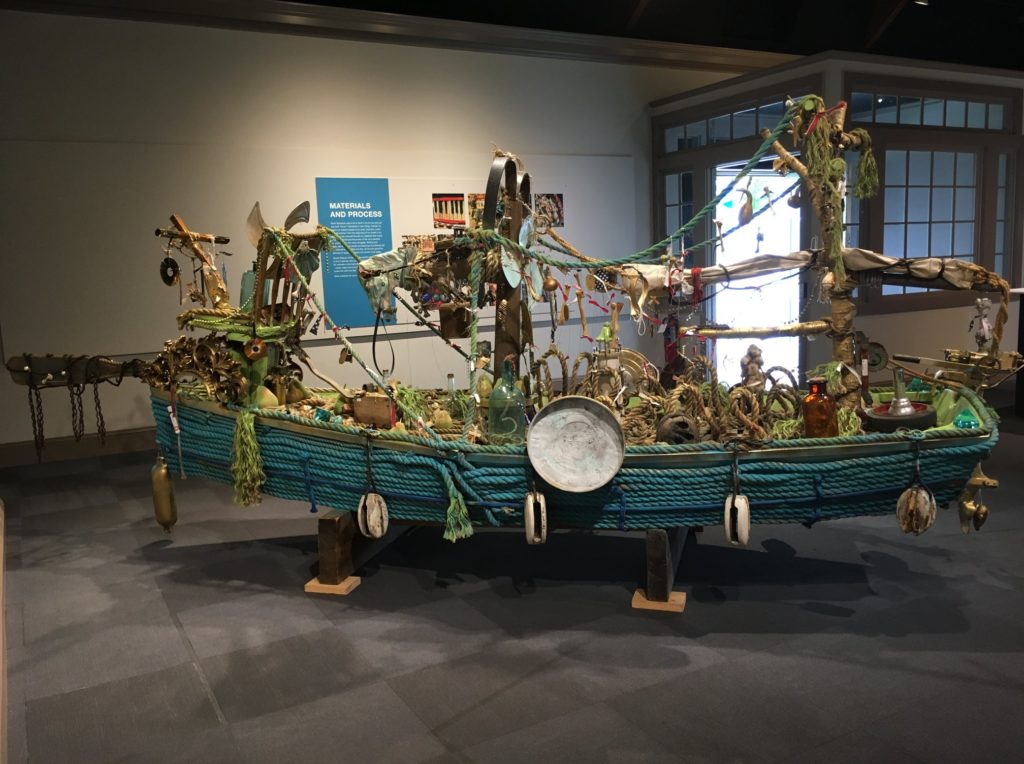
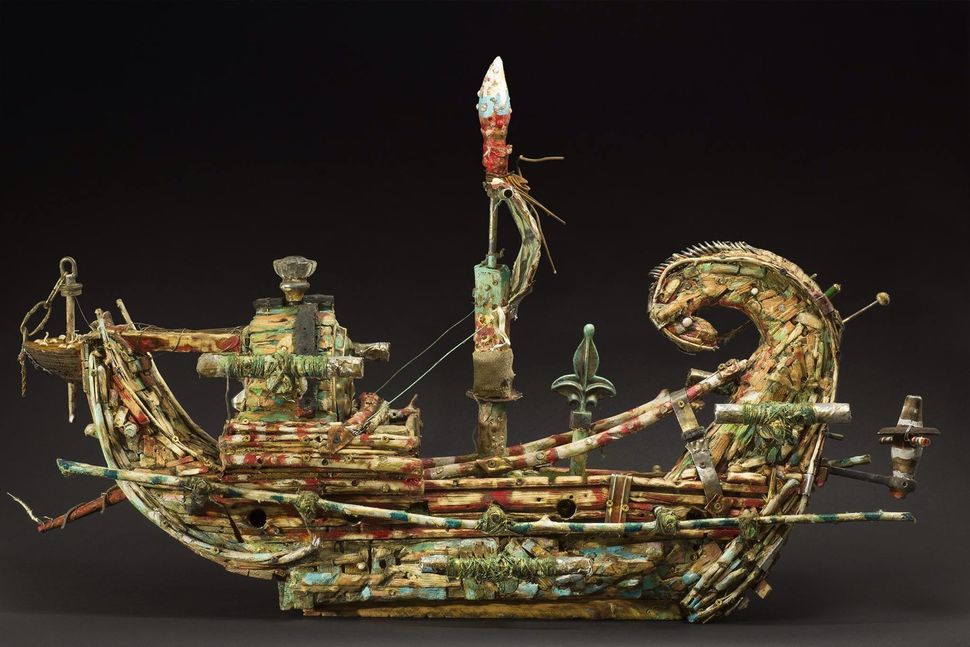
Kevin Sampson_Madjet.jpgNewark artist Kevin Sampson's "Madjet" looks like an ancient Egyptian reed boat made from stuff you'd find on a downtown street. 
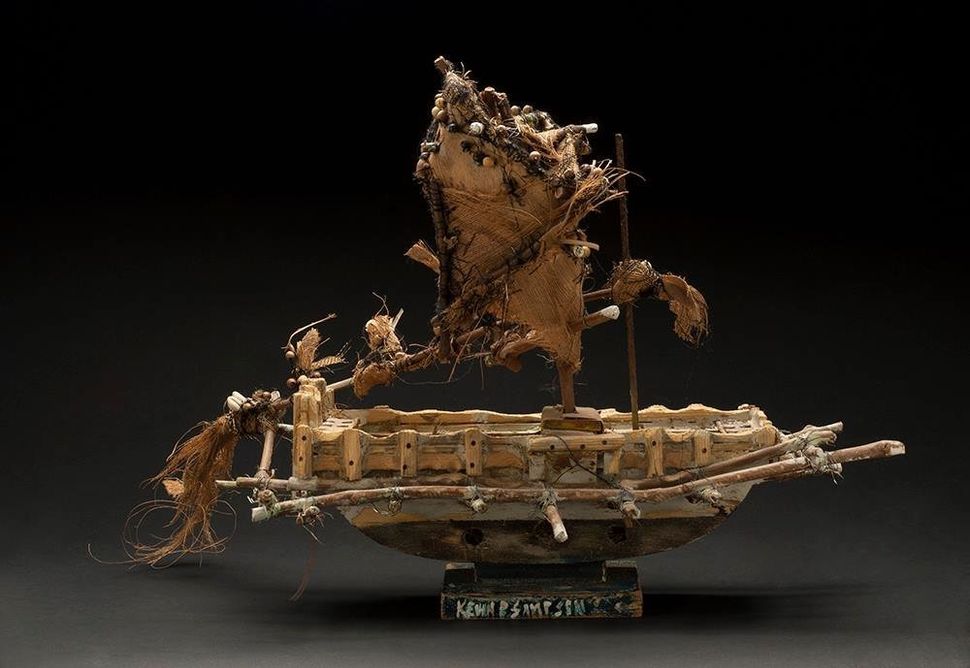
As you might expect in a city that is one of the capitals of black life in American, Newark is also home to several of the artists here. Kevin Sampson's "Madjet" is a mock-Egyptian reed boat made from found objects, like the glass cabinet knob amidships, and "Madjet" (it's the name of a constellation) is the very first artwork in "Modern Heroics." Sampson keeps a studio in the city, and shows regularly in downtown galleries.
Gladys Barker Grauer, widely considered the doyenne of African-American art in Newark, has two paintings in "Modern Heroics." Kingston-born Shoshanna Weinberger, a specialist in the many manifestations of African-American hair, has a studio in Newark, too; installation artist Kenseth Armstead, who will be artist in residence at the Yaddo art colony this year, is a graduate of Gallery Aferro's residency program. In addition, Sampson, Emma Amos and Dmitri Wright all taught at the Newark School of Fine and Industrial Arts, which closed in 1997, but was the fulcrum for art in Newark for 115 years.
African-American art in Newark has for more than 40 years been a kind of materials art, part of the assemblage movement Newark's Willie Cole—missing from this show, though his giant woodcut "Stowage," made with an ironing board that looks like the schematic of a slave ship, is in a canonical Expressionist medium—helped lead. But there are younger practitioners, like the Newark-born and educated Chakaia Booker, who twists shredded car tires into iconic sculptures.
Or like Armstead's 2014 "untitled (three ruffians killed beauty)," a series of furring strips smeared with tar and feathers. It's a reference to 18th century mob violence, but it looks in this context like an abstract painting.
And that's what African-American artists often do—take a dominant style and give it a twist. Bob Thompson did it 50 years ago, repainting Western mythological pictures with an updated palette, as in his version of Tintoretto's "St. George and the Dragon" (1961), a gem of the collection. Before he died, Norman Lewis said it would take at least 40 years for the art world to realize that the touches that make African-American art not fit a category perfectly were a feature, not a bug.
He was just about right.
90.3reduced.jpgEmma Amos's "The Heavens Rain" suggests freedom from inhibitions to the artist, but is haunting nonetheless. 
Modern Heroics: 75 Years of African-American Expressionism at the Newark Museum
Where: The Newark Museum, 49 Washington St., Newark
When: Through Jan. 8. Open noon-5 p.m. Wednesday-Sunday
How much: Adults $15, veterans and families with valid ID, students, seniors, $8, children under two free

7/29/16

The Many Terms in Our Continuum: ‘Outsider Art’


http://brutforce.com/many-terms-continuum-outsider-art/

The Many Terms in Our Continuum: ‘Outsider Art’

As Priscilla Frank and Kevin Sampson aptly point out, the term ‘Outsider Artist’ is offensive to some subgroups of artists within the art world that has manifested itself outside of the establishment. While we at Brut Force have tried to remain term agnostic, siding with the way the artist prefers to describe his or her self, we think it’s important to acknowledge the terms and classifications that exist and that will ultimately in some form describe this art movement in retrospective.
So for the sake of our readers, we thought it might be beneficial to lay out some terms that are used to describe the artists that we cover. Ultimately, we agree that integration into the larger contemporary art world is the trajectory and the future. At present though, there is still disparity. Below, we’ll attempt to expose the tip of the iceberg for the blurred lines that exist today amongst these terms.

Art Brut

The label created by French artist Jean Dubuffet is specifically focused on artists that create art outside of the art establishment or the established academic tradition. It is a French term that translates to raw art. It was thoroughly explored by this year’s exhibition by the American Folk Art Museum entitled Art Brut in America: The Incursion of Jean Dubuffet.

Folk Art

Folk Art often gets lumped into the same conversation because of its often rough or naïve nature. Folk art is often not influenced by mainstream art world trends and is not typically created by members of the art establishment. A more stringent definition align folk art with that of indigenous people or tradespeople. Folk art is more closely linked to cultural identity than any of the other categories we discuss.

Naïve Art

Naïve art is art created by a person without formal art education. Naïve art is often grouped with outsider art as its definition may hint. Strict naivety is becoming more and more rare as the forms of self-education have spread.

Outsider Art

This, the most infamous of terms, was coined by Roger Cardinal in 1972 as a synonym to art brut. It is often applied as a catch-all term for self-taught art of all forms though, which draws some criticism. The term though is more lax in its definition typically applied to self-taught artists that outside of the mainstream art world. To make things more complicated, Jerry Saltz argues that there is no such thing as Outsider Art and that the distinction is “outmoded discrimination still in place.” For better or for worse, the term Outsider Art has proven an effective marketing tool for the Outsider Art Fair and other entities tied to the name in recent years.

Self-Taught (Contemporary Self-Taught)

This is the term that Brut Force is most comfortable with and most directly influences our curation and content strategy. The manifestation of the term self-taught and specifically contemporary self-taught art was explained by Duff Lindsay of the Lindsay Gallery as, today’s “artists are not rural, they’re not southern. They might be knowledgeable about art and folk art, but you would not consider them to be outsiders. They’re not isolated from the art world or the art marketplace.” According to Lindsay, it might be hard to tell that a self-taught contemporary did not receive a traditional art education, though in spirit, the work shares something with the visionary, inspirational, or vernacular characteristics that define the genre of outsider art.

The Continuum

One of our favorite articulations of this was applied by Leslie Umberger of the Smithsonian American Art Museum. She states that if folk and self-taught are at opposite extremes of a single continuum, “with tradition at one pole and autonomy at the other, and all of it having developed apart from art world trends and markets. To discuss any particular artists you must consider where he or she falls along this line, each individual having varied amounts of traditional skills or ideas and personal vision.”
We look forward to continue to bring dialogue and discussion to the terms and the artists that make up this exciting field.

7/26/16


Should We Stop Using The Term ‘Outsider Art’?

Why are we calling community-oriented black artists like Kevin Sampson “outsiders”?

07/25/2016 09:42 am 09:42:29 | Updated 23 hours ago


Kevin Sampson
“I am not an outsider artist,” Kevin Sampson said.
He was speaking on a panel at the American Folk Art Museum in New York last week about sculptor Ronald Lockett alongside artist Michael Berube and Cara Zimmerman, a specialist in folk and outsider art at Christie’s. No one had explicitly labelled Sampson as such, but because he was invited to participate on the panel, it was surely implied.
“I have been represented by Cavin Morris Gallery for years,” Sampson continued. “My work showed in the Venice Biennale. It’s hard enough to be an African-American artist. Now we have to be ‘outsiders’”?
The conversation had shifted from discussing Lockett’s work to discussing the politics of how such work is categorized. Lockett was a black, self-taught artist living and working in Bessemer, Alabama. His work, made from tin, wire and found metals, explored resilience of the human spirit in times of political oppression and physical constraint. He died at just 33 years old from AIDS-related pneumonia. 


Kevin Sampson

In the strictest sense, Zimmerman explained, Lockett’s work belongs to the Birmingham-Bessemer School, along with his mentor and cousin Thornton Dial. But more often, perhaps when we get a little lazy, it’s described as “outsider” ― as in, outside the mainstream artistic institution.
Often, artists designated that way cannot personally respond to their opinion of the distinction. Frequently their work is discovered only after they’ve died, their artistic drive an obsessive secret they never expected would gain recognition. Or, oftentimes such artists live with developmental disabilities that limit their ability to discuss the way their work is referenced and catalogued. They make the work and leave its classification to curators, writers, dealers, etc.
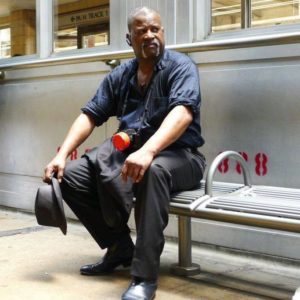
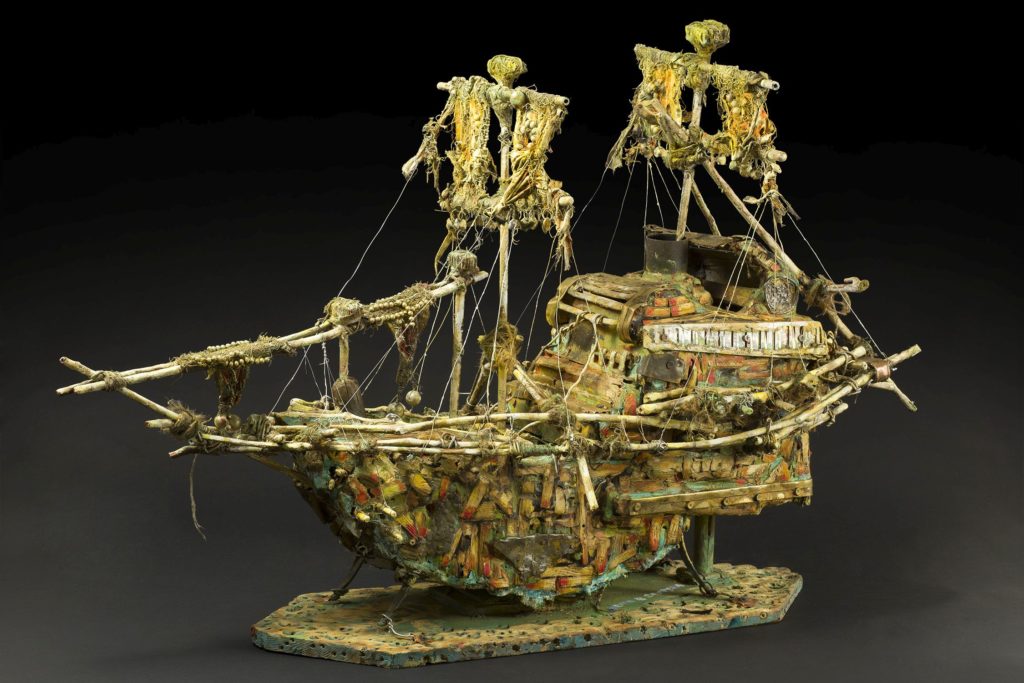
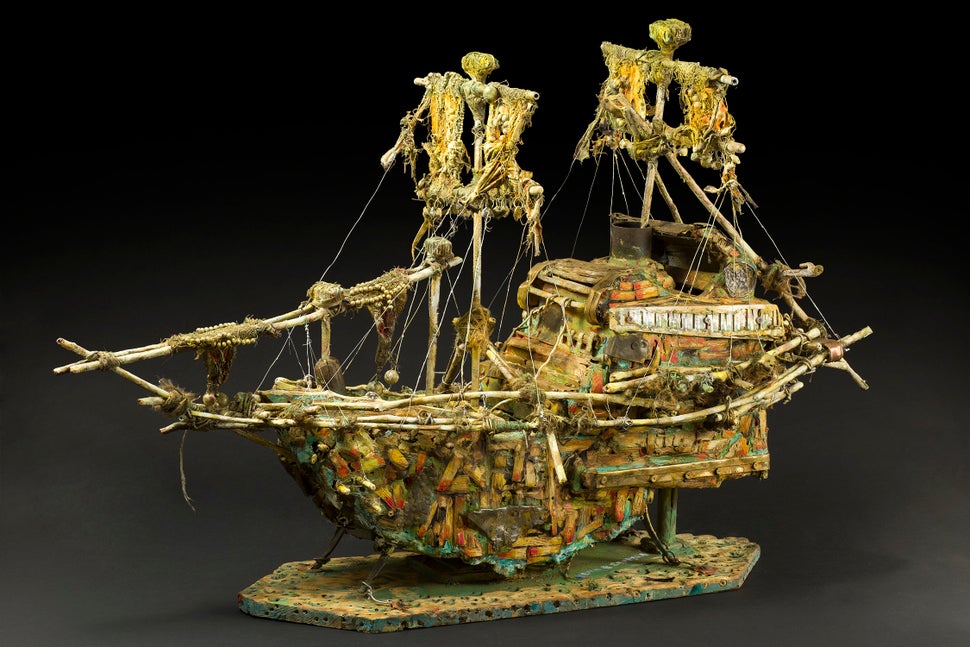
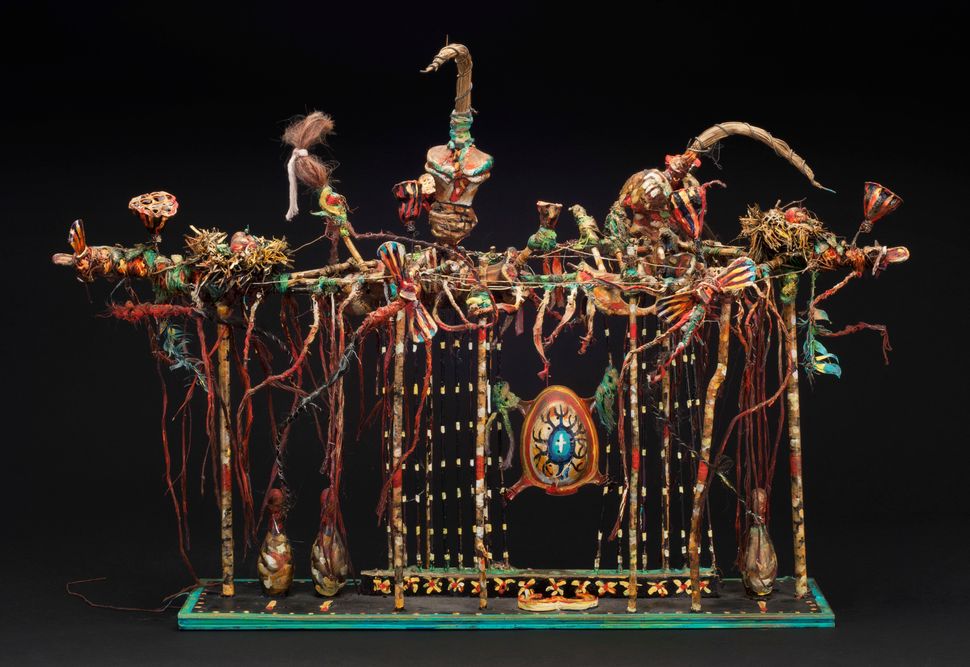
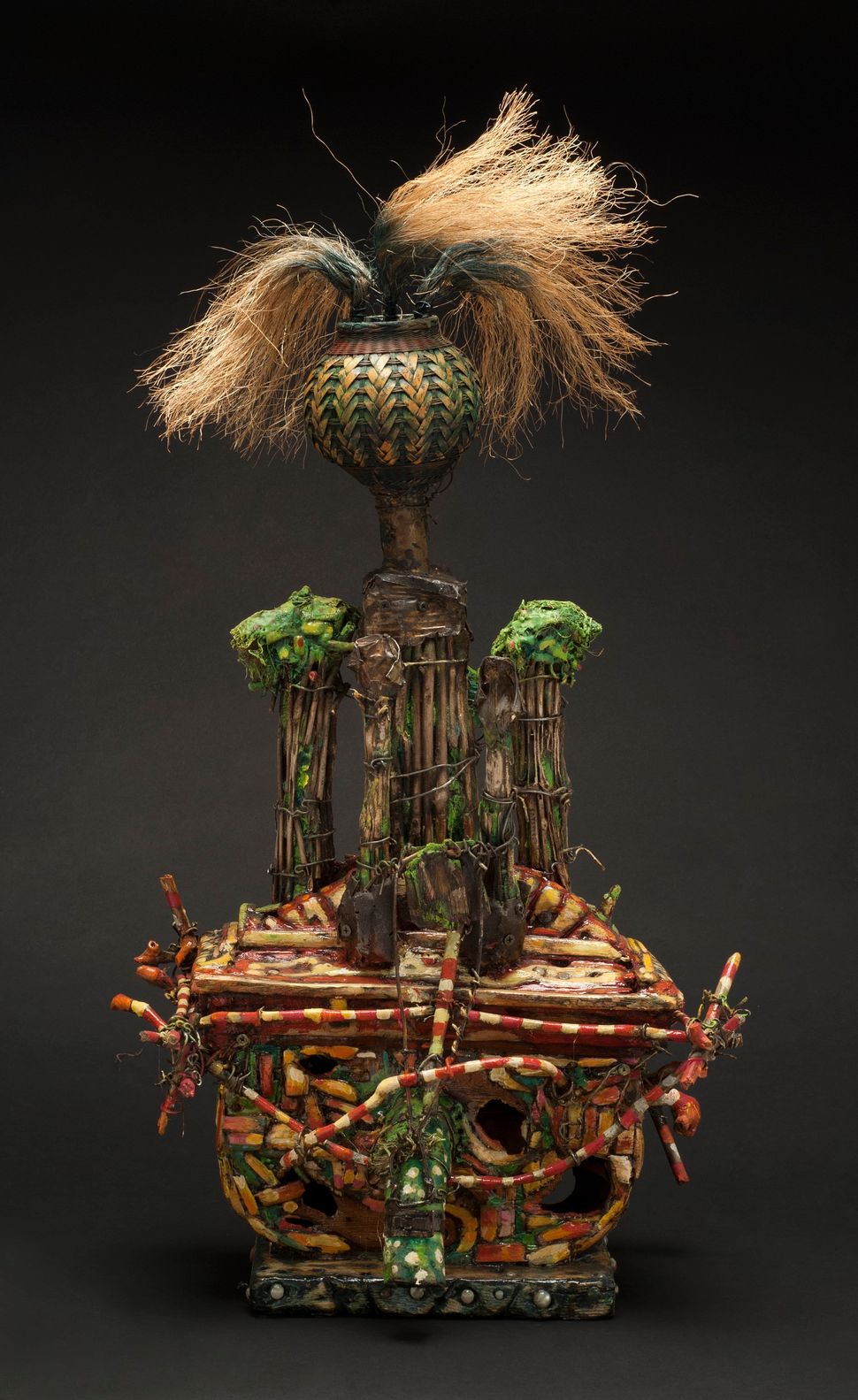
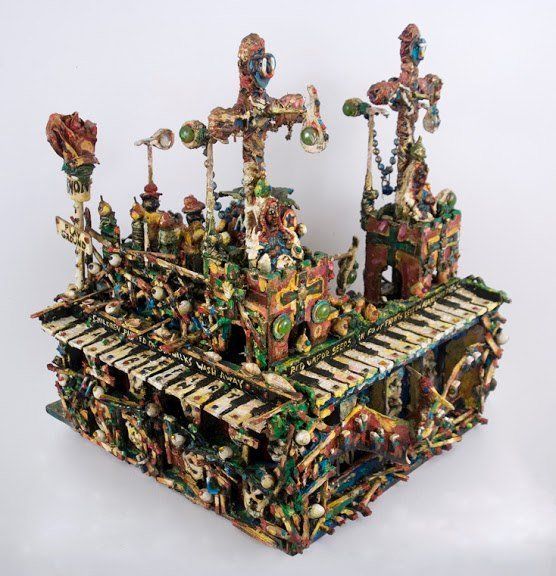
But Kevin Sampson, a New-Jersey-based sculptor who makes enchanting molten ships and structures from found objects, memories, bones, wax and hair, is able and willing to speak on the subject. “The term ‘outsider’ is offensive,” he explained in a phone interview with The Huffington Post following the panel. “I just don’t even understand what it means.”


Kevin Sampson


Originally, the term designated an artist making work outside the context of art history, removed from the artistic institution, apart from the dialogue and marketplace of contemporary art. Basically, outsider artists were isolated, working in basements, prison cells, psychiatric wards or rural towns ― places where art was, at least in theory, born purely of the individual imagination.
“The term was great 50 years ago,” Sampson said. “But there is no more making art in isolation.” Thanks to globalization and the internet, Sampson argues, it’s virtually impossible to make art outside of some sort of dialogue. “Outsider artists made art outside of the art world and outside of a community. But me, making art outside of the community? That’s nonsense.”
Sampson’s father was a civil rights leader in Newark, New Jersey, so he grew up immersed in a household full of political dialogue and community engagement. Although he was interested in art from a young age, at his parents’ insistence, Sampson opted for a traditional college education at Lincoln University, where he majored in history. He dropped out after two years.


Kevin Sampson

Sampson’s father was friends with the mayor, who told him the city was looking to recruit more African American cops. His parents urged him to take the test to join the police force. “The rest is history,” Sampson said. At his mother’s recommendation, he used his drawing skills to become a composite sketch artist. He made over 1,000 drawings on the job over the course of 10 years, eventually serving as an expert witness in identifying suspects.
Suddenly, Sampson’s life was uprooted. His wife Pam was diagnosed with a terminal illness. Their son Kyle, born prematurely, died at 4 months old. Sampson’s cousin Carol Oliver contracted HIV/AIDS and died three months later. “When I started losing people, drawing didn’t work anymore,” he explained. “I had to use my hands.”
For Sampson’s first artwork, he went into his backyard, grabbed a log and started to carve it, not knowing at all what he was doing. His cousin had turned to the Afro-Caribbean religion Santeria shortly before she died in the hope it would help provide a cure. Her mother gifted Sampson a variety of objects culled from her altars. They were tangible memories, everyday talismans, found objects imbued with intimacy.


Kevin Sampson

Sampson’s first piece was a ship, representing his cousin’s journey to the afterlife. He soon found himself creating a second, and then a third. “It was the late 80s. Everybody around me was dropping from either AIDS or crack,” he said. “I started doing these memorials for all the people dying around me. My wife thought they were from hell, there was so much darkness in them, but it was a way of working through the pain.”
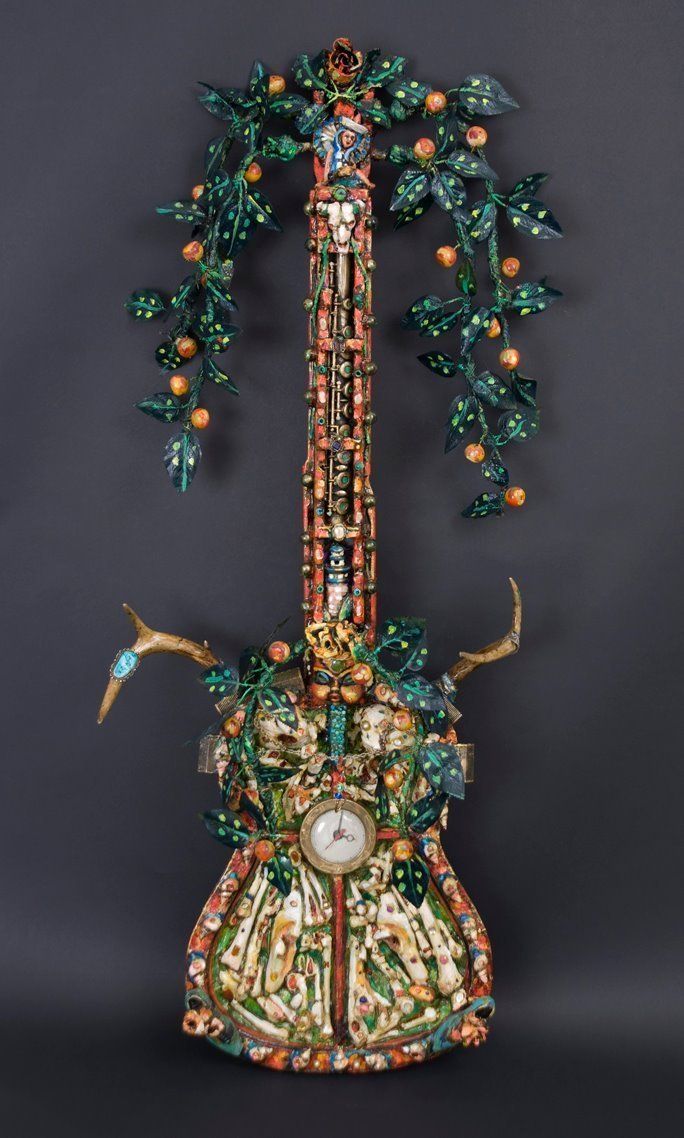
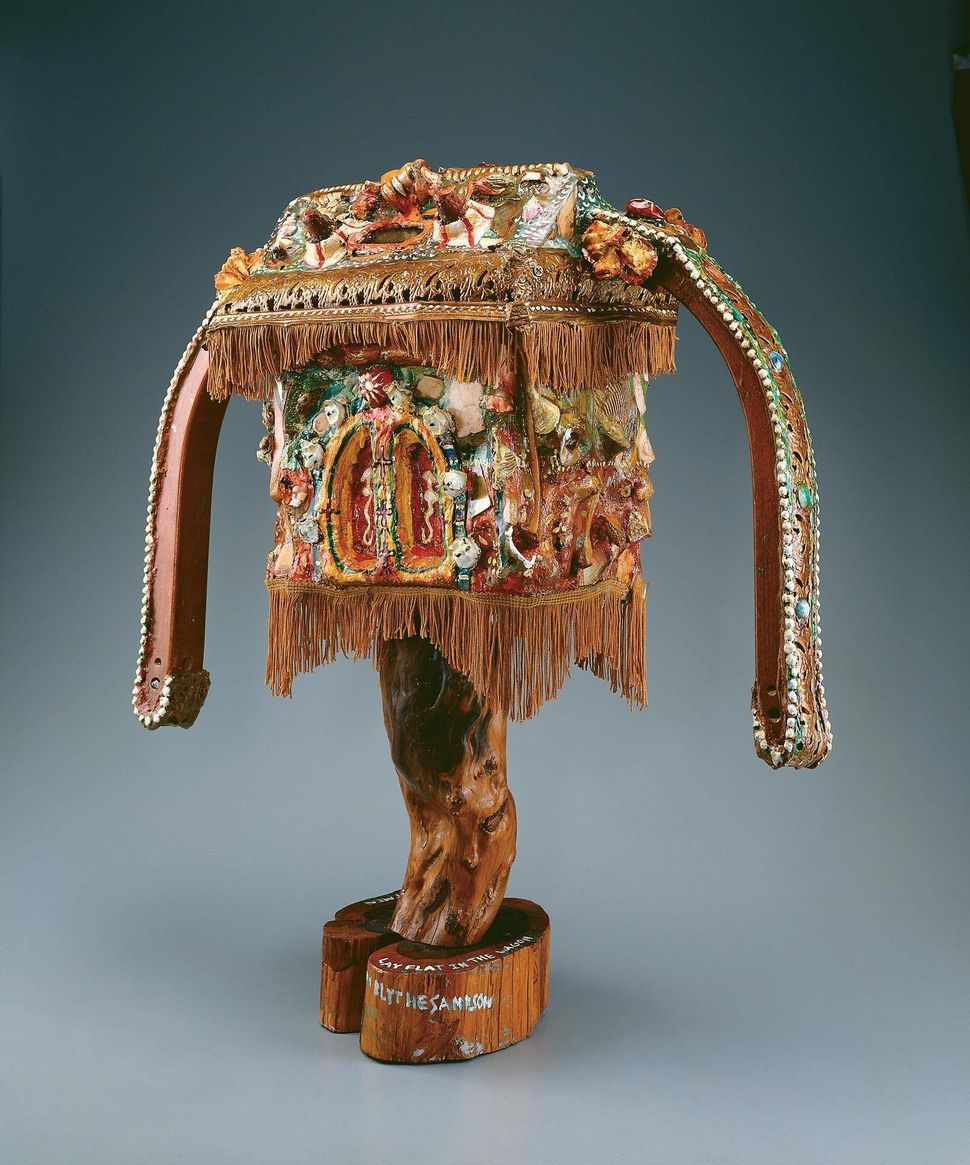
After his wife died, Sampson quit the police force after 18 years to devote his life to art. He began teaching art at local community centers and making sculptures that he’d often donate to family members of people he’d loved and lost. The sculptures, more often exhibited in Newark homes than in public, incorporate elements including chili peppers, wax, pork ribs and old jewelry, archeological relics that melt together to form otherworldly vessels, instruments and steeples.
Initially, the art-making was a way to heal. “Your focus becomes so intense you enter this liminal space,” Sampson explained. “It’s good for the soul.” But eventually, the work transcended the tragic circumstances from which it was born. As Sampson described his journey: “First you look at yourself. Then you look at your neighborhood. Then you look at God.” 


Kevin Sampson

These days, Sampson describes his work as political above all else. “I live in Newark, New Jersey, a very poor city with all kinds of problems,” he said. “Problems with poverty and crime and education. And with Trump running for president...” he trailed off. “My father branded me so civil rights is in my blood.”
Sampson’s contemporary sculptures incorporate American flags and allusions to figures like George W. Bush and Sarah Palin. He physically melds together public icons and personal artifacts, the residue of his loved ones and symbols of the nation, melting the boundaries between them in the process. In Sampson’s sculptural world, the boundaries between public and private, outside and inside, do not hold.
Perhaps the “outsider” label strikes Sampson as so ridiculous because of how important community is to his work. “I’m a community-based artist, an artist advocate,” he said. “I go out into the community. I talk, I read. I read 10 to 15 newspapers a day. I wind up building the pieces in my head, so when I start actually making the piece it’s already kind of built.”


Kevin Sampson

Sampson doesn’t particularly mind the term “self-taught artist,” but feels most affiliated with the more general title of contemporary artist. African-American contemporary artist works, too. He sees his work in conversation with an artist like Ronald Lockett, who also makes what Sampson referred to as “death-driven work.” He discussed Lockett’s work with fellow self-taught African-American artist Lonnie Holley, also often described as an outsider. And yet, the two artists found themselves exhibiting together in 2011 at the Venice Biennale, the most insider of art world affairs, discussing their relationship to Lockett’s work, an artist they both understood as speaking in their visual vernacular. 
“He’s 10 years younger than me, but we work alike,” Sampson said. “We both came out of the darkness to create out work. Lonnie and I were talking about his work one time; we noticed he used a lot of metal. We came to the conclusion that metal is flesh. All the metal pieces he did, I looked at it immediately and I thought this is flesh, this is skin.” 
During his lifetime, Lockett lived in isolation. To posthumously categorize his work as “outsider” seems like a cruel joke. In this moment, it becomes overwhelming just how preposterous a label like “outsider” can be, and perhaps has always been. 


Kevin Sampson

Also on HuffPost:

Outsider Art Fair 2016

Suggest a correction
Comments


CONVERSATIONS


3/17/16

Kevin sampson upcoming show at the Newark Musuem -Modern Heroics 75 Years of African-American Expressionism at the Newark Museum

Kevin sampson upcoming show at the Newark Musuem

https://www.newarkmuseum.org/Modern-Heroics

Modern Heroics
75 Years of African-American Expressionism at the Newark Museum
June 18, 2016-January 8, 2017

This exhibition presents selected works from Newark’s permanent collection of African-American art.  Taking a fresh look at heroic themes in modern and contemporary art, this unique exhibition features 32 paintings and sculptural works with an emphasis on storytelling and expressive imagery.   Mythical and universal subject matter, the bold use of color and dramatic scale, and the artists’ direct physical engagement with their materials are all themes explored in this exhibition.
Modern Heroics brings together rarely exhibited works by leading historical and contemporary African-American artists, placing in dialogue several generations and a range of self-taught and formally trained approaches. The exhibition will feature large-scale paintings by Norman Lewis, Purvis Young, Emma Amos, Bob Thompson and Mickalene Thomas among others; and sculptural works by Chakaia Booker, Thornton Dial, Kenseth Armstead and Kevin Sampson.
Tricia Laughlin Bloom, Ph.D., Curator, American Art
- See more at: https://www.newarkmuseum.org/Modern-Heroics#sthash.noluNSsg.dpuf

Modern Heroics
75 Years of African-American Expressionism at the Newark Museum
June 18, 2016-January 8, 2017

This exhibition presents selected works from Newark’s permanent collection of African-American art.  Taking a fresh look at heroic themes in modern and contemporary art, this unique exhibition features 32 paintings and sculptural works with an emphasis on storytelling and expressive imagery.   Mythical and universal subject matter, the bold use of color and dramatic scale, and the artists’ direct physical engagement with their materials are all themes explored in this exhibition.
Modern Heroics brings together rarely exhibited works by leading historical and contemporary African-American artists, placing in dialogue several generations and a range of self-taught and formally trained approaches. The exhibition will feature large-scale paintings by Norman Lewis, Purvis Young, Emma Amos, Bob Thompson and Mickalene Thomas among others; and sculptural works by Chakaia Booker, Thornton Dial, Kenseth Armstead and Kevin Sampson.
Tricia Laughlin Bloom, Ph.D., Curator, American Art
- See more at: https://www.newarkmuseum.org/Modern-Heroics#sthash.hU5lKkiQ.dpuf

Modern Heroics
75 Years of African-American Expressionism at the Newark Museum
June 18, 2016-January 8, 2017

This exhibition presents selected works from Newark’s permanent collection of African-American art.  Taking a fresh look at heroic themes in modern and contemporary art, this unique exhibition features 32 paintings and sculptural works with an emphasis on storytelling and expressive imagery.   Mythical and universal subject matter, the bold use of color and dramatic scale, and the artists’ direct physical engagement with their materials are all themes explored in this exhibition.
Modern Heroics brings together rarely exhibited works by leading historical and contemporary African-American artists, placing in dialogue several generations and a range of self-taught and formally trained approaches. The exhibition will feature large-scale paintings by Norman Lewis, Purvis Young, Emma Amos, Bob Thompson and Mickalene Thomas among others; and sculptural works by Chakaia Booker, Thornton Dial, Kenseth Armstead and Kevin Sampson.
Tricia Laughlin Bloom, Ph.D., Curator, American Art
- See more at: https://www.newarkmuseum.org/Modern-Heroics#sthash.hU5lKkiQ.dpuf

Modern Heroics
75 Years of African-American Expressionism at the Newark Museum
June 18, 2016-January 8, 2017

This exhibition presents selected works from Newark’s permanent collection of African-American art.  Taking a fresh look at heroic themes in modern and contemporary art, this unique exhibition features 32 paintings and sculptural works with an emphasis on storytelling and expressive imagery.   Mythical and universal subject matter, the bold use of color and dramatic scale, and the artists’ direct physical engagement with their materials are all themes explored in this exhibition.
Modern Heroics brings together rarely exhibited works by leading historical and contemporary African-American artists, placing in dialogue several generations and a range of self-taught and formally trained approaches. The exhibition will feature large-scale paintings by Norman Lewis, Purvis Young, Emma Amos, Bob Thompson and Mickalene Thomas among others; and sculptural works by Chakaia Booker, Thornton Dial, Kenseth Armstead and Kevin Sampson.
Tricia Laughlin Bloom, Ph.D., Curator, American Art
- See more at: https://www.newarkmuseum.org/Modern-Heroics#sthash.hU5lKkiQ.dpuf

Modern Heroics
75 Years of African-American Expressionism at the Newark Museum
June 18, 2016-January 8, 2017

This exhibition presents selected works from Newark’s permanent collection of African-American art.  Taking a fresh look at heroic themes in modern and contemporary art, this unique exhibition features 32 paintings and sculptural works with an emphasis on storytelling and expressive imagery.   Mythical and universal subject matter, the bold use of color and dramatic scale, and the artists’ direct physical engagement with their materials are all themes explored in this exhibition.
 
Modern Heroics brings together rarely exhibited works by leading historical and contemporary African-American artists, placing in dialogue several generations and a range of self-taught and formally trained approaches. The exhibition will feature large-scale paintings by Norman Lewis, Purvis Young, Emma Amos, Bob Thompson and Mickalene Thomas among others; and sculptural works by Chakaia Booker, Thornton Dial, Kenseth Armstead and Kevin Sampson.
 
Tricia Laughlin Bloom, Ph.D., Curator, American Art
 
- See more at: https://www.newarkmuseum.org/Modern-Heroics#sthash.noluNSsg.dpuf

Modern Heroics
75 Years of African-American Expressionism at the Newark Museum
June 18, 2016-January 8, 2017

This exhibition presents selected works from Newark’s permanent collection of African-American art.  Taking a fresh look at heroic themes in modern and contemporary art, this unique exhibition features 32 paintings and sculptural works with an emphasis on storytelling and expressive imagery.   Mythical and universal subject matter, the bold use of color and dramatic scale, and the artists’ direct physical engagement with their materials are all themes explored in this exhibition.
Modern Heroics brings together rarely exhibited works by leading historical and contemporary African-American artists, placing in dialogue several generations and a range of self-taught and formally trained approaches. The exhibition will feature large-scale paintings by Norman Lewis, Purvis Young, Emma Amos, Bob Thompson and Mickalene Thomas among others; and sculptural works by Chakaia Booker, Thornton Dial, Kenseth Armstead and Kevin Sampson.
Tricia Laughlin Bloom, Ph.D., Curator, American Art
- See more at: https://www.newarkmuseum.org/Modern-Heroics#sthash.noluNSsg.dpuf

Modern Heroics
75 Years of African-American Expressionism at the Newark Museum
June 18, 2016-January 8, 2017

This exhibition presents selected works from Newark’s permanent collection of African-American art.  Taking a fresh look at heroic themes in modern and contemporary art, this unique exhibition features 32 paintings and sculptural works with an emphasis on storytelling and expressive imagery.   Mythical and universal subject matter, the bold use of color and dramatic scale, and the artists’ direct physical engagement with their materials are all themes explored in this exhibition.
Modern Heroics brings together rarely exhibited works by leading historical and contemporary African-American artists, placing in dialogue several generations and a range of self-taught and formally trained approaches. The exhibition will feature large-scale paintings by Norman Lewis, Purvis Young, Emma Amos, Bob Thompson and Mickalene Thomas among others; and sculptural works by Chakaia Booker, Thornton Dial, Kenseth Armstead and Kevin Sampson.
Tricia Laughlin Bloom, Ph.D., Curator, American Art
- See more at: https://www.newarkmuseum.org/Modern-Heroics#sthash.hU5lKkiQ.dpuf


Modern Heroics
75 Years of African-American Expressionism at the Newark Museum
June 18, 2016-January 8, 2017

This exhibition presents selected works from Newark’s permanent collection of African-American art.  Taking a fresh look at heroic themes in modern and contemporary art, this unique exhibition features 32 paintings and sculptural works with an emphasis on storytelling and expressive imagery.   Mythical and universal subject matter, the bold use of color and dramatic scale, and the artists’ direct physical engagement with their materials are all themes explored in this exhibition.

Modern Heroics brings together rarely exhibited works by leading historical and contemporary African-American artists, placing in dialogue several generations and a range of self-taught and formally trained approaches. The exhibition will feature large-scale paintings by Norman Lewis, Purvis Young, Emma Amos, Bob Thompson and Mickalene Thomas among others; and sculptural works by Chakaia Booker, Thornton Dial, Kenseth Armstead and Kevin Sampson.

Tricia Laughlin Bloom, Ph.D., Curator, American Art

- See more at: https://www.newarkmuseum.org/Modern-Heroics#sthash.hU5lKkiQ.dpuf


Modern Heroics
75 Years of African-American Expressionism at the Newark Museum
June 18, 2016-January 8, 2017

This exhibition presents selected works from Newark’s permanent collection of African-American art.  Taking a fresh look at heroic themes in modern and contemporary art, this unique exhibition features 32 paintings and sculptural works with an emphasis on storytelling and expressive imagery.   Mythical and universal subject matter, the bold use of color and dramatic scale, and the artists’ direct physical engagement with their materials are all themes explored in this exhibition.
Modern Heroics brings together rarely exhibited works by leading historical and contemporary African-American artists, placing in dialogue several generations and a range of self-taught and formally trained approaches. The exhibition will feature large-scale paintings by Norman Lewis, Purvis Young, Emma Amos, Bob Thompson and Mickalene Thomas among others; and sculptural works by Chakaia Booker, Thornton Dial, Kenseth Armstead and Kevin Sampson.
Tricia Laughlin Bloom, Ph.D., Curator, American Art
- See more at: https://www.newarkmuseum.org/Modern-Heroics#sthash.hU5lKkiQ.dpuf