5/31/09

Obama's New York Night Out: Blue Hill, Broadway

Sunday, May. 31, 2009


By AP / ANN SANNER

(NEW YORK) — President Barack Obama made good on a campaign promise to his most important supporter Saturday night — his wife, Michelle.

The president and first lady jetted to a date in New York late Saturday afternoon, aides and media in tow. (See TIME's gallery of behind the scenes photos with Michelle Obama)

"I am taking my wife to New York City because I promised her during the campaign that I would take her to a Broadway show after it was all finished," the president said in a statement an aide read to the press.

After dining a little more than two hours at Blue Hill, a West Village restaurant touted by New York magazine as a "seminal Greenmarket haven" that features food grown by chef and owner Dan Barber on his upstate farm, the president and first lady headed to the Belasco Theater to make it in time for "Joe Turner's Come and Gone."

The play by August Wilson is about black America in the early 1900s, with residents of a boardinghouse recalling their migration from the sharecropping farms of the South to the industrialized North.

As the motorcade left the West Village and drove up Sixth Avenue to the theater, crowds of people, at times about eight deep, gathered on the sidewalks of the blockaded streets to wave as the Obamas passed. Some cheered. Cab drivers opened their doors and stood on the frames of their taxis to glimpse the president and first lady.

The Obamas left the theater after the play and were greeted by more cheers from enthusiastic bystanders along New York streets as they headed back for the flight to Washington.

The White House declined to say how much the trip was costing taxpayers, and even before the smaller jet left Washington, the there-and-back trip drew criticism from the Republican National Committee. The RNC issued a news release that chastised Obama for saying he understands American's troubles, but then hopping up to New York for "a night on the town."

Noting that General Motors is expected to file for Chapter 11 protection on Monday, the news release said: "Putting on a show: Obamas wing into the city for an evening out while another iconic American company prepares for bankruptcy."

In an interview before his inauguration, Barack Obama said he and his wife like having "date nights," usually on Fridays. Since moving to Washington, the Obamas have managed to fit in at least a few nights out in the nation's capital.

While on a trip to New York last week, Michelle Obama was reminded about the couple's first date.

"You know, after 20-some-odd years of knowing a guy, you forget that your first date was at a museum," she said. "But it was, and it was obviously wonderful. It worked."

Before traveling to New York, the Obamas watched daughter Malia's soccer game for an hour Saturday morning.

See TIME's Pictures of the Week

Obama's Vatican Pick: Boosting Hispanic Catholics, Disarming Catholic Critics

image


Sunday, May. 31, 2009

Obama's Vatican Pick: Boosting Hispanic Catholics, Disarming Catholic Critics

By Amy Sullivan

Barack Obama has an uncanny ability to disarm critics, especially those itching for a fight, and it was on full display this past week. His choice of federal judge Sonia Soto mayor as a Supreme Court nominee, of course, got all the attention. But another key appointment of a Hispanic with top-notch credentials and a compelling personal story also showed just how good the President is at keeping his opponents off balance. In fact, in selecting Catholic scholar Miguel Diaz to be the new ambassador to the Holy See, Obama not only neutralized potential controversy, but he highlighted a potential weakness of the American Catholic Church these days. (See TIME's photos: "Sonia Soto mayor [EM] The Making of a Judge")

If confirmed, the Cuban-American Diaz would be the first theologian to hold the diplomatic post, and he would become one of the country's most influential Hispanic Catholics. The choice is a shrewd one for a White House that has been under fire from leading conservative Catholics in the first few months of the Administration. What could have been an ugly confirmation battle may well proceed with all the rancor of a first communion party. (See TIME's gallery of Pope Benedict)

While the relationship between the United States and the Vatican has become an important one, the two have only enjoyed full diplomatic relations since 1984. Over the past 25 years, ambassadors to the Holy See have either been Catholic politicians or close personal friends of the President who appointed them. Ronald Reagan chose California businessman William Wilson, Bill Clinton selected former Boston mayor Ray Flynn and former congresswoman Lindy Boggs, and George W. Bush's first ambassador was former RNC chair Jim Nicholson.

Nominating a Catholic pol to the position would have been a risk for Obama. His selection of Kansas Governor Kathleen Sebelius to lead the Department of Health and Humans Services generated protests from conservatives who questioned whether a politician who supported abortion rights could be a real Catholic. A Catholic politician — even with pro-life views — would probably have been subjected to a thorough review of her record and asked to explain any votes against abortion restrictions.

Instead, Diaz is a Catholic theologian and professor at the College of St. Benedict and St. John's University in Minnesota. He is a board member of the Catholic Theological Society of America, and a scholar of the German theologian Karl Rahner, one of Pope Benedict's mentors. Diaz also happens to be pro-life and served on the Obama campaign's Catholic advisory group during the 2008 campaign. Like Sotomayor, he is the child of immigrants and was the first person in his family to attend college.

If Diaz's background as a theologian insulates him from inquiries about an abortion voting record, his Hispanic identity puts any potential critics in a bind as well. The American Catholic church may be the one institution more worried than the GOP about losing Hispanics. One-third of U.S. Catholics are Hispanic and among younger Catholics, the percentages are even larger. A full 60% of American Catholics under age 30 are Hispanic. Father Thomas Reese of the Woodstock Theological Center recently noted on the Washington Post's OnFaith site that studies show one out of three Catholics has left the church over the course of their lives. "The only reason Catholics continue to be a stable percentage of the U.S. population," he wrote, "is that Hispanics are making up for the white Catholics who are leaving."

Even so, the U.S. Catholic church has been slow to respond to this new reality. Only 9% of active Catholic bishops in this country are Hispanic and just one of the 31 archbishops is a Latino. Religion & Ethics Newsweekly reported last year that only 6% of Catholic clergy even speak Spanish. There are exceptions — the new archbishop of New York, Timothy Dolan, delivered part of his inaugural sermon there in Spanish, and Los Angeles Cardinal Roger Mahoney has been a strong national voice in favor of immigration reform.

But as in central and South America, the Catholic church is steadily losing Hispanic congregants to Evangelical denominations. A 2007 Pew Forum on Religion and Public Life survey found that half of Hispanic Catholics prefer charismatic worship styles and practices. In some cases, they are able to find that in Catholic parishes. But where they can't, they are turning to Pentecostal and other Evangelical traditions instead. Although 68% of Hispanics in the U.S. are still Catholics, that percentage has dropped from 78% in the early 1970s.

The job of ambassador to the Holy See is unusual — there are no visa issues to deal with, no military actions to observe and report. At a conference on Thursday at Catholic University to discuss the past 25 years of U.S.-Vatican relations, former ambassador Jim Nicholson said that one of his duties in the post was preparing a quarterly memo to the State Department outlining his best guess of who would be elected as a successor if the Pope died. Pope Benedict would probably prefer to debate Rahner's theological arguments with Diaz than to speculate about his own demise. But he will find in Diaz a representative of the American Catholic church's future — and an indication that the new Administration not only intends to take its relationship with the Vatican seriously, but that it won't make it easy for conservative Catholics to attack it.

See TIME's photo history of church hats

See TIME's photos of the Pope in France

5/29/09

Still one of my all time favorite movies

Farewell My Concubine (1993)
Directed By: Kaige Chen
Screenplay: Lillian Lee (also novel), Bik-Wa Lei, Wei Lu
Cast: Leslie Cheung, Gong Li

MIRAMAX / EVERETT COLLECTION

wo boys meet as students in a punishing Peking Opera school in the 1920s and remain partners, friends and enemies for 50 years. It’s The Sunshine Boys with screechy singing, and one of the boldest, most beautiful Chinese films in a decade dominated by them. In the “Concubine” opera that becomes their trademark, stolid Duan Xiaolou (Zhang Fengyi) plays the emperor, luscious Cheng Dieyi (the late, great Leslie Cheung) the concubine. Yin and yang are the roles they assume offstage as well, as Xiaolou has an affair with a courtesan (Gong Li, the imperious queen of Chinese cinema) and Dieyi flirts with the satrap of the occupying Japanese government. Sexual politics gives way to political horror during the Cultural Revolution, when personal betrayal may be the one way to stay alive. Chen Kaige’s stately, volcanic epic was one of the first Mainland films to acknowledge that damage wrought by Maoism. Beyond that, it is a rich dramatization of the venial and mortal betrayals that are the secret, somber melodies of our lives. —R.C.

From the TIME Archive:
Anyone can appreciate the splendor of the theatrical pageantry or the dagger eyes of Gong Li, as a dragon lady whose only commandment is survival
TIME Magazine, Oct. 4, 1993 >>

Princeton key to knowing Sotomayor

Princeton key to knowing Sotomayor
By: Ben Smith
May 29, 2009 04:35 AM EST

Princeton University, Michelle Obama wrote in her 1985 college thesis, was "infamous for being racially the most conservative of the Ivy League universities."
But for the second time in the Obama era, the stodgy Ivy League academy has emerged as a key to understanding the identity of a central player on the national stage — this time, Judge Sonia Sotomayor, who graduated from Princeton nine years earlier.
The first lady weathered intense storms during the campaign, many of which focused, directly or indirectly, on her race, before settling into a traditional and popular public role in the White House. The Sotomayor nomination is dragging both the judge and the Obama White House — largely against their will — back onto that charged terrain.
Foes of Michelle Obama (Princeton '85) sought to tie her most pointed recent comment on race — that her husband's campaign made her proud of her country "for the first time" — back to that Princeton thesis, where Obama's sense of aching racial exclusion came through powerfully.
For Sotomayor (Princeton '76), the words in question came from 2001, a single sentence on the final page of a speech that has emerged as an issue in her nomination: "I would hope that a wise Latina woman, with the richness of her experiences, would more often than not reach a better conclusion than a white male who hasn't lived that life," she said.

The Politico 44 Story Widget Requires Adobe Flash Player.

Friends, classmates, and Judge Sotomayor herself say that sense of racial identity as a central political category — and of her own place on the stage as not just a wise judge, but as a wise Latina — were formed in the unlikely crucible of Princeton.
It's where she was the moderate leader of a Puerto Rican activist group and where she graduated with the school's highest honors based in part on her activism. One friend from the time, Joe Schubert, dismissed the notion of Sotomayor as a student radical as "laughable."
"She had too much to lose to be the type of person who was out bombing ROTC buildings — and that happened at Princeton," Schubert said. "'Sonia' and 'radical' don't fit in the same sentence."
Sotomayor was among the first women at Princeton, and the first beneficiaries of a minority recruiting drive that would take in many of the other Ivy Leaguers now at top levels of the American government, and her story has riveted other members of that cadre.
"I was struck by how similar her story is to the president's and first lady's," said Crystal Nix Hines, a classmate of Michelle Obama who was the first black editor of Princeton's student newspaper and is now a lawyer and writer in Los Angeles. "Like Judge Sotomayor, Michelle Obama had to find her comfort zone in a community of extraordinarily intelligent and privileged individuals at Princeton, most of whom had little knowledge of the circumstances from which she had risen."
Though Obama and Sotomayor never crossed paths at Princeton, elements of their experience are almost eerily parallel.
The school was "an alien land for me," Sotomayor recalled two decades later, describing how Puerto Rican activism and the hub of minority politics, The Third World Center, "provided me with an anchor I needed to ground myself in that new and different world."
Later, Michelle Obama also came to the Third World Center, eventually serving on its governing board. In her thesis, the future first lady described a similar alienation.

"My experiences at Princeton have made me far more aware of my 'blackness' than ever before," the future Mrs. Obama wrote in her thesis introduction. "I sometimes feel like a visitor on campus; as if I really don't belong."
Both also incorporated their identities deeply into their studies: Obama wrote her thesis on the relationship of black Princeton graduates to the African-American community, while Sotomayor wrote hers on the Puerto Rican struggle for self-determination.
To understand Sotomayor's views on identity and politics, even the judge herself has said it's necessary to return to the Central New Jersey campus, when Sotomayor, 18 and the freshly minted valedictorian of Cardinal Spellman in the Bronx arrived at the Princeton Inn, a dorm on the edge of the sprawling, gothic campus.

To the outside view, she was instantly impressive. "I remember her as a bright, high-energy, confident young lady," said Andrew Oser, a student athlete who was in her dorm freshman year.
But Sotomayor was, in fact, nearly drowning. Her writing skills, she'd discovered, weren't as polished as those of her prep school classmates. And few could identify with the daughter of a single mother from one of the poorest counties in America.
The center of Princeton social life, meanwhile, were its exclusive eating clubs, which were largely white. Some even barred women at the time.
"Not many students of color belonged to eating clubs," recalled Sergio Sotolongo, who was a year behind Sotomayor at Spellman and Princeton. "There were other things that we as a group would turn to in order to fill that void."
Politics were the natural place to turn.
"This was the middle of the anti-war days. Student activism was rampant across the campus," recalled Schubert, a Mexican-American two grades older who got to know Sotomayor well while dating her best friend.
Sotomayor was initially slow to join the Puerto Rican campus group, Accion Puertorriqueno, classmates recalled; when she did join, she took it over and led the filing of a complaint in 1974 with the federal Department of Health, Education, and Welfare alleging a "lack of commitment" to federally mandated minority recruitment goals. She's pictured in that April 22 Princetonian looking soberly at the camera from behind big glasses, beside her counterpart from the Chicano Organization of Princeton.
But while the lawsuit may look in retrospect like a confrontational tactic, it was seen at the time as the path of accommodation, recalled Schubert and another Hispanic student leader, who asked that his name not be used because of his current position.
"Sonia was a voice of reason," recalled the other student leader. "There were Hispanics who felt that we shouldn't be in dialogue with the administration — we ought to be telling them to take a hike."
But the HEW complaint was "a very effective tactic ," said Schubert. "It got their attention, and they began to intensify their recruitment efforts."
Sotomayor would go on to win Princeton's highest student honor for her academic performance — she graduated summa cum laude — and her activism. The explicit attachment to what candidate Barack Obama, among others, would derisively refer to as "identity politics," never left her.

Sotomayor considered her own identity in a 1998 speech on her induction to the Second Circuit Court of Appeals, which was later reprinted in a Hispanic education magazine.
"In this time of great debate, we must remember that it is not politics or its struggles that creates a Latino or Latina identity. I became a Latina by the way I love and the way I live my life," she said. "Princeton and my life experiences since have taught me, however, that having a Latina identity anchors me in this otherwise alien world."

Michelle Obama arrived at Princeton five years after Sotomayor left it, to find a school that may have been less alien. There were more minority students. A lawsuit had forced open the doors of eating clubs to women. And her older brother, Craig, was a big man on campus.
"Talk about the hook-up — your brother is not only there already, but he is the star basketball player," said a college roommate, Angela Acree. "That gives you your total entrée, so I don't know whether Michelle would have the same feeling as another young lady arriving on campus."
But the future first lady evidently did have the same intense sense of difference that characterized the experience of many at Princeton.
"Regardless of the circumstances under which I interact with whites at Princeton, it often seems as if, to them, I will always be black first and a student second," she wrote in her thesis.
She too devoted herself to work at the Third World Center, taking a seat on the Center's board and running an after-school program for local children.
For a spell during the Democratic primaries in 2008, Michelle Obama appeared in danger of being cast as a radical, someone whose patriotism was in doubt after she said that she'd first come to "really love" America during the campaign.
Michelle Obama retreated to a more traditional spousal role, but she also appeared to benefit from the broad judgment that her politics weren't all that radical, her exploration of her identity wasn't that hard for most Americans to grasp.
Sotomayor appears headed for the same judgment: Despite the denunciations of Newt Gingrich and Rush Limbaugh, who have called her a "racist," even other conservative Republicans have decided that this isn't a battle they can win. Texas Sen. John Cornyn, chairman of the National Republican Senatorial Committee, Thursday denounced Gingrich's and Limbaugh's attacks on Sotomayor.
Meanwhile, Princeton is wrestling with the mixed blessing of being defined by two alumnae who were shaped largely in reaction against the school.
"We do suffer from old stereotypes that are no longer true today. Were they ever true? There's a reason that stereotypes are born, but Princeton has come a long, long way in a short period of time," said Lauren Robinson-Brown, a black classmate of Michelle Obama's who is now assistant vice president for communications at Princeton.
"Not many of us would say it was a wonderful place back then — but did we have wonderful experiences," she said.

© 2009 Capitol News Company, LLC

'Crazy Turtle Woman' transforms graveyard into maternity ward

MATURA, Trinidad (CNN) -- With its white sand and clear, blue water, Trinidad's Matura Beach looks like a postcard. It's a far cry from its recent past, when leatherback sea turtle carcasses littered the ground and kept tourists away.

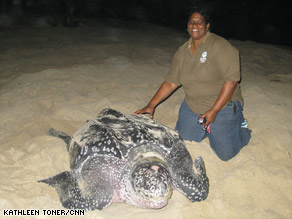
Suzan Lakhan Baptiste's efforts have turned a beach from a leatherback turtle graveyard to a nesting colony.

Suzan Lakhan Baptiste's efforts have turned a beach from a leatherback turtle graveyard to a nesting colony.

"Twenty years ago, this was a graveyard," Suzan Lakhan Baptiste said of the six-mile stretch of beach near her home.

"The stench was horrendous. You could smell it for miles," she said.

Saddened and frustrated, Baptiste launched a crusade to help end the slaughter of the gentle giants. Today, she and her group are succeeding: What was once a turtle graveyard is now a maternity ward -- one of the largest leatherback nesting colonies in the world.

It hasn't been an easy fight for Baptiste or the turtles.

For 100 million years, the creatures have traveled the world's oceans, outliving the dinosaurs. Over the last 30 years, they have become critically endangered worldwide because of fishing, pollution and hunting.

For centuries, they've been hunted throughout the Caribbean for their meat and fins, and also for their eggs, which some people prize as aphrodisiacs.

"Turtles are in serious trouble," Baptiste said.

Don't Miss

Every year, female leatherbacks make their way onto the beach, laying their eggs deep in the sand. It is a long, complicated ritual during which the enormous, slow-moving animals are easy prey for poachers.

"Leatherbacks [are] very vulnerable," Baptiste said. "They cannot pull their head and flippers back into the shell. They have no sense of defense to actually protect themselves."

By the 1980s, nearly one in three turtles that nested on Matura Beach were killed. When the government asked for volunteers to help protect the endangered creatures, Baptiste and several others answered the call. In 1990, they started Nature Seekers, one of Trinidad's first environmental groups.

'Crazy Turtle Woman'

For years, Baptiste and her group patrolled the beaches every night of turtle nesting season. She often walked alone until sunrise.

Locals mocked her efforts, calling her the "Turtle Police" or "Crazy Turtle Woman," yet her dedication to the unpaid work was fierce; when it conflicted with her day job, she quit and found a new job.

Leatherbacks were a vital source of income for some members of her village, and the poachers who prowled the beaches with machetes could be threatening. When Baptiste's then-husband was injured during a patrol, she became more determined to stand her ground.

"I was very vigilant," she said, adding that at times, she even got into physical fights.

But Baptiste persisted, and a prestigious award from the United Nations Environment Program helped validate her efforts. She and her group also worked hard to convince the villagers that using the turtles for eco-tourism could create a more sustainable income.

"I wanted to show that a turtle is [worth] so much more to us alive than dead," Baptiste said.

Gradually, her message of conservation turned the tide of public opinion, and after nearly two decades under Baptiste's leadership, Nature Seekers has largely won its battle. Today, the leatherbacks' survival rate on Matura Beach is virtually 100 percent.

"Here, turtle slaughter is a thing of the past," Baptiste proclaimed.

Even "Papa George," a village elder who used to hunt leatherbacks with his father, can attest to the cultural shift.

"Suzan brought around the change," he said. "They don't kill the turtles anymore ... because of the visitors."

Nearly 10,000 tourists a year, most of whom are Trinidadian, now visit Matura Beach, and many locals make a living by providing them with accommodations, food and souvenirs.

Since the beach is a prohibited area during the nesting season, Nature Seekers' members act as guides, explaining the turtles' ancient rituals to visitors. In addition, Baptiste and her colleagues gather data on the enormous creatures, tagging and weighing as many leatherbacks as they can. Video Watch Baptiste and her group weigh a leatherback turtle at night »

During peak season, they might see between 250 or 300 turtles a night. More than 5,000 leatherbacks nest in the area each year. The group's work is often cited as one of the most successful eco-tourism efforts in the Caribbean.

Still, turtle slaughter persists throughout the region, and Baptiste is working to help other groups learn from her success, most recently on the island of Dominica.

She finds joy in sharing her hard-earned knowledge.

"The passion that I feel, it burns me up," she said. "I have seen the fruits of our labor, and it can happen in every community." Video Watch how Baptiste helped end the slaughter of turtles in her community »

Her efforts -- and those of many others around the region -- are making a difference. While leatherbacks are still critically endangered worldwide, the Caribbean population has begun to rebound.

"When I got started, a lot of people thought I was crazy," Baptiste said, and she admits that she sometimes wondered if they were right. Reflecting on what she and her team have accomplished, she now believes it was worth it.


"I love being crazy, you know?" she said, laughing. "Crazy with a passion, crazy with a dream -- totally environmentally crazy."

Want to get involved? Check out Nature Seekers and see how to help.

E-mail to a friend E-mail to a friend

5/27/09

Red Bull's New Cola: A Kick from Cocaine?

Monday, May. 25, 2009

Red Bull's New Cola: A Kick from Cocaine?

By Jean Friedman-Rudovsky / La Paz

About a year ago, the makers of Red Bull, the famous caffeine-loaded energy drink, decided to come out with a soda, unsurprisingly named Red Bull Cola. The shared name implied the same big kick. But could the cola's boost — supposedly "100% natural" — come from something else? Officials in Germany worry that they've found the answer — cocaine. And now they have prohibited the soda's sale in six states across the country and may recommend a nation-wide ban.

"The [Health Institute in the state of North Rhine Westphalia] examined Red Bull Cola in an elaborate chemical process and found traces of cocaine," Bernhard Kuehnle, head of the food safety department at Germany's federal ministry for consumer protection, told the German press on Sunday. According to this analysis, the 0.13 micrograms of cocaine per can of the drink does not pose a serious health threat — you'd have to drink 12,000 L of Red Bull Cola for negative effects to be felt — but it was enough to cause concern. Kuehnle's agency is due to give its final verdict on Wednesday when experts publish their report. (See pictures of America's cannabis culture.)

Red Bull has always been upfront about the recipe for its new cola. Its website boasts colorful pictures of coca, cardamom and Kola nuts, along with other key "natural" ingredients. The company insists, however, that coca leaves are used as a flavoring agent only after removing the illegal cocaine alkaloid. "De-cocainized extract of coca leaf is used worldwide in foods as a natural flavoring," said a Red Bull spokesman in response to the German government's announcement. Though the cocaine alkaloid is one of 10 alkaloids in coca leaves and represents only 0.8% of the chemical makeup of the plant, it's removal is mandated by international antinarcotics agencies when used outside the Andean region. (Check out a story on how Bolivia is preaching the virtues of coca culture.)

Meanwhile, in Bolivia, halfway around the world and smack in the middle of the Andes, the controversy is causing chuckles. Coca is a fundamental part of Andean culture and for years, Bolivians have tried to get the world to understand that the leaf is not a drug if it's not put through the extensive chemical process that yields cocaine. Left-wing President Evo Morales, a coca-grower himself, has made coca validation a personal quest, chewing leaves in front of world leaders and press cameras during his travels. "Let's say [Red Bull Cola] doesn't take out the cocaine alkaloid. Have any of those millions of people across the world who have drunk that soda ever gotten sick or felt drugged?" asks Dionicio Nunez, a coca-growers' leader from the Yungas region. "We've always known that coca isn't harmful. Now maybe others will realize it too."

In Germany, the Red Bull spokesman insisted that his company's product, along with others containing the coca-leaf extract are considered safe in Europe and the U.S. And already, some experts have come to Red Bull's defense. "There is no scientific basis for this ban on Red Bull Cola because the levels of cocaine found are so small," Fritz Soergel, the head of the Institute for Biomedical and Pharmaceutical Research in the city of Nuremberg, tells TIME. "And it's not even cocaine itself. According to the tests we carried out, it's a nonactive degradation product with no effect on the body. If you start examining lots of other drinks and food so carefully, you'd find a lot of surprising things," he says. (Read about the anti-Red Bull: a drink that can calm you down.)

Coca leaves, of course, have a long record in modern soda-pop history. Most prominently, there was Coca-Cola whose original 19th century formula used unaltered coca leaves. In the early 1900s the company said it would only use "spent," or decocainized leaves, though the company refuses to confirm whether leaves in any form are still used.

But the problem is when it comes to coca and cocaine, it's not just a health concern, but a legal one. Since 1961, trade of coca outside the Andean region — where people have chewed or brewed coca in tea to stave off hunger and exhaustion for centuries — has been prohibited unless the cocaine alkaloid is removed. Few companies in the world have authorization to trade in the leaf and most are pharmaceutical companies that perform this decocainizing process. The most prominent is New Jersey-based Stepan Chemical Company which has been reported to supply Coca-Cola with its narcotic-free derivative.

But no one knows where Red Bull Cola's coca leaves come from or where they are processed. Red Bull did not respond to immediate requests for comment and Rauch Trading AG, the Austria-based food company that actually manufactures Red Bull Cola was quick to tell TIME that they are not allowed to speak about the product. Meanwhile, Bolivia, which has lots of coca leaves to sell, is getting a kick out of the fact Red Bull Cola admits to using coca in any form (since Coca-Cola evades the question). Ironically, the drink is not actually available yet in Bolivia. But, the locals say, this is a great opportunity to show that coca isn't harmful — with or without the cocaine alkaloid. With Reporting by Tristana Moore/Berlin

Technorati Tags:

image

Wednesday, May. 27, 2009

The GOP's Initial Tactic on Sotomayor: Play for Time

By Jay Newton-Small

It's no wonder that so many Republicans reacted to President Barack Obama's nomination of Sonia Sotomayor to the Supreme Court Tuesday by arguing that the confirmation process couldn't be rushed: the GOP knows it has been dealt a bad hand, and it's playing for time.

Time, after all, is what the party needs if it has any hope whatsoever of uncovering some kind of silver bullet — buried somewhere in the 17 years of Sotomayor's federal judicial writings — that could help sink her nomination. Opposing a candidate first nominated to the bench by President George H.W. Bush and twice confirmed by the Senate, after all, would be hard enough. But at a time when the party has already alienated Hispanic voters, the GOP knows it has to tread very carefully in dealing with the first Hispanic candidate for the nation's highest court, especially a woman of Puerto Rican descent with an inspiring Horatio Alger story of her own. (See TIME's photo-essay on Sotomayor's Supreme Court nomination.)

"Opposing this pick right now is really tough politically, especially since Republicans had two bites the last time around and picked two white males," said John Ullyot, a GOP consultant who has advised on judicial confirmations. "Do they really want to be put in a position of either voting against or questioning in a hostile way somebody who has a good record and will be seen by Latinos as a very important and symbolic pick? There's a disconnect between groups that expect really giving a zinger to a nominee like this and where Republicans want to be politically."

But if moderate or just plain pragmatic Republicans are worried about putting off Hispanics, they are also under enormous pressure from conservative activist groups — Rush Limbaugh called Sotomayor and Obama "reverse racists" — to not let her go through without a real fight. "President Obama carried through on his threat to nominate a Justice who would indulge her policy preferences and biases on the bench," says Ed Whelan, president of the Ethics and Public Policy Center, a group opposing Sotomayor's candidacy. "I'm going to continue to do all I can to expose Sotomayor's view of judging and why she's not a good pick for the court." (Read "Judge Sonia Sotomayor Headed for Easy Supreme Court Nomination.")

So for the moment, at least, all the GOP can seemingly agree on is to try to drag out the proceedings, and hope that Obama's vetting team has once again missed something. Senator John Cornyn, a Texas Republican and member of the Judiciary Committee, said Tuesday that Obama has agreed to a John Roberts timetable: it took 92 days from the day the Chief Justice was nominated to swear him in. By that yardstick Sotomayor will not see a vote until Sept. 8 at the earliest, since 91 days from now falls on Aug. 26, right in the middle of Congress' summer recess. Senate majority leader Harry Reid said he'd like to see Sotomayor confirmed before everyone leaves town on Aug. 7, but Republican senators have already indicated they think that's unrealistic. "The President has assured me that we will have ample time to give Ms. Sotomayor's record a full and fair review," Cornyn said in a statement. "Therefore, it is imperative that my colleagues and members of the media do not prejudge or preconfirm Ms. Sotomayor."

The nomination of Sotomayor comes at a bad time for the GOP. Republicans have only just begun the long process of wooing Latinos burned by the 2005-06 immigration battles. Obama won 67% of Latino votes compared to John McCain's 31% — enough to help Obama win Florida, New Mexico and Colorado. Hispanics had actually been somewhat disappointed in Obama's Latino-lite Cabinet and his unwillingness to take on immigration reform as a top issue in his first 100 days, but that will probably be forgotten now. The Hispanic community was "thrilled" by Obama's pick of Sotomayor, as David C. Lizárraga, chairman of the U.S. Hispanic Chamber of Commerce's board said. "She is a role model of strength, focus and discipline and exemplifies the American ethos, proving that anyone in this nation can fulfill their dreams, matching their potential with opportunity," Lizárraga said.

Walking this careful line between pleasing the base and not offending Hispanics will be Senator Jeff Sessions of Alabama, who became the top Republican on the Judiciary Committee when Arlen Specter switched parties last month. Sessions himself was once a Reagan nominee to the federal bench who was rejected by this same committee — at the time controlled by Republicans — after reports surfaced that he had called the American Civil Liberties Union and the National Association for the Advancement of Colored People "un-American" and had once told a colleague that they "forced civil rights down the throats of people."

Given that history, Sessions is surely aware that he cannot afford to become the story if he says anything indelicate. And his statement Tuesday reflected just how careful he has to be. "The Senate Judiciary Committee's role is to act on behalf of the American people to carefully scrutinize Ms. Sotomayor's qualifications, experience and record," he said, striking a neutral tone. "Of primary importance, we must determine if Ms. Sotomayor understands that the proper role of a judge is to act as a neutral umpire of the law, calling balls and strikes fairly without regard to one's own personal preferences or political views."

5/26/09

Puerto Rico since half my family is from there i am esp.. proud of this selection for the supreme court


Did i call this one or what her story is impossible to not love………….what a wondrous time we live in a  Nyorican  in the supreme court.

praise the lord

Obama Selects Sotomayor for Court

By PETER BAKER and JEFF ZELENY

WASHINGTON — President Obama announced on Tuesday that he will nominate the federal appeals judge Sonia Sotomayor for the Supreme Court, choosing a daughter of Puerto Rican parents raised in Bronx public housing projects to become the nation’s first Hispanic justice.

Judge Sotomayor, who stood next to the president during the announcement, was described by Mr. Obama as “an inspiring woman who I am confident will make a great justice.”

The president said he had made his decision after “deep reflection and careful deliberation,” and he made it clear that the judge’s inspiring personal story was crucial in his decision. Mr. Obama praised his choice as someone possessing “a rigorous intellect, a mastery of the law.”

But those essential qualities are not enough, the president said. Quoting Justice Oliver Wendell Holmes, Mr. Obama said, “The life of the law has not been logic, it has been experience.” It is vitally important that a justice know “how the world works, and how ordinary people live,” the president said.

The judge described her selection as “the most humbling honor of my life.”

“I stand on the shoulders of countless people,” she said. But towering above all, she said, is her mother, Celina, who raised her alone after her father died. “I am all I am because of her,” Judge Sotomayor said, “and I am only half the woman she is.”

Judge Sotomayor is Mr. Obama’s first selection to the Supreme Court, and her nomination could trigger a struggle with Senate Republicans who have indicated they may oppose the nomination. But Democrats are within reach of the 60 votes necessary to choke off a filibuster, and Republicans concede that they have little hope of blocking confirmation barring unforeseen revelations.

Judge Sotomayor, 54, who has served for more than a decade on the Court of Appeals for the Second Circuit, based in New York City, would become the nation’s 111th justice, replacing David H. Souter, who is retiring after 19 years on the bench. Although Justice Souter was appointed by the first President George Bush, he became a mainstay of the liberal faction on the court, and so his replacement by Judge Sotomayor likely would not shift the overall balance of power.

But her appointment would add a second woman to the nine-member court and give Hispanics their first seat. Her life story, mirroring in some ways Mr. Obama’s own, would add a different complexion to the panel, fulfilling the president’s stated desire to add diversity of background to the nation’s highest tribunal.

Judge Sotomayor’s father died when she was 9 years old, and her mother worked six-day weeks to earn enough money to send her and a brother to Catholic school. She got into Princeton University, where she once said she felt like “a visitor landing in an alien country,” but graduated summa cum laude.

Although she grew up in modest circumstances, the judge said, “I consider my life to be immeasurably rich.”

After Yale Law School, where she was editor of the Yale Law Journal, she worked for Robert M. Morgenthau in the district attorney’s office in New York and later was in private practice. The first President Bush nominated her in 1991 to the federal district court on the recommendation of Senator Daniel Patrick Moynihan, Democrat of New York, and she was confirmed a year later. President Bill Clinton decided to elevate her to the appeals court in 1997, and she was confirmed a year later.

Judge Sotomayor has said her ethnicity and gender are important factors in serving on the bench, a point that could generate debate. “I would hope that a wise Latina woman with the richness of her experiences would more often than not reach a better conclusion than a white male who hasn’t lived that life,” she said in a 2002 lecture.

She also once said at a conference that a “court of appeals is where policy is made,” a statement that has drawn criticism from conservatives who saw it as a sign of judicial activism. Judge Sotomayor seemed to understand at the time that she was making a controversial statement, adding that, “I know this is on tape, and I should never say that, because we don’t make law.”

Conservatives quickly pointed to such statements after word of her selection on Tuesday.

“Judge Sotomayor is a liberal activist of the first order who thinks her own personal political agenda is more important than the law as written,” said Wendy E. Long, counsel to the Judicial Confirmation Network, an activist group. “She thinks that judges should dictate policy, and that one’s sex, race and ethnicity ought to affect the decisions one renders from the bench.”

White House officials concluded that such statements, while perhaps providing fodder for opponents, would not be problematic enough to hinder her confirmation. Some officials have said in recent days that they relish the prospect of Republicans standing up against a Hispanic woman with her life story, because it would only damage the G.O.P. with a key voting bloc.

The president sought to defuse some of those charges in advance, declaring his confidence that she has “a recognition of the limits of the judicial role.”

Indeed, in nominating the first Hispanic justice, Mr. Obama may appeal to a large and growing constituency whose party loyalty is still very much in play. Hispanic groups have expressed excitement about the idea of one of their own serving on the high court. (Some scholars argue whether Benjamin Cardozo was really the first Hispanic justice, but with his Portuguese-Jewish background, he never identified himself as a Hispanic.)

On the appeals court, Judge Sotomayor has not been involved in many hotly disputed decisions, but one that she participated in is before the Supreme Court right now. As part of a panel, she voted to uphold New Haven’s decision to throw out a set of fire department promotion tests because no minority candidates made the top of the list. White firefighters who scored high but were denied promotion are appealing that ruling.

As a district judge, she briefly earned fame in 1995 by ending a Major League Baseball strike, ruling in favor of players and against the owners, who she said were trying to subvert the labor system.

At the White House announcement, the East Room filled with members of the legal community and several Hispanic leaders, who received calls and e-mails on Tuesday morning to attend the ceremony and applauded enthusiastically when Mr. Obama entered the room with the nominee. To keep the decision secret, outside groups were not notified until about two hours before the event began.

The president conducted a face-to-face interview of Judge Sotomayor on Thursday at the White House, officials said. She was the second finalist to be interviewed, following Judge Diane P. Wood of Chicago.

Mr. Obama called her at 9 p.m. on Monday, officials said, to inform her that she was his choice. She traveled to Washington late Monday evening.

The president reached his decision over the long Memorial Day weekend, aides said, but it was not disclosed until Tuesday morning when he informed his advisers of his choice less than three hours before the announcement was scheduled to take place.

Mr. Obama telephoned Judge Sotomayor at 9 p.m. on Monday, officials said, advising her that she was his choice to fill the Supreme Court vacancy. Later Monday night, Mr. Obama called the three other finalists — Judge Diane P. Wood of Chicago, Homeland Security Secretary Janet Napolitano and Solicitor General Elena Kagan — to inform them that he had selected Judge Sotomayor.

Home

DCSIMG

The Hawkins Street mural…….On Newark USA A fotojournal about LIVING in Newark USA, New Jersey's largest and most cultured city, by the author of the foto-essay website RESURGENCE CITY: Newark USA.

Friday, May 22, 2009

Hawkins Street Mural Finished

On Tuesday I went to see and take pix of the mural that Ironbound artist Kevin Blythe Sampson did with a bunch of kids in the auditorium at the Hawkins Street Elementary School quite far east in the Ironbound, six miles from my house. I have an atlas that contains an inset map of the New York Metropolitan Area in which there are three labels for this city: "Newark", "Vailsburg" (my area, on the far west), and "Ironbound" (far to the east), and on Tuesday I passed thru the largest part of the city traveling between the two far ends. Ferry Street is a bottleneck. Had I thought to Mapquest the route, I would have been directed to go via Market Street after Newark Penn Station until it joined up with Ferry Street past the congested area. But I didn't.

Here is the mural in its setting (from far enuf away and at low-enuf resolution that the children are not personally identifiable, something the school's administration was concerned about as regards any foto to appear in the magazine.

Kevin wrote a poem about his experience working with the kids on this project, which affected him more deeply than he had anticipated. I'm not going to show his poem here, because a folk-art magazine is planning to run it. They wanted "a really good picture" of the mural to show with it. The one foto I showed here that Kevin took didn't seem quite right for the purpose, so I offered to take some pix he could make available to the publisher. Kevin chose two, one wide and one detail view. We'll see if the magazine's art director is satisfied with them or would like a professional fotografer to take better pix, perhaps using floodlites to bring out the colors. The (Haitian-Iranian) custodian, a cheerful, helpful guy who also teaches in a daycare center at St. Stefan's (the iconic church of the Ironbound, at the Five Corners) turned on such lites as are regularly available in the auditorium, but the mural would benefit from briter liting. (The fotos I show today are not the same as those sent to the magazine. )

The Hawkins Street School is an old building with the kind of grand sense of itself and its place that many of the institutional buildings of post-1950 schools lack. This is the view looking out from the stage for which the mural serves as backdrop.

The earlier foto wasn't appropriate in any case because the mural at April 11th was very different from the present, finished(?) version. The finished mural combines elements of reality with the Hollywood fable of The Wizard of Oz and the legend of the Pied Piper. Obama's music makes the children dance all the way along the yellow-brick road to the U.S. Capitol, shown here surrounded by the towers of the Emerald City.

Kevin stands alongside mural.

The largest human figure is President Obama, left of center at the bottom, dressed in flowing robes with slogans on the folds. New Jersey After 3 is the program Kevin works with at the Hawkins Street School.

Here, one little girl dances in a wide dress whose skirt bears the Spanish equivalent of "Yes we can".

Here, one little girl dances in a wide dress whose skirt bears the Spanish equivalent of "Yes we can".

The children who worked on the mural wanted things in it that may not have been essential to the theme but didn't detract from it, so Kevin included them. Here, one of the most common wild animals in Newark, a squirrel, scampers past Obama. Kevin and I couldn't figure out the Spanish ("Bentige") on one fold of Obama's cloak. Anyone? I found an expression, "Dios te ventiga", on the Internet, but have no idea what it means. Anyone? (The misspelling in that Spanish text, "Amerca", will be fixed.) "I too sing America" is from Langston Hughes and I suspect references Walt Whitman's "I Hear America Singing".

Here, a doggy looks up adoringly at another little girl dancing.

Tho I am not privy to the motivations of the kids in creating the various elements of this mural, let me tell something of what I see. Different people will see different things. The yellow-brick road is touched with gold paint, reflecting the "streets paved with gold" language of immigrants' dreams of "America".

Musicians are among the people on the road to the Capitol, reflecting the importance of the many diverse types of music that both stand on their own and merge into a synthesis of American popular music. The yellow-brick road becomes a highway of music binding the Nation as much as do the Interstates.
+
At the apex of the mural is the Capitol, flanked by forms that seem to represent the pipes of an organ as much as the idealized pure forms of the towers of the Emerald City. A blue H (for "Hawkins") on a golden shield caps the mural, and the school's motto, "Believe and Achieve", carries the "Yes we can" theme all the way from bottom to top, as aspirations can carry kids higher. The Newark Public Schools work to instill in students the belief that they can be what they want to be if they study hard, set realistic goals, and do the work — year after year — that is necessary to success.

This mural uses happy fictional references to make its points. "Toto [remember the little dog in the mural?], I've a feeling we're not in Kansas [Newark] any more." But, for all the color and flowers along the yellow-brick road and the beauty of the multicolored towers of the Emerald City, Dorothy ended up tapping her heels together and saying, "There's no place like home, there's no place like home", woke up in Kansas [Newark] and was very glad to be there. The first job of Newark schools is to prepare kids to live in Newark and understand that, as Dorothy came to realize:

"The next time I go looking for my heart's desire, I won't look any further than my own backyard. If it's not there, then I never really lost it to begin with."
Kevin Sampson is a first-class, self-taught artist. He has connections to the New York art world, and his work is in various museums. Paris, London, and Tokyo might love his work. But he lives in the Ironbound. The Emerald City is a fantasm. Newark is home.

posted by L. Craig Schoonmaker @ 11:59 PM

Links to this post:
See links to this post

<$BlogBacklinkTitle$>
<$BlogBacklinkSnippet$>
posted by <$BlogBacklinkAuthor$> @ <$BlogBacklinkDateTime$>

Create a Link

<< Home

About Me

My Photo
Name: L Craig Schoonmaker
Location: Newark, New Jersey, United States

I am an intellectual with nothing of the nerd about him. I'm also the guy who in 1970 offered the term "Gay Pride" as it is now used. If any of my fotos should not appear, it is because AOL closed all subscribers' file-storage spaces. I can email a copy of any foto someone really wants to see. Feel free to send constructive comments to ResurgenceCity{the AT-sign}aol.com .

View my complete profile

Previous Posts

Powered by Blogger

5/25/09

My pick for the supreme court. Puerto Eico

Judge Sonia Sotomayor

image

Early life and family

Sotomayor was born in The Bronx, New York to Puerto Rican parents. She grew up in a housing project in the South Bronx, just a short walk from Yankee Stadium.[1][2] She was diagnosed with diabetes at age 8.[3] Her father, a tool-and-die worker with a third-grade education, died the following year.[4] Her mother, a nurse, raised Sotomayor and her younger brother, who is now a doctor, on a modest salary. In 1976 Sotomayor married while still a student at Princeton University, and divorced in 1983.[3]

[edit] Education and early legal career

Sonia Sotomayor graduated from Cardinal Spellman High School in the Bronx. She earned her A.B. from Princeton University, summa cum laude, in 1976, where she won the Pyne Prize, the highest general award given to Princeton undergraduates.[5] Sotomayor obtained her J.D. from Yale Law School in 1979, where she was an editor of the Yale Law Journal. Sotomayor then served as an Assistant District Attorney under prominent New York County District Attorney Robert Morgenthau, prosecuting robberies, assaults, murders, police brutality, and child pornography cases. In 1984, she entered private practice, making partner at the commercial litigation firm of Pavia & Harcourt, where she specialized in intellectual property litigation.[1][4][6]

image

May 15, 2009

On a Supreme Court Prospect’s Résumé: ‘Baseball Savior’

By NEIL A. LEWIS

WASHINGTON — Federal judges are rarely famous or widely celebrated. Yet during a brief period in 1995, Judge Sonia Sotomayor became revered, at least in those cities with major league baseball teams.

She ended a long baseball strike that year, briskly ruling against the owners in favor of the players.

The owners were trying to subvert the labor system, she said, and the strike had “placed the entire concept of collective bargaining on trial.”

After play resumed, The Philadelphia Inquirer wrote that by saving the season, Judge Sotomayor joined forever the ranks of Joe DiMaggio, Willie Mays, Jackie Robinson and Ted Williams. The Chicago Sun-Times said she “delivered a wicked fastball” to baseball owners and emerged as one of the most inspiring figures in the history of the sport.

Judge Sotomayor is now high on lists that lawyers and politicians have assembled of possible replacements for Justice David H. Souter of the Supreme Court.

Part of the reason is her approach on the bench, which she displayed as a trial judge in the baseball strike and for the last 11 years has shown as a judge on the United States Court of Appeals for the Second Circuit, based in New York City. She questions lawyers vigorously, and delivers what her admirers say are crisp, forceful and reasoned decisions.

But her potential appeal to President Obama as a nominee to the Supreme Court also derives in part from her personal story, a version of the up-from-modest-circumstances tales that have long been used to build political support. Judge Sotomayor, 54, grew up in a Bronx housing project, a child of Puerto Rican parents. She would be the court’s first Hispanic justice.

Her father died when she was 9, leaving her mother to raise her and a brother. In speeches to Latino groups over the years, Judge Sotomayor has recalled how her mother worked six days a week as a nurse to send her and her brother to Catholic school, purchased the only set of encyclopedias in the neighborhood and kept a warm pot of rice and beans on the stove every day for their friends.

She loved Nancy Drew mysteries, she once said, and yearned to be a police detective. But a doctor who diagnosed her childhood diabetes suggested that would be difficult. She traded her adoration of Nancy for an allegiance to Perry — she became a fan of Perry Mason on television, she said, and decided to become a lawyer.

She went to Princeton, which she has described as a life-changing experience. When she arrived on campus from the Bronx, she said it was like “a visitor landing in an alien country.” She never raised her hand in her first year there. “I was too embarrassed and too intimidated to ask questions,” Judge Sotomayor said.

In one speech, she sounded some themes similar to Mr. Obama’s description of his social uncertainties as a biracial youth in a largely white society.

“I have spent my years since Princeton, while at law school and in my various professional jobs, not feeling completely a part of the worlds I inhabit,” she said, adding that that despite her accomplishments, “I am always looking over my shoulder wondering if I measure up.”

After graduating summa cum laude from Princeton, she went to Yale Law School, worked for Robert M. Morgenthau in the Manhattan District Attorney’s Office and spent time in private practice before being named to the bench.

In addition to ending the baseball strike while on the trial court, Judge Sotomayor ruled in another case that homeless people working for the Grand Central Partnership, a business consortium, had to be paid the minimum wage.

She had been nominated to the district court in 1992 by the first President Bush, but actually chosen for the seat by Senator Daniel Patrick Moynihan, a Democrat, who had an arrangement with his Republican counterpart, Senator Alfonse M. D’Amato, to share district court judge selections in New York.

In 1997, Republican senators held up her nomination by President Bill Clinton to the appeals court for more than a year, because they believed that as a Hispanic appellate judge she would be a formidable candidate for the Supreme Court.

On the Circuit Court, she has been involved in few controversial issues like abortion. Some of her most notable decisions came in child custody and complex business cases.

Her most high-profile case involved New Haven’s decision to toss out tests used to evaluate candidates for promotion in the fire department because there were no minority candidates at the top of the list.

She was part of a panel that rejected the challenge brought by white firefighters who scored high but were denied promotion. Frank Ricci, the lead plaintiff, argued that it was unfair he was denied promotion after he had studied intensively for the exam and even paid for special coaching to overcome his dyslexia.

The case produced a heated split in the Circuit Court and is now before the Supreme Court.

Judge Sotomayor married before she graduated from college and divorced a few years later. Her diabetes, for which she takes insulin daily, has not proved to be a problem, but some have speculated as to whether her illness could or should be an issue in terms of her projected longevity on the court, because of the potential for complications.

Some lawyers have described her courtroom manner as abrupt, but several others said in interviews that it represents nothing more than her direct, New York style. Judge Martin Glenn, who as a veteran appeals lawyer had appeared before her frequently, said that she was widely regarded as an excellent judge

Judge Glenn, now a federal bankruptcy judge, said that Judge Sotomayor always asked “questions that were penetrating but fair.”

“She was always respectful,” he said.

Judge Glenn said lawyers generally regard her as representative of what he said is called “a hot bench,” meaning that questions come fast and furious and lawyers have to be fully prepared.

This article has been revised to reflect the following correction:

Correction: May 16, 2009
An article on Friday about Judge Sonia Sotomayor, a possible candidate for nomination to the Supreme Court, referred incorrectly to her parents. As people who moved to New York from Puerto Rico, they were United States citizens. They were not “immigrants.”

Ebonyjet.com What We Should Be Calling Our New President

Mr. President? Mr. Obama? Obama? Dude?
What We Should Be Calling Our New President
Wednesday, May 06, 2009
By Del Walters
It seems difficult for some to grasp the fact that the 44th President of United States is somehow different than the other 43.  As a result, for the first time in presidential history, there seems to be confusion as to what he should be called. Who can forget the famous moment in Campaign 2008 when John McCain referred to Barack Obama as “that one.” He apologized, but the damage was done.  It was taken as, and should have been, a slight against his opponent.
Somehow ‘that one’ won. Now ‘that one’  Barack Hussein Obama is the 44th President of the United States, and the same people who had difficulty figuring out what to call him are at it again.  They seem to strain with calling him what he is, ‘President Barack Obama’.
We should not believe that all of this is innocent.  The first President Bush had trouble pronouncing the name of his nemesis Saddam Hussein. According to the University of Washington, “Putting the emphasis on the wrong syllable, experts say the first President Bush also converted the meaning of the name in Arabic, from sa-DAM, which means one who confronts, to Sad-um, which means a barefoot beggar.”   At the height of the furor over Minister Louis Farrakhan there was a tendency for pundits to intentionally mispronounce the cleric’s name as “Louie Farra-CAN,” clearly hoping to devalue his standing through informality.
Nothing in Washington happens in a vacuum, or for that matter, by accident. Remember the campaign when much was written about calling Barack Obama, Barack Hussein Obama?  The hard right saw an opportunity to paint the democratic candidate as some sort of ‘Muslim sleeper,’ who was going to take over the United States by raising hundreds of millions of dollars and somehow winning the election. AS As a result, many bought into the myth that somehow Barack Obama was evil.  If you don’t believe me, just tune in to Rush Limbaugh or Sean Hannity on any given day and listen to the callers who still believe that President Barack Obama is anything but Christian. 
To be certain, the erosion of formality in Washington is nothing new.  When I first arrived in this town, almost three decades ago, Senators and other members of Congress routinely referred to themselves as ‘The distinguished gentleman’ from their particular state of origin.  When the tone became nastier, the protocols disappeared as well.   When women began getting elected ‘the distinguished gentleman’ became ‘Senator,’ and in some cases, just the person’s last name.
Miss Manners, the bible on all things proper, explains why the founding fathers chose to call the man who sits in the White House, Mr. President:
“Mr. President,” they thought, had devised the ultimate in casual forms of official address. In contrast to the sycophantic titles used toward European monarchs, which they considered unbefitting a republic of equals, this would give the person holding the highest office no grander an honorific than any ordinary citizen.
George Washington had a different approach. “His High and Mightiness” had rather a nice ring to it, he ventured to suggest. However, ridicule carried the day…and when the first President left office, he made a concession to the American taste for simplicity by decreeing that he would, henceforth, no longer carry the title of President, not even as a mere courtesy.
There could only be one President of the United States at a time, he reasoned, as our newest President also observed during the transition period. But there could be more than one American General, so George Washington let it be known that he would revert to his previously held title and should be addressed as General Washington. We now have four living former Presidents addressing one another as Mr. President, and a citizenry worried that it would be disrespectful to follow George Washington’s rule.”
She continues: “Here, then, is a brief Protocol Primer. The sitting President should be addressed as Mr. President.”
The Associated Press, also weighed in on the issue. In November it declared that: “Effective Thursday at 3 a.m. EST, the AP will use the title and first and family names on first reference: President George W. Bush, not just President Bush; President-elect Barack Obama, not just President-elect Obama; President Nicolas Sarkozy, not just President Sarkozy.”
Which brings us to the issue at hand.  Listen to any Sunday morning talk show, and you will hear the President addressed in a variety of manners, Obama, Mister Obama, but rarely ‘President’ Obama.  It should be noted that the majority of those who are experiencing difficulties with the title often appear from the republican side of the aisle.
Coincidence?
So what are we talking about here?  In a nutshell, respect, or as Aretha so poetically put it,  R-E-S-P-E-C-T.  It is an insult to both the office and the man not to get his title right, and as African Americans we have every right to be upset with anything less than the formality both deserve.
After all, Sojourner Truth, (not “Truth”) struggled for this day, as did the Reverend Dr. Martin Luther King Jr. and not King, or Malcolm X and not just X.  People, white and black, bled and died in the struggle for racial equality in this country and soldiers fought and died on battlefields to preserve it.
It is one thing to mispronounce the names of our enemies, but quite another to mispronounce the names of our leaders. There is only one explanation. Those who are doing the mispronouncing have it backwards.  “Those ones” are the ones we should be concerned about.

rs. There is only one explanation. Those who are doing the mispronouncing have it backwards.  “Those ones” are the ones we should be concerned about.

It seems difficult for some to grasp the fact that the 44th President of United States is somehow different than the other 43.  As a result, for the first time in presidential history, there seems to be confusion as to what he should be called. Who can forget the famous moment in Campaign 2008 when John McCain referred to Barack Obama as “that one.” He apologized, but the damage was done.  It was taken as, and should have been, a slight against his opponent.

Somehow ‘that one’ won. Now ‘that one’  Barack Hussein Obama is the 44th President of the United States, and the same people who had difficulty figuring out what to call him are at it again.  They seem to strain with calling him what he is, ‘President Barack Obama’.

We should not believe that all of this is innocent.  The first President Bush had trouble pronouncing the name of his nemesis Saddam Hussein. According to the University of Washington, “Putting the emphasis on the wrong syllable, experts say the first President Bush also converted the meaning of the name in Arabic, from sa-DAM, which means one who confronts, to Sad-um, which means a barefoot beggar.”   At the height of the furor over Minister Louis Farrakhan there was a tendency for pundits to intentionally mispronounce the cleric’s name as “Louie Farra-CAN,” clearly hoping to devalue his standing through informality.

Nothing in Washington happens in a vacuum, or for that matter, by accident. Remember the campaign when much was written about calling Barack Obama, Barack Hussein Obama?  The hard right saw an opportunity to paint the democratic candidate as some sort of ‘Muslim sleeper,’ who was going to take over the United States by raising hundreds of millions of dollars and somehow winning the election. AS As a result, many bought into the myth that somehow Barack Obama was evil.  If you don’t believe me, just tune in to Rush Limbaugh or Sean Hannity on any given day and listen to the callers who still believe that President Barack Obama is anything but Christian. 

To be certain, the erosion of formality in Washington is nothing new.  When I first arrived in this town, almost three decades ago, Senators and other members of Congress routinely referred to themselves as ‘The distinguished gentleman’ from their particular state of origin.  When the tone became nastier, the protocols disappeared as well.   When women began getting elected ‘the distinguished gentleman’ became ‘Senator,’ and in some cases, just the person’s last name.

Miss Manners, the bible on all things proper, explains why the founding fathers chose to call the man who sits in the White House, Mr. President:

“Mr. President,” they thought, had devised the ultimate in casual forms of official address. In contrast to the sycophantic titles used toward European monarchs, which they considered unbefitting a republic of equals, this would give the person holding the highest office no grander an honorific than any ordinary citizen.

George Washington had a different approach. “His High and Mightiness” had rather a nice ring to it, he ventured to suggest. However, ridicule carried the day…and when the first President left office, he made a concession to the American taste for simplicity by decreeing that he would, henceforth, no longer carry the title of President, not even as a mere courtesy.

There could only be one President of the United States at a time, he reasoned, as our newest President also observed during the transition period. But there could be more than one American General, so George Washington let it be known that he would revert to his previously held title and should be addressed as General Washington. We now have four living former Presidents addressing one another as Mr. President, and a citizenry worried that it would be disrespectful to follow George Washington’s rule.”

She continues: “Here, then, is a brief Protocol Primer. The sitting President should be addressed as Mr. President.”
The Associated Press, also weighed in on the issue. In November it declared that: “Effective Thursday at 3 a.m. EST, the AP will use the title and first and family names on first reference: President George W. Bush, not just President Bush; President-elect Barack Obama, not just President-elect Obama; President Nicolas Sarkozy, not just President Sarkozy.”

Which brings us to the issue at hand.  Listen to any Sunday morning talk show, and you will hear the President addressed in a variety of manners, Obama, Mister Obama, but rarely ‘President’ Obama.  It should be noted that the majority of those who are experiencing difficulties with the title often appear from the republican side of the aisle.

Coincidence?

So what are we talking about here?  In a nutshell, respect, or as Aretha so poetically put it,  R-E-S-P-E-C-T.  It is an insult to both the office and the man not to get his title right, and as African Americans we have every right to be upset with anything less than the formality both deserve.

After all, Sojourner Truth, (not “Truth”) struggled for this day, as did the Reverend Dr. Martin Luther King Jr. and not King, or Malcolm X and not just X.  People, white and black, bled and died in the struggle for racial equality in this country and soldiers fought and died on battlefields to preserve it.

It is one thing to mispronounce the names of our enemies, but quite another to mispronounce the names of our leaders. There is only one explanation. Those who are doing the mispronouncing have it backwards.  “Those ones” are the ones we should be concerned about.


Allrecipes | Quinoa and Black Beans

  image

Rated:
rating

Submitted By: 3LIONCUBS

Photo By: SunFlower

Prep Time: 15 Minutes

Cook Time: 35 Minutes

Ready In: 50 Minutes

Servings: 10

Ingredients:

1 teaspoon vegetable oil

1 onion, chopped

3 cloves garlic, peeled and chopped

3/4 cup uncooked quinoa

1 1/2 cups vegetable broth

1 teaspoon ground cumin

1/4 teaspoon cayenne pepper

salt and pepper to taste

1 cup frozen corn kernels

2 (15 ounce) cans black beans, rinsed and

drained

1/2 cup chopped fresh cilantro

Directions:

1.
Heat the oil in a medium saucepan over medium heat. Stir in the onion and garlic, and saute until lightly browned.

2.
Mix quinoa into the saucepan and cover with vegetable broth. Season with cumin, cayenne pepper, salt, and pepper. Bring the mixture to a boil. Cover, reduce heat, and simmer 20 minutes,

3.
Stir frozen corn into the saucepan, and continue to simmer about 5 minutes until heated through. Mix in the black beans and cilantro.

ALL RIGHTS RESERVED © 2009 Allrecipes.com
Printed from Allrecipes.com 5/25/2009

Click here to find out more!

Click here to find out more!

Allrecipes | Print Recipes

Living In | Bloomfield, N.J. A Starter Spot for Suburbanites

image

TIDY ALTERNATIVE A view of Church Street in Bloomfield, a place with tightly packed houses, a great commute, and lower prices than Montclair and Glen Ridge. More Photos >

Published: May 22, 2009

By DAVE CALDWELL

CHRIS AND LISA CHEPLIC sometimes find golf balls in their backyard, sliced there by duffers taking whacks at the neighboring Glen Ridge Country Club. But they say they can deal with issues like that; in fact, it’s a small price to pay for actually having a backyard.

Seventeen months ago, they paid $379,000 for an 85-year-old three-bedroom Dutch colonial in the quiet, verdant Brookdale section, and they do not plan on leaving anytime soon. Ms. Cheplic is expecting a baby girl next month, and the couple have settled in.

“We wanted a nice starter home that was affordable, in our price range,” said Mr. Cheplic, a Port Authority police officer who is stationed at Newark Liberty International Airport. “It was location more than anything.”

After searching in Montclair and Glen Ridge to the west, many house hunters have ended up in Bloomfield, an Essex County township of about 45,000 that straddles the Garden State Parkway.

Houses here might be smaller and more tightly packed than they are in towns to the west, but Kevin Kinney, an agent for Rhodes, Van Note Realtors in Upper Montclair, says they sell for about half as much. “It’s a steppingstone into the suburbs,” said Mr. Kinney, who is a vice president of the West Essex Board of Realtors.

It also has a stop on the New Jersey Transit’s seven-year-old Midtown Direct train line — and is closer to Pennsylvania Station than Montclair or Glen Ridge are. Enough planning has gone into its layout that the township is soon to receive a 2009 Smart Growth Award from New Jersey Future, a research and policy group that advocates revitalization while preserving open space.

Bloomfield has long been known as a working-class town where families stay for generations. Although it has become more diverse, it remains charming in an old-fashioned kind of way.

Holsten’s, a restaurant-cum-ice-cream parlor near the Cheplics’ house, made its mark on the national consciousness two years ago because the last scene of “The Sopranos” was shot there.

Recently, municipal leaders formulated a two-phase plan to redevelop the area around busy Bloomfield Avenue at the south end, which has plenty of stores but not as many residents.

“In order to make the stores successful, you need people to live there,” said Raymond J. McCarthy, a real estate appraiser who has lived in Bloomfield for 31 years and has been its part-time mayor for the last eight years.

The plan, approved in December, calls for several hundred units of housing and shops to be built near the train station. The development will not alter many of the features that brought people like the Cheplics to town. They enjoy strolling through Brookdale Park, at the northern end of the township, and they like to eat at the Nevada Diner on Broad Street.

“It is probably a town that is on its way back up,” said Francis Busby, an agent for Keller Williams Realty. “Before they opened the Midtown Direct line, Bloomfield was kind of stuck.”

WHAT YOU’LL FIND

Bordered by Montclair and Glen Ridge to the west, Nutley and Belleville to the east and East Orange and Newark to the south, Bloomfield Township takes up a thin sliver of northeastern Essex County. It is about five miles long and one mile wide.

“You’ve got everything around you,” said Vic Reczynski, a 27-year-old Bloomfield resident who with his wife, Colleen, decided about 18 months ago to assume the $200,000 mortgage on his parents’ home instead of buying in a neighboring town. “New York is 20 minutes away,” he said. “There are great restaurants in Bloomfield and Upper Montclair, places for eating and shopping, and you’re a half-hour from any mall.”

Bloomfield Avenue, which cuts through the southern section of town, is lined with storefronts and municipal buildings, and home to Bloomfield High School. Watchung Avenue cuts across the northern end of town, passing through the mostly residential Brookdale and Oak View sections.

Broad Street, which runs north-south, links to West Passaic Avenue when it crosses the Garden State Parkway. It runs alongside the town green, then cuts through Glen Ridge Country Club, which is surrounded by wood-frame houses with small, tidy yards.

“There’s not as much room as we like between the houses,” Mr. Cheplic acknowledged, “but that’s not a problem.”

The Brookdale shopping district is near the intersection of Broad and Watchung. Things there have not changed much over the years, which in some ways lends it charm. In addition to Holsten’s, there are two barber shops, a hair salon, Mastriano Prime Meats and Poultry, a pet shop, a liquor store and a Greek restaurant.

According to statistics compiled by the state police, the crime rate hovered around 32 incidences per 1,000 residents in 2006 and 2007, the most recent years for which data are available, compared with 45 per 1,000 in 2004.

WHAT YOU’LL PAY

Agents say that calls from prospective buyers have increased since the beginning of the year because of lower interest rates, and that bargains can be had, at least when compared with two or three years ago. Mr. Kinney is listing a three-bedroom colonial built in 1930 in the Oak View section for $468,000. It sold for $522,000 in March 2006.

A recent look at the Garden State Multiple Listing Service (gsmls.com) revealed 215 homes on the market. The median price was $309,900. The range was from $135,000, for a one-bedroom condominium in the Brookdale Gardens complex, to $829,000, for a renovated 106-year-old four-bedroom colonial.

Sales have remained steady, but prices have dropped by about 7 percent. According to figures supplied by Mr. Kinney, 313 houses sold in 2008, down 3 percent from the 323 in 2007.

The average 2008 list price was $338,000, and the average sale price was $325,000. The average 2007 list price was $357,000, and the average sale price, $349,000. The average length of time on the market was 82 days in 2008, versus 68 days in 2007.

Bloomfield’s affordability, especially relative to Montclair, is a strong selling point. The gap has grown. The average 2008 list price for a house in Montclair was $745,000; the average sale price was $740,000.

“You have taxes that are much lower in Bloomfield than in Montclair because Montclair doesn’t have as many industrial locations,” said Tammy Williams-Blackwell, an agent for Re/Max Village Square in Upper Montclair.

A four-bedroom colonial listed at $399,000 in Bloomfield had a 2008 tax bill of $7,895; a four-bedroom colonial listed at $399,999 in Montclair had a 2008 tax bill of $13,044.

THE COMMUTE

The Bloomfield train station, built in 1912, is on the Montclair-Boonton Midtown Direct line to Penn Station. A monthly pass is $135. Six trains make the 28- to 36-minute trip to New York on weekdays from 6 to 9 a.m., and six trains go to Bloomfield from 5 to 8 p.m.

The Bloomfield Parking Authority has waiting lists for permit lots near the Bloomfield and Watsessing stations; the latter is one stop closer to New York. Permit parking at the Farrand Street lot, near the Bloomfield station, is $200 for six months. Long-term meter parking is available. Parking at the Myrtle Street lot at the Watsessing station is $100 for six months.

Another option is to take DeCamp Bus Lines (the No. 33, 44 or 88) to the Port Authority in Midtown. One-way trips take about 25 minutes, and a 40-trip pass is $205.

WHAT TO DO

There are two large parks in the township: Brookdale Park, to the north, designed by the renowned landscape architect Frederick Law Olmsted, and Watsessing Park to the south. There are eight other smaller parks, and the recreation department offered a list of programs in the spring that ranged from adult Pilates to a Guitar Hero tournament to hip-hop dance classes. The township runs camps for prekindergarten through seventh grade.

Bloomfield Arts (bloomfieldarts.org) has listings for theater, dance, concert bands and orchestras. The Historical Society of Bloomfield has a museum in the public library on Broad Street.

THE SCHOOLS

The system has eight elementary schools. Bloomfield Middle School is for seventh- and eighth-graders, and the high school has about 1,800 enrolled in Grades 9 through 12. SAT averages last year were 453 in math, 453 in reading and 449 in writing, versus 514, 492 and 494 statewide. The class of 2008 had a 93.1 percent graduation rate, versus 92.8 percent statewide.

THE HISTORY

Bloomfield Township and the 1796 Bloomfield Presbyterian Church on the Green are named after Gen. Joseph Bloomfield, a two-term governor who also served in the House of Representatives. According to a 1972 book about the church, the general gave $140 to its building fund during a visit in July 1797.

 
Design by Free WordPress Themes | Bloggerized by Lasantha - Premium Blogger Themes | Macys Printable Coupons