
120 Years of Non-Concluded Abolition
Vinicius Souza and Maria Eugênia Sá
October 22, 2008
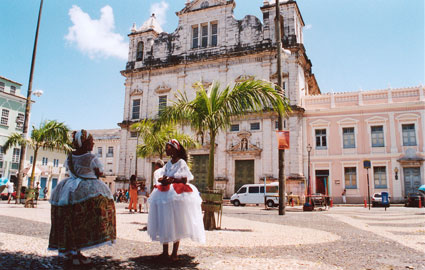
Historic centre of Brazil and former Jesuit church of Salvador (17th century), now cathedral. (Photo: Vinicius Souza and Maria Eugênia Sá)
Slavery was officially abolished more than a century ago, but there has never been a social inclusion policy for Brazil’s blacks. Therefore, prejudice and racism are still a problem in this nation that will have more blacks than whites until the end of 2008.
2008 is a year of important celebrations in Brazil. It is the 200th anniversary of the arrival of the Portuguese Royal Family escaping the troops of Napoleon Bonaparte and transforming the colony into the capital of the Empire. We are also celebrating, with parties, exhibitions and even a new TV channel, 100 years of Japanese immigration. In the middle of the festivities, the date of May 13th has almost passed unnoted, although it is the 120th anniversary of the Lei Áurea [Golden Law]. Signed by Princess Isabel in 1888, the law that officially abolished slavery in Brazil was the peak of a process driven by the republican movements and by the resistance of the black people that had already managed to prohibit slave trade and to impede children of black women to become slaves. The liberation, however, was not accompanied by any policy of repair, social inclusion or distribution of lands. Quite the contrary, the Republic that would be proclaimed in 1889 would concentrate its effort on immigration from Italy, Germany, Spain and, 20 years later, Japan. Although the blacks are the core from which arise Brazilian identity, music and culture, the blacks, indigenous peoples and their descendents have never been considered for a project of a nation.
"Unfortunately, in Brazil, it is still taught that the abolition of slavery was a ‘generous act’ of Princess Isabel and nothing is spoken of the economic pressure on the part of England and of the revolts of the blacks that escaped and created independent cities, the so-called ‘Quilombos’", says Dennis de Oliveira, member of the NEINB – Center for Interdisciplinary Studies of the Brazilian Blacks. The most important of all was the Quilombo dos Palmares that resisted for 100 years. And it’s the most important leader was Zumbi, of which anniversary of death on November 20, 1695, would represent the true date to be remembered by the Blacks. With the election of President Lula, the longstanding claim for a new national date for the acknowledgment and creation of awareness among the population concerning the question of racism has been appraised better. Thus, in 2003 Law 10.639/03 was enacted that established November 20 as "Black Conscience Day". Today more than 260 cities in Brazil have already instituted the day as holiday. "It is the only official holiday proposed by a social movement and it is a victory of the Unified Black Movement ("Movimento Negro Unificado") and of other entities that fight against racism and for social equality", says Oliveira.
"The blacks were never slaves, they were slaved, and until today fights for a factual abolition of slavery", defines Sinvaldo José Firmo, member of the Human Rights Commission of the Brazilian Bar Association. "Such abolition has not yet been completed because on May 14, 1888 differentiated policies were established for blacks and for immigrants, whereby the immigrants received support, financial aid and lands that had always been denied to the old slaves". According to both, the Brazilian governments invested in a succumbed population "whitening" policy. The evidence is a study of the Applied Economic Research Institute – IPEA, published May 13 of this year, showing that until the end of the year the population slice that defines itself as black or brown will overtake the white population. In 1976, the whites represented 57.2% of the population, blacks and brown 40.1% and yellows and indigenous less than 3%. Thirty years later, the percentage of whites fell to 49.7%, and the one of the blacks rose to 49.5% and the percentage of yellows and indigenous does not reach 1%. Also according to the study, in 2010 the blacks will be absolute majority of the population.
Clink on link below to read the full article


No comments:
Post a Comment