The art of Kevin Blythe Sampson

THE ART OF
KEVIN BLYTHE SAMPSON

1/31/10

What Not To Wear To Ghetto Prom 2009: New, But Unimproved!!! (Part 1)


2009 June 4

tags: Black Culture, Black Teen, crunk, Diva, Fashion Advice, ghetto, Ghetto Around The Globe, ghetto fashion, ghetto humor, ghetto mom, ghetto prom, ghetto prom dress, ghetto prom family, ghettofabulous, OMG, prom, random, rants, Style, Tacky People, Trashy Fashion, Urban Humor, urban style, WTF

by seriouslymcmillan

banook

I really do search out these photos and hope that I don’tcome up with any new ones.

Just then, I find them.  I shake my head and just wonder, “WT…..?”

Can’t wait to share my latest album of  “Ghetto Prom 2009″

Its a creative dress, but its not fitting so well.

Religion Journal - Black Priest in a White Town Sees Several Paths to Understanding - NYTimes.com

Black Priest Shares Past, Enlightening White Town

Mark Schiefelbein for The New York Times

By founding a black history museum and telling his own story, the Rev. Moses Berry has tried to remind people of part of southwest Missouri’s past.

Exploded! Photographer Dissects Objects « Wonderment Blog

Texas based photographer Adam Voorhes takes four objects (telephone, frog, gun, etch-a-sketch) and dissects them for his photo essay entitled Exploded. The frog in particular looks like an illustration, but is indeed a photograph.

Voorhes explains his process (via It's Nice That):

Military Technology Used to Create Video Game Drone « Wonderment Blog

An iPhone-controlled drone unveiled at the recently held CES is expected to revolutionize the world of video gaming. Called the AR.Drone (AR stands for augmented reality), this new product will literally bring video games to the streets.

Via Daily Mail,

Clothes and mens and ladies fashions in the 1940's prices and examples

Pre-War and Post-War 1940s Fashion Trends

A shift in dress happened from during WWII to after the war ended. The styles of this time signified the darkness of this particular time in history.

One of the most significant examples of wartime fashion are the uniforms worn by military members and their brides. The groom would usually wear his service uniform and the bride would wear something that today’s time would consider a simple office skirt suit.

Fashion Attitudes During Wartime

Before the war, frivolous and glamorous style was out. Additionally, clothing rations limited the types of materials available for making and/or obtaining clothes.

For instance, there was only a limited supply of wool during this time, starting in 1942. Instead, artificial fibers such as viscose and rayon were used. These materials were derived from wood pulp.

The colors of clothing during this time were of plain and solemn colors. Most outfits were of a solid color such as ivory (for women’s wedding suits), black, navy, or other dark colors.

Otto Preminger

Otto Preminger
b. December 5, 1905, Vienna, Austria.
d. April 23, 1986, New York, USA.

by Chris Fujiwara


Chris Fujiwara, the author of Jacques Tourneur: The Cinema of Nightfall (Johns Hopkins University Press), writes on film for The Boston Phoenix, The Boston Globe, The Criterion Collection, et al. He is based in Boston, Massachusetts. His home page contains links to his online writing on film
Otto Preminger

Otto Preminger was born in 1905 (not 1906, as usually reported), the son of a prosecutor for the Austrian Empire. Otto studied law but wanted to become an actor, and at 17 joined the company of Max Reinhardt. He rose quickly to director, was chosen to take over Reinhardt's theater on the latter's retirement, and was offered, at age 27, the post of the head of the State Theatre in Vienna. He turned it down on learning that a condition of assuming the post was conversion to Catholicism (the Premingers were Jewish, although Otto was not religious).

Film History of the 1950s

The Dawning of the 50s:

The 50s decade was known for many things: post-war affluence and increased choice of leisure time activities, conformity, the Korean War, middle-class values, the rise of modern jazz, the rise of 'fast food' restaurants and drive-ins (Jack in the Box - founded in 1951; McDonalds - first franchised in 1955 in Des Plaines, IL; and A&W Root Beer Company - formed in 1950, although it had already established over 450 drive-ins throughout the country), a baby boom, the all-electric home as the ideal, white racist terrorism in the South, the advent of television and TV dinners, abstract art, the first credit card (Diners Club, in 1951), the rise of drive-in theaters to a peak number in the late 50s with over 4,000 outdoor screens (where young teenaged couples could find privacy in their hot-rods), and a youth reaction to middle-aged cinema. Older viewers were prone to stay at home and watch television (about 10.5 million US homes had a TV set in 1950).

Vintage Fashion History - 1950's Weddings

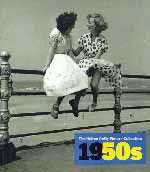
The 1950s will be a decade forever linked to the advent of television, the American baby boom and the culture of the middle class suburb. This affected women in a profound way. The end of World War II created a nesting period that is unparalleled in the 20th century and weddings were the conduit. American society pushed ahead with an era of new conservatism and some say that if you weren't married by the age of 27 years, well, good luck to you "old maid."

Encouraged by the G.I. Bill, many newlyweds had moved out of the city and into affordable suburban housing. Women who had worked during the War saw their jobs eliminated once the men returned. 1946 magazine advertisements showed a model woman as a perky housewife who could manage a happy husband and home without complaint. Women were bombarded with images and articles of domesticity. One magazine even went so far as to suggest vacuuming while wearing spike heels and pearls, "just in case your Husband comes home." Soon the culture of the middle class suburb exploded into a preferred lifestyle, enabling the baby boom and nearly eliminating women's rights.

Butterick Costume Patterns 1940-45 McCalls Dressmaking

For superb Victorian or Edwardian
re-enactment costumes in USA, try the reproduction costume range at:
Recollections for Victorian and Edwardian costumes recollections.biz


Lingerie, Sexy Lingerie, Plus Size Lingerie
Lingerie and Underwear
Lingerie, Plus Size Lingerie
Butterick Costume Patterns 1940-45

Butterick and McCall Costume Patterns
Dressmaking Fashion Pictures 1940-45

By Pauline Weston Thomas for Fashion-Era.com


Butterick and McCall Costume Patterns 1940-45

.

Butterick and McCall 1940s Magazines

Early 1940-1945 McCall and Butterick Magazine Pattern Covers

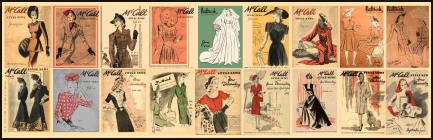
These fashion pictures are a selection of McCall and Butterick Magazine Pattern Cover images from the World War II era 1940-1945.

Film History of the 1940s

Hollywood During the War Years:

The early years of the 40s decade were not promising for the American film industry, especially following the late 1941 attack on Pearl Harbor by the Japanese, and the resultant loss of foreign markets. However, Hollywood film production rebounded and reached its profitable peak of efficiency during the years 1943 to 1946 - a full decade and more after the rise of sound film production, now that the technical challenges of the early 30s sound era were far behind. Advances in film technology (sound recording, lighting, special effects, cinematography and use of color) meant that films were more watchable and 'modern'. Following the end of the war, Hollywood's most profitable year in the decade was 1946, with all-time highs recorded for theatre attendance.

Dorothy Dandridge - Wikipedia, the free encyclopedia

Dorothy Dandridge

From Wikipedia, the free encyclopedia

Jump to: navigation, search
Dorothy Dandridge

from The Decks Ran Red (1958)
Born Dorothy Jean Dandridge
November 9, 1922(1922-11-09)
Cleveland, Ohio, U.S.
Died September 8, 1965 (aged 42)
West Hollywood, California, U.S.
Occupation Actress/Singer
Years active 1935–1961
Spouse(s) Harold Nicholas (m. 1942–1951) «start: (1942)–end+1: (1952)»"Marriage: Harold Nicholas to Dorothy Dandridge" Location: (linkback:http://en.wikipedia.org/wiki/Dorothy_Dandridge)
Jack Denison (m. 1929–1962) «start: (1929)–end+1: (1963)»"Marriage: Jack Denison to Dorothy Dandridge" Location: (linkback:http://en.wikipedia.org/wiki/Dorothy_Dandridge)

Dorothy Jean Dandridge (November 9, 1922 – September 8, 1965) was an American actress and popular singer, and was the first African American to be nominated for an Academy Award for Best Actress.[1]

She performed as a vocalist in venues such as the Cotton Club and the Apollo Theater. In 1954, she was nominated for an Academy Award for Best Actress and a BAFTA Award for Best Actress in a Leading Role for Carmen Jones, and, in 1959, was nominated for a Golden Globe Award for Best Actress in a Motion Picture Musical or Comedy for Porgy and Bess. In 1999, she was the subject of the HBO biopic Introducing Dorothy Dandridge. She has been recognized on the Hollywood Walk of Fame.

Dandridge was married and divorced twice, first to dancer and entertainer Harold Nicholas (the father of her daughter, Harolyn Suzanne) and then to Jack Denison. Dandridge died of an accidental drug overdose.

Contents

1/30/10

José Clemente Orozco - Orozco: Man of Fire | American Masters | PBS

The life of Mexican muralist José Clemente Orozco (1883-1949), a life filled with drama, adversity, and triumph, is one of the great stories of the modern era. Despite poverty, childhood rheumatic fever that damaged his heart and an explosion in his youth that cost him his left hand, Orozco persisted in his wish to become an artist. He experienced the carnage and duplicity of the Mexican Revolution, the hardship following the New York stock market crash in 1929, and rising fascism in Europe during his only trip there in 1932, and emerged with an aesthetic and moral vision unparalleled in twentieth century painting.

Alfred Hitchcock - About Alfred Hitchcock | American Masters | PBS

Alfred Hitchcock
About Alfred Hitchcock

On December 10, 1938, David O. Selznick burned down Atlanta. On the back of his Culver City studio, Selznick had begun filming what would be his and Hollywood’s greatest triumph, GONE WITH THE WIND. Selznick was just thirty-six years old and already a legend. He had run a major studio before the age of thirty and created his own studio by the time he was thirty-three. With a harsh and controlling demeanor, he dominated every film he made. In a town of Mayers, Zanucks, and Goldwyns, David Selznick was king. But one of his most lasting contributions would have nothing to do with his grand, southern epic. Instead, it would be bringing to America a rotund, quiet director who was the shining star of British cinema. In the summer of 1939, David Selznick brought Alfred Hitchcock to Hollywood.

James Baldwin - About the Author | American Masters | PBS

James Baldwin
About the Author

Although he spent a great deal of his life abroad, James Baldwin always remained a quintessentially American writer. Whether he was working in Paris or Istanbul, he never ceased to reflect on his experience as a black man in white America. In numerous essays, novels, plays, and public speeches, the eloquent voice of James Baldwin spoke of the pain and struggle of black Americans and the saving power of brotherhood.

James Baldwin was born in Harlem in 1924. The oldest of nine children, he grew up in poverty, developing a troubled relationship with his strict, religious father. As a child, he cast about for a way to escape his circumstances. As he recalls, “I knew I was black, of course, but I also knew I was smart. I didn’t know how I would use my mind, or even if I could, but that was the only thing I had to use.” By the time he was fourteen, Baldwin was spending much of his time in libraries and had found his passion for writing.

D.W. Griffith - About D.W. Griffith | American Masters | PBS

D.W. Griffith
About D.W. Griffith

“To watch his work is like being witness to the beginning of melody, or the first conscious use of the lever or the wheel; the emergence, coordination, and first eloquence of language; the birth of an art: and to realize that this is all the work of one man.” – James Agee

Lillian Gish called him “the father of film” and Charlie Chaplin called him “the teacher of us all.” At the pinnacle of his worldwide prominence, D.W. Griffith screened his films for the urban working-class as well as for presidents at the White House. Griffith’s films became part of history in the making—unleashing the power of movies as a catalyst for social change. More than anyone of the silent era, he saw film’s potential as an expressive medium, and exploited that potential.

The Birth of a Nation (1915) - Trivia

  • Director D.W. Griffith visualized the whole film in his mind and did not write out a script or keep written notes.

  • Premiered in Los Angeles with the title "The Clansman", after the novel on which it was based.

  • Some of the black characters are played by white actors with make-up, particularly those characters who were required to come in contact with a white actress. The person playing the Cameron's maid is not only clearly white, but is also obviously male.

What Do iPads, Teabaggers, and 'Beavis and Butthead' Have in Common? -- Politics Daily

What Do iPads, Teabaggers, and 'Beavis and Butthead' Have in Common?


I'm already weary from the pushback about the name Apple gave its latest techtoy.
If you're just back from a visit to Uranus, the new computer tablet is called the iPad. From pretty much the moment that Steve Jobs revealed the name Wednesday morning, the jokes started. A few of them are funny:
Get the new
PD toolbar!

"I'm waiting for the version with wings."

New Counterterrorist Teams To Seek Out Plots -- Politics Daily

The nation's counterterrorism agency is hiring dozens of intelligence analysts to staff new teams of specialists charged with seeking out emerging terrorist plots, it was reported Friday.

The staff build-up at the National Counterterrorism Center comes in response to the failings of several federal agencies before the attempted Christmas Day bombing of a U.S. airliner by a Nigerian man with explosives sewn into his underwear, according to
The New York Times.

The center's director, Michael Leiter, told the House Homeland Security Committee this week that the new so-called "pursuit teams" will focus on threats from countries in the Middle East, Asia, and Africa where al-Qaeda has a foothold.

"We've been very good at chasing down those threats that come out of Afghanistan and Pakistan," Leiter said. "We're going to be better now at chasing down those small bits of information that come out of Yemen or North Africa or East Africa."

Salinger's Final Mystery - The Daily Beast

Salinger's Final Mystery


BS Top - Rich Salinger AP Photo Novelist Nathaniel Rich mourns the loss of a literary hero—and fantasizes about the books that Salinger was possibly writing all of these years.

It is a peculiar, half-hearted thing to mourn the death of an author who has been dead to the world for nearly half a century. My mourning period didn’t begin on Thursday, but in July 1994, when I was 14, as soon as I finished Catcher in the Rye. It was renewed the next year when, reading Nine Stories, I had a strange sensation of recognition: I knew these stories already. My middle school baseball coach, on bus rides to games, would tell the team disturbing stories about the disfigured Laughing Man and about a young boy who recalls a previous life in India. These were childhood myths; not until Nine Stories did I realize they’d been written by a writer who, rumor had it, was still alive.

This very moment a giant U-Haul truck, filled with paper, may be trundling down I-95 toward the offices of The New Yorker, or Harold Ober Associates, or Little, Brown.

The Fall of Harrison Ford - Page 1 - The Daily Beast

The Fall of Harrison Ford


BS Top - Rushfield Harrison Ford Everett Collection The actor who could once carry an entire franchise now has yet another box office bomb in Extraordinary Measures. Richard Rushfield on the downward spiral of Ford's career.

Throughout the ‘80s and ‘90s, Harrison Ford reigned as the unchallenged star of middle-of-the-road cinema. Almost unique in modern history, he not only created two iconic characters—Han Solo and Indiana Jones—but also managed to step away from them, into a hugely successful leading-man career in movies such as Working Girl, Patriot Games, and The Fugitive, to name a few. He excelled in grownup action roles, respectably above the pyrotechnic-driven thrills of Stallone and Schwarzenegger—but he was also able to charm as a romantic lead.

As one-note as Ford’s performances were, audiences seemed never to tire of that note. Until one day, they did

John Edwards' Sugar Mama - Page 1 - The Daily Beast

John Edwards' Sugar Mama


John Edwards, Bunny Mellon Reuters; Corbis Meet Bunny Mellon, the 99-year-old heiress who helped fund Edwards' presidential run—and apparently his extra-marital exploits as well.

You’d assume Rachel Lowe Lambert Lloyd Mellon—who, just shy of 100 years old, is probably the last surviving member of the old-money aristocracy that once lorded it over America—would be mortified by her involvement in a tabloid-ready sex scandal.

Hardly.

1/29/10

Genealogy.com: What is a First Cousin, Twice Removed?

What is a First Cousin, Twice Removed?

by Genealogy.com
Print this article
Printer-friendly version
Figuring Out Family Relationships
At Genealogy.com, we get asked about how to determine relationships all the time. Here, you'll learn how to figure out the relationships between family members using a simple chart.

If someone walked up to you and said "Howdy, I'm your third cousin, twice removed," would you have any idea what they meant? Most people have a good understanding of basic relationship words such as "mother," "father," "aunt," "uncle," "brother," and "sister." But what about the relationship terms that we don't use in everyday speech? Terms like "second cousin" and "first cousin, once removed"? We don't tend to speak about our relationships in such exact terms ("cousin" seems good enough when you are introducing one person to another), so most of us aren't familiar with what these words mean.

Obama related to Pitt, Clinton to Jolie - Decision '08- msnbc.com

Obama related to Pitt, Clinton to Jolie

Researchers find remarkable family connections for the candidates

Image: Angelina Jolie and Brad Pitt.
Frazer Harrison / Getty Images
Brad Pitt and Angelina Jolie arrive at the Screen Actors Guild awards on Jan. 27 in Los Angeles.

Genealogist: Obama and Massachusetts Sen.-elect Scott Brown related | D.C. Now | Los Angeles Times

Click here to find out more!

D.C. Now

News from Washington, minute by minute


Genealogist: Obama and Massachusetts Sen.-elect Scott Brown related

January 29, 2010 | 9:37 am

Never mind Brad Pitt or Warren Buffett.

President Obama has found another long-lost cousin: Scott Brown, the Republican state senator from Massachusetts who won the Senate seat long held by the late Sen. Edward M. Kennedy.

The president and the senator-elect from Massachusetts are 10th cousins, according to the New England Historic Genealogical Society.

Experts there report that Obama's mother, Stanley Ann Dunham, and Brown's mother, Judith Ann Rugg, both descended from Richard Singletary of Haverhill, Mass. He died in 1687 at 102.

Why Jonathan Demme loves Haiti – amFIX - CNN.com Blogs

Dirty hotels gross out travelers

By A. Pawlowski, CNN
January 29, 2010 9:41 a.m. EST
Unpleasant hotel rooms send some travelers packing.
STORY HIGHLIGHTS
  • California establishment tops list of what TripAdvisor.com calls the country's dirtiest hotels
  • Experts: They survive because of low rates, locations that don't require repeat business
  • It's up to each hotel to decide how it handles many cleanliness matters
  • The large majority of hotels do a good job, hospitality management professor says
RELATED TOPICS

(CNN) -- By the time Debbiie White spotted some uninvited guests of the insect kind in her hotel room, she had already had enough.

Earlier, the Sunnyvale, California, resident had found a dirty wash rag in the bathroom and a takeout container with old food in the microwave.

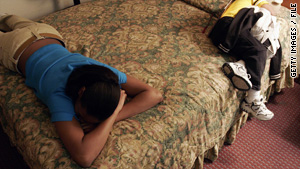
The room was filthy and the sheets creeped her out, White said, so she, her husband and their 10-year old niece slept on their own blankets.

Dirty hotels gross out travelers - CNN.com

Dirty hotels gross out travelers

By A. Pawlowski, CNN
January 29, 2010 9:41 a.m. EST
Unpleasant hotel rooms send some travelers packing.
STORY HIGHLIGHTS
  • California establishment tops list of what TripAdvisor.com calls the country's dirtiest hotels
  • Experts: They survive because of low rates, locations that don't require repeat business
  • It's up to each hotel to decide how it handles many cleanliness matters
  • The large majority of hotels do a good job, hospitality management professor says
RELATED TOPICS

(CNN) -- By the time Debbiie White spotted some uninvited guests of the insect kind in her hotel room, she had already had enough.

Earlier, the Sunnyvale, California, resident had found a dirty wash rag in the bathroom and a takeout container with old food in the microwave.

The room was filthy and the sheets creeped her out, White said, so she, her husband and their 10-year old niece slept on their own blankets.

1/28/10

On Washington - Clinton Turned Right in ’96 Speech, While Obama Plowed Ahead - NYTimes.com

On Washington

Where Clinton Turned Right, Obama Plowed Ahead

Doug Mills/The New York Times

President Obama walked to the Oval Office on Wednesday afternoon.

Published: January 28, 2010

WASHINGTON — When President Bill Clinton faced a Republican uprising and a nation that turned deeply skeptical about his agenda, he used the 1996 State of the Union address to declare that “the era of big government is over.”

Skip to next paragraph

Blog

The Caucus
The Caucus

The latest on President Obama, his administration and other news from Washington and around the nation. Join the discussion.

That move to the middle — arguably more rhetoric than reality — stopped Newt Gingrich’s Republican Revolution in its tracks. So why did President Barack Obama go a different route on Wednesday night, giving little

Museum Cafes Morph Into Fine Dining Establishments - NYTimes.com

After the Putti, the Baby Calamari

Marilynn K. Yee/The New York Times

The Guggenheim's new restaurant, the Wright, with its expandable wall sculpture by Liam Gillick.

Published: January 28, 2010

WHO doesn’t have childhood memories of field trips to the museum? After a morning of being guided through the paintings and sculptures of the great masters, everyone would head for the basement cafeteria, where you would stand in line, plastic trays in hand, waiting to be treated to a lunch of rubbery chicken and gooey tapioca pudding. Those days are gone, or at least numbered. Increasingly museums are moving away from the middle-school approach to feeding visitors, with its emphasis on a lowest-common-denominator menu, in favor of stylish restaurants that offer fine dining to go with the fine art.

Skip to next paragraph

Related

Times Topics: Danny Meyer

Blog

ArtsBeat
ArtsBeat

The latest on the arts, coverage of live events, critical reviews, multimedia extravaganzas and much more. Join the discussion.

Chester Higgins Jr./The New York Times

Robert, the new restaurant at the Museum of Arts and Design, at 2 Columbus Circle.

Readers' Comments

Share your thoughts.

Last month sleek new restaurants with sophisticated menus opened in the Solomon R. Guggenheim Museum and the Museum of Arts and Design. The Whitney Museum of American Art has just announced plans to open a new cafe during the second half of this year, to be run by the celebrated restaurateur Danny Meyer, and at least two other smaller art museums in Manhattan are in negotiations to install restaurants or cafes.

The trend, though strong locally, is by no means confined to New York City. In recent years, Wolfgang Puck has partnered in museum restaurants in Boston, Chicago, Los Angeles, Minneapolis and Washington, and other high-end dining rooms have opened recently in museums in cities including Toronto and Atlanta.

“More and more over the past five years that is what museums, libraries and even botanical gardens have been demanding,” said Dick Cattani, the chief executive officer of Restaurant Associates, which operates both the Wright, the new restaurant at the Guggenheim, and a cafe that opened in May off the American wing at the Metropolitan Museum of Art. “Our company has been doing this since the 1960s, and the tendency is definitely away from the quick serve of the old days and toward fine dining.”

A variety of factors seems to be behind the shift. One is simple economics: with the Great Recession now in its second year and donations from corporations and wealthy board members becoming harder to obtain, museums, especially those that committed to ambitious expansion plans before the downturn, are eager to tap into new sources of income.

“We built a new museum, just to open during the crisis,” said Holly Hotchner, director of the Museum of Arts and Design, which moved into the renovated 2 Columbus Circle in the fall of 2008. “When we conceived of doubling our budget, earned income became really important, and that was even before the recession. We had to find another $5 million, and our donors are stretched to give what they give. So creative revenue sources, new ways to find income, have become very important.”

But museum officials also talk about “enhancing the museum experience” so as not to lose ground to other forms of entertainment. Visitors are both more discerning and demanding than they used to be, and many want, or even expect, a memorable meal to round off their day. And they don’t want to have to leave the building to find it.

“Given that people spend so much time here, having a dining experience comparable to the facility itself, whether formal or more casual, was important to us,” said James Gara, the chief operating officer of the Museum of Modern Art, which has offered three eating establishments in its building since 2004, when it completed its renovation. “To have just a concessionaire wasn’t up to the standards of what we were aiming for. We wanted to offer our membership and visitors something on a level with the rest of the museum.”

For restaurateurs the benefits are even more obvious. For one thing, the typical contract to operate a restaurant in a museum is accompanied by exclusive catering rights at museum events. That can be quite lucrative in its own right and also introduces the food provider to trustees, donors and other wealthy people who might want to use the caterer’s services at parties and receptions.

Then there is the lure of what amounts to a very large captive audience: MoMA, for example, attracts more than 2.7 million visitors each year. Then there is the prestige factor that comes with being associated with a major arts institution.

“A museum is an exciting facility, with high standards and benchmarks, and it gives a company a very high profile and visibility,” said Mr. Cattani, whose company operates all the food establishments at the Met, including its afternoon tea. “If you can succeed in that environment, that offers you entree to other opportunities. And museums are here to stay, so contracts are typically long term, and that brings some stability in your business.”

But installing and running a restaurant in a museum requires a balancing act on both sides. For starters there are logistical questions, like where to put a kitchen so that visitors can’t smell cooking odors and so that the artwork is in no way affected.

“This was a totally foreign area for me, and there were all these things that no one else here had any background in,” said Ms. Hotchner of the Museum of Arts and Design, whose new restaurant, Robert, is operated by the restaurateur Michael Weinstein’s Ark group. “I knew nothing about restaurant law. And dealing with a grease trap from the ninth floor to the basement?”

Beyond that, there are the larger aesthetic issues central to a museum’s mission and image. For the restaurant operator the principal challenge is to blend in and not overwhelm a museum’s distinctive look and style with a design that clashes or contradicts.

“We’re in a Breuer building that is a great piece of architecture, so we have to have to respect the quality and distinctiveness of that,” said Adam Weinberg, director of the Whitney, where the new cafe is now being designed. “Whatever we do can’t fight against that, but it can’t totally acquiesce to it either, because we’re not looking for a period piece. It’s a fine balance between being deferential, but not slavish.”

Advertisements

Ads by Google what's this?