4/30/09

People & Events John Brown 1800 - 1859


People & Events
John Brown
1800 - 1859
Resource Bank Contents

John Brown


John Brown was a man of action -- a man who would not be deterred from his mission of abolishing slavery. On October 16, 1859, he led 21 men on a raid of the federal arsenal at Harpers Ferry, Virginia. His plan to arm slaves with the weapons he and his men seized from the arsenal was thwarted, however, by local farmers, militiamen, and Marines led by Robert E. Lee. Within 36 hours of the attack, most of Brown's men had been killed or captured.
John Brown was born into a deeply religious family in Torrington, Connecticut, in 1800. Led by a father who was vehemently opposed to slavery, the family moved to northern Ohio when John was five, to a district that would become known for its antislavery views.
During his first fifty years, Brown moved about the country, settling in Ohio, Pennsylvania, Massachusetts, and New York, and taking along his ever-growing family. (He would father twenty children.) Working at various times as a farmer, wool merchant, tanner, and land speculator, he never was finacially successful -- he even filed for bankruptcy when in his forties. His lack of funds, however, did not keep him from supporting causes he believed in. He helped finance the publication of David Walker's Appeal and Henry Highland's "Call to Rebellion" speech. He gave land to fugitive slaves. He and his wife agreed to raise a black youth as one of their own. He also participated in the Underground Railroad and, in 1851, helped establish the League of Gileadites, an organization that worked to protect escaped slaves from slave catchers.
In 1847 Frederick Douglass met Brown for the first time in Springfield, Massachusetts. Of the meeting Douglass stated that, "though a white gentleman, [Brown] is in sympathy a black man, and as deeply interested in our cause, as though his own soul had been pierced with the iron of slavery." It was at this meeting that Brown first outlined his plan to Douglass to lead a war to free slaves.
Brown moved to the black community of North Elba, New York, in 1849. The community had been established thanks to the philanthropy of Gerrit Smith, who donated tracts of at least 50 acres to black families willing to clear and farm the land. Brown, knowing that many of the families were finding life in this isolated area difficult, offered to establish his own farm there as well, in order to lead the blacks by his example and to act as a "kind father to them."
Despite his contributions to the antislavery cause, Brown did not emerge as a figure of major significance until 1855 after he followed five of his sons to the Kansas territory. There, he became the leader of antislavery guerillas and fought a proslavery attack against the antislavery town of Lawrence. The following year, in retribution for another attack, Brown went to a proslavery town and brutally killed five of its settlers. Brown and his sons would continue to fight in the territory and in Missouri for the rest of the year.
Brown returned to the east and began to think more seriously about his plan for a war in Virginia against slavery. He sought money to fund an "army" he would lead. On October 16, 1859, he set his plan to action when he and 21 other men -- 5 blacks and 16 whites -- raided the federal arsenal at Harpers Ferry.
Brown was wounded and quickly captured, and moved to Charlestown, Virginia, where he was tried and convicted of treason, Before hearing his sentence, Brown was allowed make an address to the court.


. . . I believe to have interfered as I have done, . . . in behalf of His despised poor, was not wrong, but right. Now, if it be deemed necessary that I should forfeit my life for the furtherance of the ends of justice, and mingle my blood further with the blood of my children, and with the blood of millions in this slave country whose rights are disregarded by wicked, cruel, and unjust enactments, I submit: so let it be done."

Although initially shocked by Brown's exploits, many Northerners began to speak favorably of the militant abolitionist. "He did not recognize unjust human laws, but resisted them as he was bid. . . .," said Henry David Thoreau in an address to the citizens of Concord, Massachusetts. "No man in America has ever stood up so persistently and effectively for the dignity of human nature. . . ."
John Brown was hanged on December 2, 1859.


WGBH | PBS Online | ©

Mother Jones (1837–1930)

Mother Jones (1837–1930)

Typically clad in a black dress, her face framed by a lace collar and black hat, the barely five-foot tall Mother Jones was a fearless fighter for workers’ rights—once labeled "the most dangerous woman in America" by a U.S. district attorney. Mary Harris "Mother" Jones rose to prominence as a fiery orator and fearless organizer for the Mine Workers during the first two decades of the 20th century. Her voice had great carrying power. Her energy and passion inspired men half her age into action and compelled their wives and daughters to join in the struggle. If that didn’t work, she would embarrass men to action.  "I have been in jail more than once and I expect to go again. If you are too cowardly to fight, I will fight," she told them.

Photo Credit: The George Meany Memorial Archives

Mother Jones

Mother Jones’ organizing methods were unique for her time. She welcomed African American workers and involved women and children in strikes. She organized miners’ wives into teams armed with mops and brooms to guard the mines against scabs. She staged parades with children carrying signs that read, "We Want to Go to School and Not to the Mines."

Early Years
Born Mary Harris in 1837 in Cork, Ireland, the woman who would become Mother Jones immigrated to North America with her family as a child to escape the Irish famine. She spent her early years in Canada and trained to be a dressmaker and teacher.

In her early 20s, she moved to Chicago, where she worked as a dressmaker, and then to Memphis, Tenn., where she met and married George Jones, a skilled iron molder and staunch unionist. The couple had four children when tragedy struck: A yellow fever epidemic in 1867, which killed hundreds of people, took the lives of Mary’s husband and all four children.

Mary moved back to Chicago and returned to commercial dressmaking. She opened her own shop, patronized by some of the wealthiest women in town. According to one account of her life, Mary’s interest in the union movement grew when she sewed for wealthy Chicago families. "I would look out of the plate glass windows and see the poor, shivering wretches, jobless and hungry, walking alongside the frozen lake front," she said. "The tropical contrast of their condition with that of the tropical comfort of the people for whom I sewed was painful to me. My employers seemed neither to notice nor to care."

Tragedy struck Mary again when she lost everything in the Great Chicago Fire of 1871. After the fire, Mary began to travel across the country. The nation was undergoing dramatic change, and industrialization was changing the nature of work. She moved from town to town in support of workers’ struggles. In Kansas City, she did advance work for a group of unemployed men who marched on Washington, D.C. to demand jobs. In Birmingham, Ala., she helped black and white miners during a nationwide coal strike. Mary organized a massive show of support for Eugene Debs, the leader of the American Railway Union, after he served a six-month prison sentence for defying a court order not to disrupt railroad traffic in support of striking Pullman workers.

A Mother to Millions of Working Men and Women
In June 1897, after Mary addressed the railway union convention, she began to be referred to as "Mother" by the men of the union. The name stuck. That summer, when the 9,000-member Mine Workers called a nationwide strike of bituminous (soft coal) miners and tens of thousands of miners laid down their tools, Mary arrived in Pittsburgh to assist them. She became "Mother Jones" to millions of working men and women across the country for her efforts on behalf of the miners.

Mother Jones was so effective the Mine Workers sent her into the coalfields to sign up miners with the union. She agitated in the anthracite fields of eastern Pennsylvania, the company towns of West Virginia and the harsh coal camps of Colorado. Nearly anywhere coal miners, textile workers or steelworkers were fighting to organize a union, Mother Jones was there.  

She was banished from more towns and was held incommunicado in more jails in more states than any other union leader of the time. In 1912, she was even charged with a capital offense by a military tribunal in West Virginia and held under house arrest for weeks until popular outrage and national attention forced the governor to release her.

Mother Jones was deeply affected by the "machine-gun massacre" in Ludlow, Colo., when National Guardsmen raided a tent colony of striking miners and their families, killing 20 people—mostly women and children. She traveled across the country, telling the story, and testified before the U.S. Congress.  

In addition to miners, Mother Jones also was very concerned about child workers. During a silk strike in Philadelphia, 100,000 workers—including 16,000 children—left their jobs over a demand that their workweek be cut from 60 to 55 hours. To attract attention to the cause of abolishing child labor, in 1903, she led a children’s march of 100 children from the textile mills of Philadelphia to New York City "to show the New York millionaires our grievances." She led the children all the way to President Theodore Roosevelt’s Long Island home.

In her 80s, Mother Jones settled down near Washington, D.C., in 1921 but continued to travel across the country. In 1924, although unable to hold a pen between her fingers, she made her last strike appearance in Chicago in support of striking dressmakers, hundreds of whom were arrested and black-listed during their ill-fated four month-long struggle. She died at the age of 94 in Silver Spring, Md., and was buried in the Union Miners Cemetery in Mount Olive, Ill.

Sources
Collins, Gail. America’s Women, 2003, p. 287-289; The Illinois Labor History Society, www.kentlaw.edu/ilhs/majones.htm; photo from George Meany Memorial Archives.


Copyright © 2009 AFL-CIO | American Federation of Labor - Congress of Industrial Organizations
Contact Us | Union Jobs | Privacy Policy | Site Map

Republicans are dead with my babble then a post “the off brand Presidency

Kevin says……
 

I said it once I will say it again. The Republican Party as we know it is dead. It's a corpse, populated by old white men with dead ideas.

It is so dead that they have resurrected Cheney, Rove, and newt, what the hell is up with that. They look to Dick Cheney who I still think just might be the precursor to the anti Christ. We he any good at evil. He isn't as the Iraq war showed us.

And reaganomist is so silly that I can even start to describe the silliness of following a senile possible altzimers ridden president. Who wasn't that bright in the first place.

I mean he used to tell his staff that he wanted some thing done, and them they would try to figure out how to do it.

Doesn't any one read, this guy was out of it? You had not much government involvement because your president was semi stupid.

DO republicans even read……………..

And this same government this is a class thing an ownership thing a plantation thing.

What does that mean; it means we should allow states to make their own decisions

Meaning that some states might just reinstitute slavery

Where would people of color be without government?

What would have happened without the voting rights act?

Or troop intervention during the civil rights movement

Where would MLK have been with out the troops?

Republicans are simply selfish business folks, who use the working class slobs and small business owners to supplement their pillage of the country and its money.

Republicans can't figure out Obama because they can't figure out their selves

They have been co-opted by the Christian right, who wants to follow people who don't believe in birth control or evolution.

Sarah Palin, that house fray needs to crawl back into her igloo and make some more elk chili

What an embarrassment

This party ………………is done…………and it's about time

p>

april 29, 2009, 10:08 pm

The Off-Brand Presidency

He campaigned for activist government, a less confrontational foreign policy, a business-friendly way to a green revolution. A liberal. Or, to use the term favored by those who are afraid of the lingering toxicity of that word – a progressive.

As president, he sent truckloads of money to the rescue of a sick economy, gave most working people the biggest tax cut of their lives and told a foreign audience that his country's occasional arrogance was no excuse for reflexive anti-Americanism.

President Barack Obama is making it safe to be a liberal again – and showing how meaningless such labels can be. His first lap reveals not so much about him as it does the country he governs: a nation willing to follow a man whose policies they may not fully believe in.

He is as advertised. We are not.

When asked to pick a political label, barely one in five voters called themselves liberal in the 2008 election. Another 36 percent said they were moderate. And 38 percent self-identified as conservative. Those numbers are largely unchanged over the last two decades.

Given that makeup, the public might be expected to look harshly at a president who has all but nationalized the auto and banking industries, run up the national debt and shaken hands with a foreign leader reviled as a nuisance at best.

But there he is: with 68 percent job approval rating in the New York Times poll. This from an electorate with nearly half the voters saying Obama is more to the left than they are.

In other words, he's not fooling anyone. Nearly 60 percent in the NBC/Wall Street Journal Poll viewed him as "very or somewhat liberal." And, with a shrug and thumbs up, they're cheering for the new guy.

"It's not like anybody should be surprised," Obama said in Wednesday's town hall meeting. "We're doing what we said we'd do."

Obama's broad support points to an old American character trait – pragmatism. It can tilt conservative or liberal, as resilient as the times.

We are said to be a center-right country. In truth, we lean to common sense. If that means tying up the banks in ropes of new regulation to keep them from running amok again, despite cries about restraining free enterprise, most people are for it. If that means firing hack public school teachers to the wails of the educational establishment, the public is there as well.

In a recent Pew Center poll, Americans were asked to describe Obama in a single word; the top of the list was "intelligent." Not black, which is what historians dwelled on. Not socialist, which is what the pickled cranks of the far right have called him.

In his 100th-day news conference, Obama had a bit of my-burden-is-great tone, while going out of his way to reject cartoon liberalism. "I don't want to run auto companies," he said. "I don't want to run banks. I've got two wars to run already."

He seemed genuinely humbled by his meetings with average servicemen and servicewomen, and empathetic to the moral qualms presented to any woman considering an abortion.

What we are seeing is a president, though arguably more liberal than anyone since Lyndon Johnson, who is hard to dismiss in the shorthand of our politics – the caricature branding of left or right.

Karl Rove insists that Obama is a more polarizing president than George W. Bush, pointing to yawning approval gap between Democrats and Republicans. Nobody knows how to wield a wedge like Rove, but he's wrong on this one.

The gap is there because the Republican Party has shrunk to a raisin of its former self, baking in the sun of the old Confederacy. A mere 21 percent of people called themselves Republicans in a Washington Post poll. The vast majority of the country – Democrats and independents – are with Obama, given his high marks by both groups.

Rove's side was not exactly in hiding. Their ideas were well-known, tried and "rejected by the American people in an historic election," Obama said Wednesday.

Those who speak for what is left of the Republican Party diminish their ranks every time they do. On Rove's advice, they killed stimulus money for fighting pandemics like swine flu. They still follow the post-bunker missives of Dick Cheney, who has as much credibility on competent governing as the Octomom has on birth control.

And now there is the exquisite irony that nearly half the Republicans in the only big state left in the Party of Lincoln – Texas – say they favor seceding from the Union. So much for America first.

No doubt, 38 percent of Americans are still conservative, as they've been for the last 20 years. But a good portion of them are no longer Republican.

They are parked, for now, in a lane of open-mindedness, along with the 75 percent of Americans who see Obama as a "strong leader." If their president also happens to be a liberal, they don't care – so long as he succeeds.

Praise the Lord……………… black women turned out at a higher rate than any other racial, ethnic and gender group.

May 1, 2009

No Racial Gap Seen in '08 Vote Turnout

By SAM ROBERTS

The long-standing gap between blacks and whites in voter participation evaporated in the presidential election last year, according to an analysis released Thursday. Black, Hispanic and Asian voters made up nearly a quarter of the electorate, setting a record.

The analysis, by the Pew Research Center, also found that for the first time, black women turned out at a higher rate than any other racial, ethnic and gender group.

The study attributed the findings to several factors beyond the obvious one: the candidacy of Barack Obama.

For instance, the number of eligible Hispanic voters has soared by more than 21 percent since 2004, a reflection of both population gains and growing numbers who are citizens. Their share of eligible voters increased to 9.5 percent, from 8.2 percent four years earlier.

In 2008, for the first time, the share of white non-Hispanic eligible voters fell below 75 percent.

"What this report demonstrates is a pretty potent one-two punch of demographic change and behavioral change," said Paul Taylor, executive vice president of the Pew Research Center and a co-author of the analysis. "The white share of the overall vote has been stepping down pretty steadily for 20 years."

"In 2008 we obviously had a historic candidacy," added Mr. Taylor, who was a co-author of the analysis. "That's certainly a plausible explanation for the spike in African-American turnout. The question was, Would other minorities vote for this minority? Not only did he get a big vote, but he got a big turnout."

The analysis, by Mr. Taylor and Mark Hugo Lopez, associate director of the Pew Hispanic Center, was drawn from Census Bureau surveys of voter participation and was supplemented by a study from the Center for Information and Research on Civic Learning and Engagement at Tufts University.

Despite widespread predictions of record voter turnout last November, the overall rate was virtually the same as in 2004. But the composition of the electorate changed. The turnout among eligible whites declined slightly, by 1.1 percent, but rose by 4.9 percent among blacks.

In 2004, the gap between white and black turnout rates was nearly seven percentage points. It was less than one percentage point four years later.

Polls during the campaign found that young people in general and blacks in particular were the most energized by Mr. Obama's candidacy.

The Pew analysis found that whites constituted 76.3 percent of the record 131 million Americans who voted last November. Blacks accounted for 12.1 percent, Hispanic voters for 7.4 percent and Asians for 2.5 percent.

Together, black, Hispanic and Asian voters made up 22 percent of the voters, compared with about 12 percent in 1988.

The analysis found that Southern states with large populations of black eligible voters recorded the greatest increase in turnout rates. In Mississippi, the rate increased by eight percentage points compared with 2004 — to 69.7 percent, from 61.7 percent.

Mr. Obama scored upsets in several Southern states. Those victories were attributed to the growing number of migrants from other parts of the country, younger voters and a surge in turnout among blacks.

4/29/09

Obama administration urges equal penalties for crack, powder cocaine dealers

latimes.com
http://www.latimes.com/news/nationworld/nation/la-na-crack30-2009apr30,0,2194990.story
From the Los Angeles Times
Obama administration urges equal penalties for crack, powder cocaine dealers
Mandatory-minimum sentencing guidelines for crack sellers are so inherently unfair that they have undermined trust in the country's judicial institutions, a Justice Dept. official tells lawmakers.
By Josh Meyer

April 30, 2009

Reporting from Washington — The Obama administration, signaling a sharp departure from more than 20 years of federal policy, urged Congress on Wednesday to close the gap in prison sentences given to those convicted of dealing crack versus powdered cocaine.

Assistant Atty. Gen. Lanny Breuer said the mandatory-minimum sentencing guidelines are so inherently unfair that they have undermined trust in the country's judicial institutions, particularly among minorities who bear the brunt of the law.

Currently, it takes 100 times more powdered cocaine than crack cocaine to trigger the same harsh mandatory minimum sentence.

Testifying before a Senate judiciary subcommittee, Breuer and other witnesses said that the guidelines, instituted in 1986 when authorities feared that crack use was becoming an epidemic, were based on faulty assumptions -- including that crack users were far more violent and dangerous to the community than powder cocaine users.

Breuer said the Obama administration and its Justice Department support equal sentencing for crack and powder cocaine dealers, and that sentence enhancements should be reserved for those who use weapons in drug trafficking crimes.

"This administration believes our criminal laws should be tough, smart, fair and perceived as such by the American public," Breuer said. To that end, he said, Atty. Gen. Eric H. Holder Jr. has established a task force that will determine how to proceed, especially on the potentially explosive issue of establishing a retroactive policy. The group will be headed by Deputy Atty. Gen. David Ogden.

Critics of the current guidelines said that if Congress passed equal-sentencing legislation, it could affect thousands of families that have been torn apart.

"This means a great deal, and more than symbolically," said Mary Price, vice president and general counsel of Families Against Mandatory Minimums. She noted that although several bills to address the issue were pending in the House, prior Senate efforts to deal with sentencing disparity had been unsuccessful.

Breuer and other witnesses noted that applying a new law retroactively could swamp the courts with thousands of crack dealers seeking to have their sentences reduced.

The U.S. Sentencing Commission took an incremental step toward such retroactivity several years ago, which has strained the court system, U.S. District Judge Reggie B. Walton testified. But the former federal prosecutor and drug policy official, who has been an outspoken opponent of the crack cocaine policy, said: "I don't think we can let that burden impair us from doing what fundamentally has to be done to make our process fair."

Several senators, most of them Democrats, indicated that they supported such a change in policy but wanted to hear more details about how it could be implemented retroactively.

"I think we need to know exactly what we're talking about," said Sen. Dianne Feinstein (D-Calif.).

In the past, conservative senators have opposed changes in the law, saying they did not want to go easy on crack dealers. But little of that was in evidence Wednesday. Sen. Lindsey Graham (R-S.C.) said he was concerned about testimony that indicated some juries were acquitting defendants rather than saddle them with long prison sentences for selling crack.

josh.meyer@latimes.com

4/28/09

President Obama: Set Cuba Free


Eric Margolis

Eric Margolis

Posted January 21, 2009 | 02:36 PM (EST)

The inauguration of President Barack Obama seemed like a cross between the second coming and the liberation of Paris in 1944. I have witnessed every presidential inauguration since that of Gen. Dwight Eisenhower, but have never seen the nation - and the world - so joyous or enthused by a new American president.
Of course, the Bush administration, the most catastrophic in memory, was an easy act to follow. Barack Hussein (the middle moniker that still dares not speak its name) Obama brings a bounty of hope, whereas the Bush administration brought fear-mongering, wars, flirtation with fascism, shame on America, and financial ruin.
Like most Americans, I was deeply relieved to see the last of the sinister Bush administration and welcome the new president, a man of dignity, intelligence and strength.
Now that the celebration is over, one of President Obama's first acts should be to immediately close the shameful Devil's Island at Guantanamo, Cuba, and order this unneeded military base, an embarrassing relic of 19th Century American imperialism, returned forthwith to Cuba.
The president's next step should be to ask Congress to end the hypocritical, idiotic 50-year embargo of Cuba. I am just back from Cuba covering the 50th anniversary of its Communist revolution. Here are my observations:

The celebrations of Fidel Castro's 1959 revolution was a very modest, low key, even glum affair, totally out of keeping with this island's normally boisterous fiestas. Fidel remains gravely ill. He has been out of sight for the past two years, though he publishes news commentary from his self-imposed seclusion. Most Cubans mourn Castro, as they would a moribund relative.
Economically stricken Cuba is hanging on by its fingernails. Life is grim and hard on this beautiful but impoverished island. Food is rationed and scarce, public transport erratic, and blackouts common. Many people living in decrepit apartment buildings must haul buckets of water up numerous flights of stairs.
In the early 1950's, my parents used to bring me to Havana each winter, and we often joined Ernest Hemingway and his mistress Pilar for daiquiris at its fabled 'Floridita Bar.' Hemingway was a big, vivacious man with a white beard and a rumbling laugh. I took an immediate liking to the famed writer, and he was very kind to me, telling me stories about the Spanish civil war and deep water fishing. I still have one of his books, inscribed, 'to Eric, your friend Ernest Hemingway, Havana, 1951.'
Eight years later, a young Communist lawyer named Fidel Castro Ruiz stormed ashore with 81 men to begin a guerilla war against the US-backed Batista dictatorship. Cuba was then a virtual American colony: Americans owned 60% of Cuba's farmland and industry. The corrupt, inept Batista regime took its orders from Washington.
But, contrary to faux Communist history, the island was not just a cesspool of gangsters, prostitutes and oligarchs. In 1959, Cuba was the West Indies' most developed, prosperous island with a sizable middle class and a living standard that was one of the highest in Latin America.
On January 1, 1959, Castro's guerilla fighters arrived in Havana and proclaimed a revolutionary republic. For the first time in its long history (Havana is 50-70 years older than New York City), Cuba was genuinely independent of Spanish rule and American domination.
Once Castro was in power, his comrade-in-arms, Ernesto 'Che' Guevara, today an icon of romantic revolution to the uninformed and juvenile, ordered the execution of over 600 'bourgeois.' Che then went off to the Congo to wage revolution. But instead of a waiting Congolese proto-Marxist proletariat, Guevara found cannibalism and primitive tribes. Che and his Cuban would-be conquistadores were quickly run out of the chaotic country by the Central Intelligence Agency.
Undaunted, Che headed to Bolivia, where he got killed leading a farcically inept Marxist revolution. Bolivia's dirt poor peasants rejected Che and turned him in. CIA's famed agent, Felix Rodriguez, finished off Guevara. But, as Che rightly observed, 'revolutionaries never die.' His memory went on to live as a global pop image on t-shirts, berets, and now a monumental film.
Ironically, a quixotic revolutionary successor was to appear four decade later: a second Che Guevara in a turban, Osama bin Laden. Like Che, he declared revolution and war against the hated American Imperium, and vowed to liberate the Muslim world.
Che's fiascos notwithstanding, in an era when America bullied and exploited Latin America, and treated its people with contempt and scorn, Castro's revolution was a triumph. His resistance to 50 years of shameful US efforts to overthrow or assassinate him, and a near-lethal embargo, was certainly epic. Recall that this was the era when most of Latin American was ruled by US-backed military dictators or civilian oligarchs.
Even the many Latin Americans who had no use for Fidel's increasingly Stalinist economic and political policies still enormously admired the vociferous Cuban leader for his 'machismo' and big cojones in standing up to Uncle Sam and putting the swaggering gringos in their place.
US attempts to topple Castro nearly led to nuclear war with the USSR in 1962. The Soviets rushed nuclear-tipped missiles into Cuba to thwart a planned US invasion. The US imposed a naval blockade of Cuba and massed forces for an invasion. Nuclear war was very close. I was a student at Washington's Georgetown University at the time and vividly recall how frightened we all were.
In the end, Moscow won the confrontation, though Americans were led to believe by White House spin, their media, and Hollywood that President John Kennedy was the victor. Moscow withdrew its missiles in exchange for the US agreeing never to invade Cuba and pulling its missiles out of Italy and Turkey. Castro was saved by Moscow.
In recent years, KGB veterans of the Cuban missile crisis have claimed that Castro begged Nikita Khrushchev to fire nuclear weapons at the US mainland. Khrushchev refused.
The cost of maintaining Cuba's independence and dignity was poverty, dictatorship, and quickly becoming a Soviet satellite until the USSR collapsed in 1991. Today, only oil-rich Venezuela and Canadian tourists are keeping battered Cuba afloat.
Havana, once called 'the naughtiest city on earth,' is a museum of the 1950's: decaying, melancholy, dark and depressing.
Cuba has one of Latin America's best medical and education system, and highest literacy. But life in Cuba is punishing: food and power shortages, endless queuing, grinding poverty and constant supervision by secret policemen and Communist party informers - in short, tropical Stalinism.
Castro blames this misery on the US embargo. The US blames Castro's failed Stalinist economics for the mess. In fact, both are responsible. Cuba has suffered fifty years of the kind of pitiless collective punishment that Gaza has been experiencing, just in slower motion.
The US has maintained its crushing boycott under the laughable pretexts that Havana holds 200 political prisoners and is Communist. Yet the US cheerfully deals with Communist China and Vietnam, and itself holds 36,000 Iraqi political prisoners, not to mention Guantanamo. America's ally Israel holds 10,000 Palestinian political prisoners.
The real reason for punishing Cuba was, of course, the extraordinary political clout of southern Florida's fanatically anti-Castro Cuban exile community, bedrock of Republican support.
It's high time the West Indies' largest island was welcomed back to this hemisphere and given civilized treatment. A recent poll showed that even 55% of Miami's Cubans now support ending the US embargo.
On an interesting side note, Fidel Castro used to warn black and mulatto Cubans, who are about 60% of the population, that the US was a deeply racist nation that hated blacks. The election of Barack Obama has exploded that argument. Cubans are just as agog over Obama as everyone else.
Chinese influence is moving into Cuba. I learned that Russia is reasserting its strategic presence and plans to rearm Cuba's obsolete military forces. So the US has little time to lose.
First Fidel, and now Raul Castro, have been happy to keep the US at arm's length by provoking occasional crises. An end to US-Cuban hostility could bring up to two million US tourists. The creaky Communist control system could not withstand this invasion. Nor could Cuba's down market tourist infrastructure.
Young Cubans are yearning for the kind of anti-Communist revolution that swept Eastern Europe. So the Party, which so far refuses to implement Chinese-style reforms, seems set on keeping Cuba frozen in time.
As I wrote from Havana eight years ago, there will be no major changes until Fidel Castro, whom just about all Cubans regard as their nation's beloved 'papa,' finally dies.
The age of Yankee imperialism in Latin America is over. Cuba raised the banner of revolt, and paid the price. Now is the time for Cuba to rejoin the polity of Latin American democratic nations as a member in good standing. America, I hope, will by now have learned to treat Cuba with dignity and respect.
Releasing Cuba from 50 years of prison could be one of President Barack Obama's most sensible, easiest, and most applauded early acts.

Cheney for President

Op-Ed Columnist


By ROSS DOUTHAT

Published: April 27, 2009

Watching Dick Cheney defend the Bush administration’s interrogation policies, it’s been hard to escape the impression that both the Republican Party and the country would be better off today if Cheney, rather than John McCain, had been a candidate for president in 2008.


Certainly Cheney himself seems to feel that way. Last week’s Sean Hannity interview, all anti-Obama jabs and roundhouses, was the latest installment in the vice president’s unexpected – and, to Republican politicians, distinctly unwelcome – transformation from election-season wallflower into high-profile spokesman for the conservative opposition. George W. Bush seems happy to be back in civilian life, but Cheney has taken the fight to the Obama White House like a man who wouldn’t have minded campaigning for a third Bush-Cheney term.

Imagine for a moment that he’d had that chance. Imagine that he’d damned the poll numbers, broken his oft-repeated pledge that he had no presidential ambitions of his own, and shouldered his way into the race. Imagine that Republican primary voters, more favorably disposed than most Americans to Cheney and the administration he served, had rewarded him with the nomination.

At the very least, a Cheney-Obama contest would have clarified conservatism’s present political predicament. In the wake of two straight drubbings at the polls, much of the American right has comforted itself with the idea that conservatives lost the country primarily because the Bush-era Republican Party spent too much money on social programs. And John McCain’s defeat has been taken as the vindication of this premise.

We tried running the maverick reformer, the argument goes, and look what it got us. What Americans want is real conservatism, not some crypto-liberal imitation.

“Real conservatism,” in this narrative, means a particular strain of right-wingery: a conservatism of supply-side economics and stress positions, uninterested in social policy and dismissive of libertarian qualms about the national-security state. And Dick Cheney happens to be its diamond-hard distillation. The former vice-president kept his distance from the Bush administration’s attempts at domestic reform, and he had little time for the idealistic, religiously infused side of his boss’s policy agenda. He was for tax cuts at home and pre-emptive warfare overseas; anything else he seemed to disdain as sentimentalism.

This is precisely the sort of conservatism that’s ascendant in today’s much-reduced Republican Party, from the talk radio dials to the party’s grassroots. And a Cheney-for-President campaign would have been an instructive test of its political viability.

As a candidate, Cheney would have doubtless been as disciplined and ideologically consistent as McCain was feckless. In debates with Barack Obama, he would have been as cuttingly effective as he was in his encounters with Joe Lieberman and John Edwards in 2000 and 2004 respectively. And when he went down to a landslide loss, the conservative movement might – might! – have been jolted into the kind of rethinking that’s necessary if it hopes to regain power.

If a Cheney defeat could have been good for the Republican Party; a Cheney campaign could have been good for the country. The former vice-president’s post-election attacks on Obama are bad form, of course, under the peculiar rules of Washington politesse. But they’re part of an argument about the means and ends of our interrogation policy that should have happened during the general election and didn’t – because McCain wasn’t a supporter of the Bush-era approach, and Obama didn’t see a percentage in harping on the topic.

He wasn’t alone. A large swath of the political class wants to avoid the torture debate. The Obama administration backed into it last week, and obviously wants to back right out again.

But the argument isn’t going away. It will be with us as long as the threat of terrorism endures. And where the Bush administration’s interrogation programs are concerned, we’ve heard too much to just “look forward,” as the president would have us do. We need to hear more: What was done and who approved it, and what intelligence we really gleaned from it. Not so that we can prosecute – unless the Democratic Party has taken leave of its senses – but so that we can learn, and pass judgment, and struggle toward consensus.

Here Dick Cheney, prodded by the ironies of history into demanding greater disclosure about programs he once sought to keep completely secret, has an important role to play. He wants to defend his record; let him defend it. And let the country judge.

But better if this debate had happened during the campaign season. And better, perhaps, if Cheney himself had been there to have it out.

Ross Douthat's column appears on Tuesdays.

Why Michelle Obama inspires women around the globe

By John Blake
CNN

Editor's note: How would you rate President Obama's first 100 days? You'll get a chance to make your opinion known at 7 p.m. ET Wednesday on the CNN National Report Card.

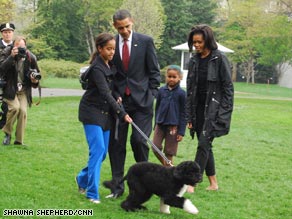
The Obamas enjoy their new family dog, Bo, at the White House.

The Obamas enjoy their new family dog, Bo, at the White House.

(CNN) -- Heather Ferreira works in the slums of Mumbai, India, where she has watched thousands of women live under a "curse."

The women she meets in the squalid streets where "Slumdog Millionaire" was filmed are often treated with contempt, she says. They're considered ugly if their skin and hair are too dark. They are deemed "cursed" if they only have daughters. Many would-be mothers even abort their children if they learn they're female.

Yet lately she says Indian women are getting another message from the emergence of another woman thousands of miles away. This woman has dark skin and hair. She walks next to her husband in public, not behind. And she has two daughters. But no one calls her cursed. They call her Michelle Obama, the first lady.

"She could be a new face for India," says Ferreira, program officer for an HIV-prevention program run by World Vision, an international humanitarian group. "She shows women that it's OK to have dark skin and to not have a son. She's quite real to us."

Those who focus on Michelle Obama's impact on America are underestimating her reach. The first lady is inspiring women of color around the globe to look at themselves, and America, in fresh ways. Photo See photos of past first ladies »

"She might be the first woman of color that females in male-dominated countries have seen as confident, bright, educated, articulate and persuasive," says Barbara Perry, author of "Jacqueline Kennedy: First Lady of the New Frontier."

A symbol for women around the globe

Don't Miss

The notion of a woman being a first in anything is alien in many parts of the world. Millions of women struggle against sexual violence, discrimination and poverty, several women activists say.

But Michelle Obama offers a personal rebuke to that message. Her personal story -- born into a blue-collar family; overcoming racism and once even making more money than her husband -- makes her a mesmerizing figure to women across the globe, says Susan M. Reverby, a professor of women's studies at Wellesley College in Massachusetts.

Reverby says this is the first time many women have seen their class and color reflected in America's first lady. Video Watch how Michelle Obama has done during her first 100 days »

"This is someone who appeals across the usual divides," Reverby says. "She is a celebrity you can imagine being, not a celebrity you have to watch from afar."

A hint of Michelle Obama's global appeal came recently when she spoke at an all-girls school in London, England. The students came from various backgrounds: Muslim, Christian, black and white. Yet they all surged forward, shrieking and even crying, as they hugged the first lady.

Thu Nguyen, a native of Vietnam, wasn't at the London school, but she experienced a similar sense of elation when Obama became first lady.

In her native country, she says women "are not human beings." But when Obama became the first lady, Nguyen called her niece and told her that any hard-working woman could become the first.

Vietnamese women can identify with Michelle Obama, Nguyen says.

"We have a yellow color because we're Asian, so we felt a bond with [Michelle] Obama when she became the first black first lady," says Nguyen, who works at a nail salon in South Pasadena, California.

Some women's identification with the first lady, however, goes deeper than skin color.

Sue Mbaya of Nairobi, Kenya, says the first lady inspires African woman to assert themselves in their personal and professional lives.

Many African women are conditioned to be subservient, she says. They're prevented from rising to management positions in the workplace, and their families often relegate them to taking care of household tasks while sending their brothers off to school.

But Obama is a high achiever who didn't intimidate her husband, says Mbaya, a native of Zimbabwe who is the advocacy director for World Vision's Africa's region.

"I've always liked knowing that she was Barack Obama's supervisor when they first met," Mbaya says. "He once said that he wouldn't be where he is without his wife. That really appeals to me."

Women in the West also find inspiration in Obama.

Christine Louise Hohlbaum, who lives near Munich, Germany, says the first lady impresses German women because she is a powerful public figure who doesn't seem threatening. German history is marked by charismatic leaders who wielded personal power for malevolent ends, she says.

"She's the perfect blend of power and civility. That's important in German culture," says Hohlbaum, author of "The Power of Slow: 101 Ways to Save Time in Our 24/7 World."

How does Michelle Obama define herself?

While other women have defined Obama's appeal, the first lady is refining her role.

She has talked publicly about the pressures military families face. She has encouraged healthy eating by planting a White House garden. She's opened the White House to ordinary people and children. Service to community and family seems to be her theme.

She recently drew the most attention for what she did, not said, during a visit to London. She briefly embraced Britain's Queen Elizabeth II, breaking royal protocol. The Queen, however, according to press accounts, responded warmly to the first lady's embrace.

Obama has often been compared to another regal woman: Jacqueline Kennedy Onassis. But Autumn Stephens, author of "Feisty First Ladies," says that Obama reminds her more of former first lady Hillary Clinton.

"But Hillary really downplayed the mom part whereas Michelle has really played it up," Stephens says. "She is straddling both worlds."

In a poll of first ladies, certain women are invariably cited by historians as the most noteworthy: Abigail Adams, Lady Bird Johnson and Eleanor Roosevelt, who is widely considered to be the most influential first lady, Stephens says.

advertisement

Where would Stephens rank Michelle Obama?

"She's got the whole package," Stephens says. "She's in a class by herself."

E-mail to a friend E-mail to a friend

Share this on:

Mixx Digg Facebook del.icio.us reddit StumbleUpon MySpace

| Mixx it | Share

All About Michelle ObamaWorld VisionEleanor Roosevelt


4/26/09

http://diehipster.com/

exerpts from a place to laugh at hipsters

http://diehipster.com/

Good morning you ar now a artist

I wonder if the hipster can remember the actual day they became "artists". I imagine they rolled out of bed and simply said "hey look at me I'm an artist". Or was it the first day of liberal art school? Or the day they graduated? Or immediately after the pilot said "you may now unfasten your seatbelts" as their plane flew in from the West and landed in NYC. When? When tell me!?!? Look at these video's of the most childish art you've ever seen. At the hipsters explaining how they are part of the "community". You'll see pieces like "Musical Chair", which is a camera pointed at a chair. Or "The Time Machine" which is a VCR tape wrapped around the walls of this wanna-be gallery. Or dust particles on a projector. Or water vibrating.
You fucking call this shit art? I swear, I want to go undercover as a hipster and smear my shit on a canvas and then hang it in some bullshit gallery full of spoiled fucksters and say "like, yah, like yah, this like, represents the food I like ate yesterday, and now like, you can see it the next day in another form, yah." These fucks wouldn't even flinch and I would probably receive a toast of organic wine for my "hard" work. You filthy, gentrifying, clueless, pseudo rats must end your embarrassing lives immediately. GET-THE-FUCK-OUT-OF-HERE-ALREADY!


Hipster shows MTA his MacBook Skills.


A liberal arts degree. An all expense paid trip to Brooklyn, New York. A Mac, and a good community vibe is all you need to show the MTA how frustrated you are with two VERY IMPORTANT subway lines. I don't mean very important to the plain folk. I mean very important to the "creative type" hipsters who need these subway lines to travel through the land of make believe neighborhoods they think they've created.  There's very few of them, I doubt you've ever seen one. If you saw two that looked similar, don't worry, you're not going crazy. Those are two verrrrrrry different people with very distinct talents and  pseudo-intellectualism.
Ok, this is funny for two seconds only because it looks like a real MTA sign. Then after reading you begin to realize it's coming from a finger painting, bearded, gentrifying, cocksucking stick figure, hipster. You don't think the D, F, N, B, Q have their troubles? You don't think people that live in Manhattan or The Bronx or Queens have subway problems?  It just shows how fucking transplanted this person is. As for me, subway delays are the least of my problems. If you've been riding them your whole life becuase you grew up here, you're used to it. The people that constantly complain about the G and the L only ride during off peak hipster hours. They've been riding the subway anywhere from 6 months to 5 years. They complain about the crowds, the homeless, the rats and being late to their part time dime a dozen creative jobs??? They complain because they can't leave their overpriced apartment or "creative artistic affordable loft" which will soon be a condo, at 10pm on a Tuesday to go to a bullshit art or music show and come home at 4am and expect the trains to be waiting at their Converse All-Star feet??? Every train screws somebody everyday. Big deal. You spoiled, cul-de-sac, pseudo-urban, talentless phonies better hit the road. You simply just can't hang. Get the fuck out of Brooklyn and go show your homestate that art and laid-backism is the road to coolness. Fuckers!

del.icio.us Stumbleupon Technorati Digg

The Organic Myth


Hipsters are so easily marketed to. The hipster is so distracted with keeping up with the latest tight clothes and achieving bed head hair-do's that big produce/meat companies have easily tricked them into paying double the price for food right under their noses or above their moustaches. Their [hipsters] biggest claim to fame is being non-conformist, yet they continuously conform without even knowing it. I remember seeing supermarkets dedicating a very small amount of shelf space to organic products years ago. Now there are dedicated chain stores that pretty much only push organic like Whole Foods, etc. What a fucking scam! This organic food is so overpriced. I mean, it's so obvious that even hipsters have to know that it's a scam by now yet they keep on buying and promoting it to stay cool. Thousands of them eating organic just to be part of a crowd in Brooklyn and many other places. Without even reading the links below, I always looked at organic food as a scam. After reading the links, you'll see facts such as it takes twice as much land to grow organic produce and that their pesticides and chemicals are "organic" but you need 6 or 7 times as much to do the job which raises the costs. There is no difference in taste. The same giant companies that sell conventional meat and produce are the ones who sell the organic shit. Yet the hipster will still go to Whole Foods and spend $40.00 for a bag of produce that really costs $10.00.  The one thing the transplanted hipster is really good at is being ripped off whether it be rent, clothes or food. Pretty much the basics and necessities which used to be affordable in our great city. Thanks a lot you filthy douchebag hipsters. Here are the links:
Skeptoid: Organic Myths
Google Search: Organic Food Myths

del.icio.us Stumbleupon Technorati Digg

Cavin-Morris GalleryWe present this as the Cavin-Morris newsletter. New artists, new directions, new pieces, new ideas and old will all be presented here in a user-friendly form. We welcome commentaries pertinent to the art.

Link to Cavinmorris.blogspot.com/

Kevin Notes that this guy is still one of my favorite artist I got to hang out with him in Jamaica, I didn’t understand a thing he said (it took me a while to get the accent down), but it was the time of my life

Written by Randall Morris

Tuesday, July 31, 2007

My Summer Vacation part 2

We traveled up intricate and winding mountain roads through exquisite green vista after vista to see the yard show environment of Errol McKenzie. The last time Wayne had seen McKenzie alittle less than a year ago he had been upset by the fact that McKenzie had destroyed part of his environment; in fact destroyed one of the most sensitive and important aspects of the site; the belly of the Black Moon Goddess, her womb disbanded and consigned to dissolution, her bones and floor reduced to rubble.
It seemed like a funeral march when we got there, some kind of grandeur diminished with no wind and no air only a cruel metallic heat that bore down like an occupying army. McKenzie pointed across the way where he had been doing some terracing. I felt selfish, I wanted his graceful surreal palace back, I thought he was rationalizing some loss, that something cataclysmic and sad had happened in his life. There was no roof, there was no electricity connected to his refrigerator, he mumbled something about channels of energy connecting to his control room, which was his bedroom and did have a roof. We ducked down into the entrance and walked in.
The room still held some of its marvels. The iconography of the carved walls was still sharp and succinct. There were moon rocks molded in and wooden carvings sunk into the architecture, but this room used to open out into the other rooms that had been destroyed, now it was isolated unto itself. In the corner were stacked some of the wooden sculptures he had taken from the original womb room.
He explained then that he had needed the stones in order to build the belly of the White Moon Goddess and that she was more important to him right now because she was getting more feedback from white (nonblack) people then he was from black people and so it was important that he have the site ready for a white woman who shall go nameless for the time being who had come to see him and whom he had recognized as the Goddess, knowing of her arrival before she ever showed up.
So listen to what I am telling you here and try to see it from where we were experiencing it. All the way through the country's heart to see one of the most idiosyncratic and important of the younger generation of Intuitives and he had crashed and burned, destructed Black Moon Island using her bone/stones to create a terrace in honor of some woman whom he now felt was the Great White Goddess.
The whole way up the mountain we had been talking about the problematics of the Gee's Bend situation fully aware of how easily things can go wrong across class, across race and across culture. Politically correct is often morally ridiculous. The artist, the academic, the collector etc are basically walking across a perpetual minefield, usually with little or no cognizance of what other people might have done minutes, hours or days before you arrive on the scene, that will have lasting consequences on what you do or wish to do. The core of Gee's Bend is a simple yes or no, right or wrong with as much chance of being settled out of court through communication as in court.
That very morning I had read the chapter in Sacred and Profane about Gee's Bend and neither side can downplay the glory and the power of the idea that the word artist is such that anyone can wear it and has the right to wear it and be it and be great at it and not held back by the words: self-taught, folk, outsider, or craft. That is the bottomline of the Arnett's intentions and no matter what has happened they have made that necessity of artistic identity public where it wasn't very public before. The artists of Gee's Bend aren't going to let their artistic identities slip away from them so easily ever again. The rest of it seems to be saber-bashing between lawyers and that can be very ugly to behold.
So here we are in the heart-stopping heat with Errol Mckenzie standing there gesticulating and rapping a kilometer a second about numbers and demons and goddesses and it gets more and more obvious all the time that being a sufferer and having less in the world, against your will, never makes things less complicated. He pulled us up to the top terrace and there was a three dimensional mound in relief in concrete and he said that was the moon eye, the combination of the black and white Moon Mothers. He wasn't letting up on us, he was driven to make his old friend Wayne Cox see exactly what it was he is trying to do here. The eye then abstracted off bipedally into two lobes that were the White Moon Goddess's head on one side going down into her neck which was about ten feet long and then a wall that looked like an old burnt out revolutionary era wall maybe pu together with Inca know-how. We were still looking behind us at the skeleton of the old installation. This concrete and neck was not hitting us right. My short hair was hot, my neck throbbing. I kept checking for imaginary fever. I had forgotten my water bottle at the house so all I had was this wet washcloth in a plastic bag. I went down to the car discouraged and de-energized and put the delicious cloth on my face listening to the beautiful little kid in a bright green dress sitting on a bright blue porch of a one room house compulsively slapping her leg in rhythm and I realized that I had been hearing that same beat on her leg since we had arrived and I turned to look at her and just then she went into a sequence of Touretts' barking.
Mckenzie was right behind me. I was still feverishly roiling all this over in my head and actually coming to the right conclusion in thinking: Get off it man. This is his place. The story is whatever he does. Holding on to what it was is fine but environments are not static. They are always on the edge of some kind of movement. He is still Errol McKenzie and you have no right to judge a Vision. No right!
He asked us to walk up the hill across from the site so we could get a better view. I remembered my kid when she was six running up this very hill because she thought she saw a deer. It was a brown goat. We would understand better up the hill he felt. The obvious implication of course and he was right was that we weren't getting it yet. And he was so right because we were focusing on the implications of ruins and this white goddess interloper and exploitation and he of course was immersed in this enormous overview. He, even though he now wanted to give the land to this new Goddess, was in control. Control was key word. Everything as built to resolve in his control room.
I climbed the hill in front of him passing the blue house. Blue is the color of warding off evil, and the child in the green dress and the odd smell of sweet laundry detergent where the mother was washing clothes in a metal pail and McKenzie behind me saying Turn, turn around now and I did. And it all looked different!
“Is the white moon goddess you now see…..”
“The black wall is her belly?, I asked.
“Exactly” he said…”And that is…..”
“Oh man McKenzie I think I see her!”
The wall was her belly he said made from the stones that had been in the womb of the old structure. She was there. Instantly huge. Instantly immensely important. There was nothing else like this in Jamaica; there was nothing else like this in the United States and there were several sites remotely related in Europe but still not like this. Not with sacred seals buried under them in the earth, not born from the womb of an older Goddess. The entire dynamic of the site had changed. For over twenty years Black Moon Island had slowly labored along changing incrementally but fundamentally dedicated to the uplifting of the Black Mother, the black moon female presence against the sun, against the patriarchal dyad of Father and Son. A site he wanted to be a didactic demonstration of cosmic balance.
But it had become consumed by devils. Eaten by evil. Evil was throwing his sculptures out into the yard at night and tormenting his head. His wife had finally left after years of a struggle to keep it together. His neighbors were not fond of him. “I saw her before she came, “ he said.
She is there on the hillside in blazing sun yet filled with Mystery and mysteries. His whole effort is a constant stream of attempting to balance a morally neutral universe that cannot be balanced by any institutions that have come before. Her head is divided into two lobes and unified by a single eye. Beneath the earth are buried numerous seals, moon stones and secret things that drive the forces of connection. Her neck is about ten feet long and flows into a graceful torso that culminates in the eight foot high black wall of womb stones. The rest of her body is white so her belly and womb have been carefully created from the black stones that made up the now dismantled womb of the Black Earth Mother.
Below the belly terrace are her two legs which are in motion and activated. Each is at least twenty to twenty five feet long. It must be remembered that these limbs and outlines, with the exception of the head units are not a single layer of outline stones but actual terraces. Earth was moved in large quantities and hundreds if not thousands of stones were lifted and fitted because he didn have money for cement to hold it together so each stone was handfitted and solid into terraces and walls between three and four feet high.
One leg ran toward the the lower south west of the torso in running configuration. Running or dancing. Most likely dancing because the other leg, a much longer one was bent at the knee where (o most amazing concept!) it touched part of the remaining wall of the old Black Moon Island. It then continued down almost doubled under the thigh.
McKenzie was elated that we saw it. He pointed to the knee. “See where she touch? That is the heart.” I squinted. There was a large smooth concrete construction about three feet in diameter split down the middle attached to the wall righ ton the other side of the knee. “that is the heart of both the Black Moon Mother and the White Moon Mother. They have the same heart for Moon Balance.”
And then we could see that from the heart stone began to run the white-marled paths or channels of communication about three to four feet wide that led to his bedroom/control center. Suddenly I could see the entire site as this network of interconnected forms and shoots and it was all organic and connected below, on and above the earth with buried seals, stones, secrets, and wooden and concrete extrusions.
McKenzie has, in essence, managed to create a work that structurally combines sculptural language with the two dimensional schemata of his evil-eating paintings which are compendiums of his channels, seals, organs, wombs, and eggs. His sculptures and paintings can now be read in a similar way. His art work as a whole has achieved forma l theoretical balances, extending his urgencies meaningfully into other planes, pun intended.
As I stood on the hill trying to take in the unified totality of what before had seemed to me truncated and disconnected, sad and broken down I was renewed in my admiration for this man who, against seemingly insurmountable odds, mental and pysical, could create this monument of iconic belief, from earth, wood, stone and concrete.
I was an am still concerned about the white goddess in the flesh. I feel she adds to the thinness of the edge he lives on. I cannot imagine too many potentially happy scenarios to come out of this. At the same time she inspired some of this vision, even though unknowingly. (We now know who she is). McKenzie's life is too real and too abstracted for anyone to be able to warn him about the possible debacle to come when either she never shows up again or does not fulfill his sense and need for a culmination of immediate prophecy.
But McKenzie is an artist who is well acquainted with the use of art as a mode of active cognition. For him it is a vehicle of self-healing. What to unknowing eyes like ours seemed to be meaningless destruction was actually a massive act of creative regeneration and one can only hope and even pray a bit that in the future he will pick himself up yet again from the void and begin to fill it with his unique and important visionary works. I look forward to Wayne Cox's paper on him at the Kohler symposium at the end of September.
(to be continued)


Errol McKenzie

clip_image002
clip_image003


The Eye of Moon Balance

clip_image004
clip_image005


The Heart of the Black and White Moon Mothers

clip_image006


The White Moon Goddess

clip_image007
clip_image008
clip_image009

posted by Cavin-Morris Gallery at 10:02 AM 0 comments clip_image001[4]

More Control Room

clip_image010

posted by Cavin-Morris Gallery at 10:01 AM 0 comments clip_image001[5]

Inside the Control Room

clip_image011
clip_image012
clip_image013

posted by Cavin-Morris Gallery at 9:58 AM 0 comments clip_image001[6]

Entrance to the Control Room

clip_image014


Errol McKenzie: What seemed to be in ruins

clip_image015
clip_image016
clip_image017
Here are some of the photos when we first got there and before we had the epiphany on the hill. Fortunately the site was well documented by Wayne in its earlier form as well. Remember you are looking at a transitional phase.


Some Freestanding McKenzie works

clip_image018
clip_image019
These are just a tiny tiny sampling of Errol McKenzies paintings and freestanding sculptures. Please remember this is just a recording of this visit and not an attempt to be comprehensive about the art.